



@TomR1 - Keep on trying Tom! It can take some getting used to, but once you've got it dialed in, it can really be useful. It's normal to have to bracket focus when doing super macro photography. Any bit of surge, exhalation, or hand shake can ruin your shot! These problems are amplified with teleconverters, due to the larger distances involved.
@Craig - The SubSees were actually originally designed for hand-held use, so were labeled for use with the human eye. When used with a camera lens underwater, it needs to be used in the opposite direction (has to do with being within the focal length of the SubSee). Unfortunately, we'd already bulk ordered our labels years ago, so couldn't justify making the "correction" until stock ran out, which just recently occurred.
As for the units you saw in Indonesia...what a disaster that was! I labeled one by hand (incorrectly), and the other was correctly labeled, but a miscommunication between Cor and I led to it also being used backwards. I hate Murphy's law (i.e. my carelessness)!
There are a few other things I want to comment on that you mentioned:
-The magnification ratio that the SubSee offers when used with a 100/105mm lens is between 2:1 and 2.2:1. This is the actual magnification, not including any "DX crop factor". As I'm sure you know, the size of the sensor has nothing to do with actual magnification ratio. Here is a shot with my D300 + 105mm + SubSee:
REPRODUCTION RATIO
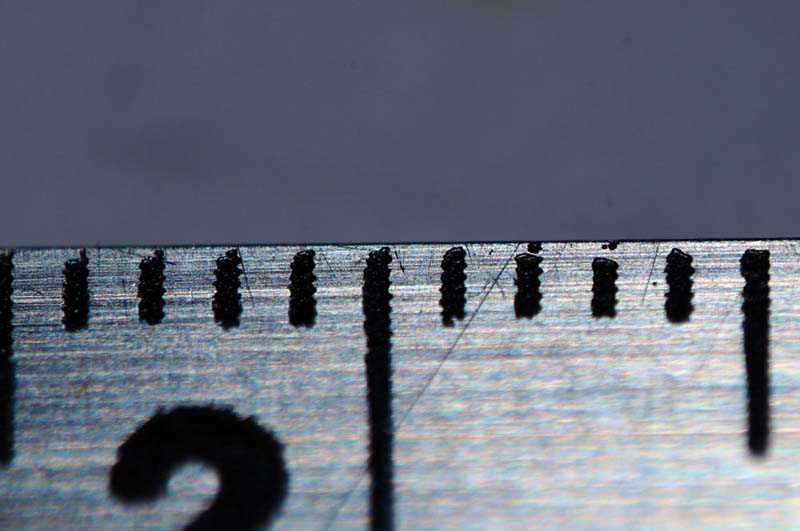
23.6mm sensor being filled by a 10.5mm section of ruler = 2.25:1 magnification. (D300 + 105mm + SubSee; 1/320, F11, ISO200)
-Regarding the example shot you posted...you are comparing apples to oranges. First, at 1.8:1, you've got about 30% more DOF than at 2.2:1, so of course you'll have an easier time getting a flat surface in focus. Second, you're comparing the performance of a +3 diopter achromat to a +10, which is unfair, since peripheral distortion becomes increasingly difficult to correct as radius of curvature decreases (i.e. more curved/shorter focal length/higher power/etc.), without using aspherics or other expensive optical systems. Third, Scott's shot was through an additional 3 optical interfaces (the housing port, and two sealed windows on the SubSee), so comparing an "air diopter" shot to it isn't fair either. And lastly, it seems to me that your shot isn't in focus in the center. I'm actually curious to see how your Hoya performs when the center point is in focus, on a perfectly flat subject.
Please don't think I'm being argumentative.... I'm just defending my baby 
________________________________________
In any case, I took a few 'air shots' with the SubSee mounted on my D300/105mm....here is one straight-on-ish showing that there is almost no edge distortion:
STRAIGHT-ON SHOT

I taped a piece of paper with text to a table, took a series of shots by hand, then picked the best shot. (D300 + 105mm + SubSee; 1/320, F11, ISO200)
And here are some shots with the SubSee at maximum magnification on my 105mm lens (2.25:1), showing the plane of focus extending from edge to edge:
DEPTH OF FIELD
Shots taken at 2.25:1 magnification, corresponding to a field of view of 10.5mm
All shots taken with a Nikon D300 + 105mm lens + SubSee, 1/320, ISO200
F11

F22

F57

Keri


