



Olympus 60 mm plus Nauticam CMC:
I got 17 mm with the 60 mm alone and 9 mm with the SMC (approx 2x).
Autofocus and f10.

Photography Gear and Technique / Archived topic
Started by troporobo ·
Read-only discussion
Olympus 60 mm plus Nauticam CMC:
I got 17 mm with the 60 mm alone and 9 mm with the SMC (approx 2x).
Autofocus and f10.
As you go to the sides the image is blurred probably f/10 is not sufficient even for a flat surface?
Even at f20 you can see how shallow the depth of field from my nudi pic. It's a challenging lens to use but gives some great results. CMC-1 also works with the Canon 60mm on my DSLR.Small Collingwoods Chromodis nudi only 20-25 long, head is about 4-5mm across.
Olympus EM1 with 60mm macro in Nauticam housing and Nauticam CMC-1. Single S&S YS-D1 strobe
1/320, f20 ISO 200, strobe less than 1/10 power directly over end of CMC.
Well worth the effort to master this combination. This was first dive with CMC after selling my Subsee +10 to buy this.
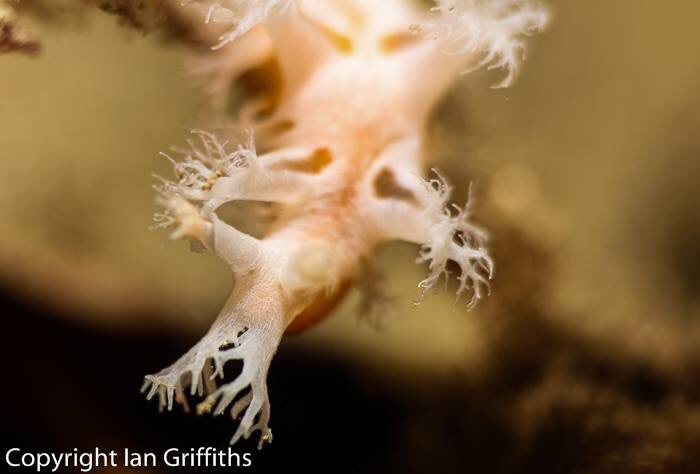
In this image I can't see anything in focus to be honest. If you do a simulation on dofmaster for the 60mm with a focus distance of 9.5 cm that corresponds to 2x magnification compared to the lens alone you get 0.6mm at f/22 and the lens is already garbled at those apertures. Shooting a flat ruler gives you an idea of magnification but doesn't really tell if the lens will be usable or not. For comparison at f/11 with the lens at normal working distance you get 2.3mm which is around 4 times the dof of the lens with the CMC and at f/11 the lens has around double the resolution than f/22. If you crop the resulting image to 4 megapixels you would in effect end up with the same effective resolution. This is nothing to do with the CMC specifically is that micro four third lenses perform really poorly at small apertures the sweet spot is around f/5.6 and resolution drops a lot after f/8 f/11. From my tests on land the lens is still usable at f/16 but past this point is really bad
As you go to the sides the image is blurred probably f/10 is not sufficient even for a flat surface?
The camera was at a slight angle.
I did this in my bobble bath.
Seems like the symbol at the bottom edge is in focus.
That's because that is in line with the centre as you go further away from the centre the depth of field or lack of thereof starts showingThe camera was at a slight angle.
I did this in my bobble bath.
Seems like the symbol at the bottom edge is in focus.
Diffraction limiting resolution happens on all camera systems. For m43 and macro images seems to be usuable to f16 at least.

In this image I can't see anything in focus to be honest. If you do a simulation on dofmaster for the 60mm with a focus distance of 9.5 cm that corresponds to 2x magnification compared to the lens alone you get 0.6mm at f/22 and the lens is already garbled at those apertures. Shooting a flat ruler gives you an idea of magnification but doesn't really tell if the lens will be usable or not. For comparison at f/11 with the lens at normal working distance you get 2.3mm which is around 4 times the dof of the lens with the CMC and at f/11 the lens has around double the resolution than f/22. If you crop the resulting image to 4 megapixels you would in effect end up with the same effective resolution. This is nothing to do with the CMC specifically is that micro four third lenses perform really poorly at small apertures the sweet spot is around f/5.6 and resolution drops a lot after f/8 f/11. From my tests on land the lens is still usable at f/16 but past this point is really bad
Of course I only use very low res pictures on the internet so if you blow it on your phone or screen it will be a mushy mess that's why I use low res (29kb).
At least I try to post real world pictures taken under the water to give people an idea of what they can achieve with the CMC and don't criticize every ones work without adding their own examples.
This is a full res crop of a nudi taken at a local dive site, which was about 10mm in length and his head about 2mm across, to give an idea of magnification.
Nobody is criticising anything. If part of the image is nothin focus is not your fault is the lack of depth of filed. There's nothing you can do about the ruler example shows that you can't even cover a flat surface at f/10 without blurred edges. The CMC main use appears to be with compacts that have slightly smaller sensor and a bit more depth of field. And it also works well with zoom lenses as the capture area is small but not minuscule. 9mm width for a micro four third with a minimum aperture of f/22 is just too small area to have decent depth of field. 0.6mm seems a bit small and it shows in the pictures don't you think?
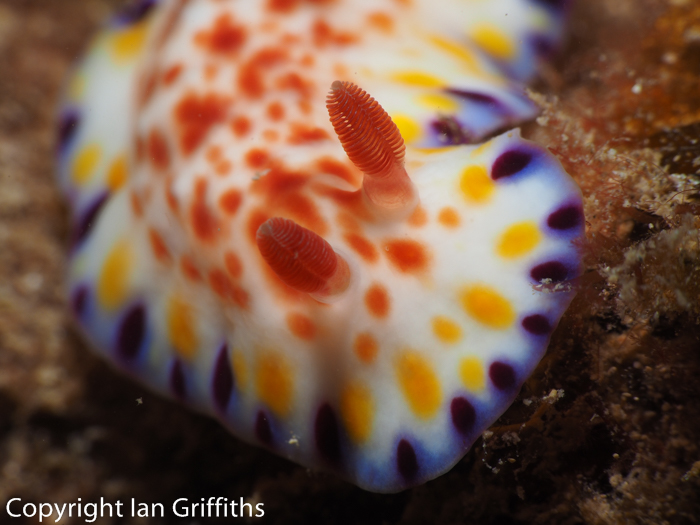
I disagree that the diffraction ruins the picture and you can't focus with the CMC. This is straight out of the camera, not cropped, nudi is about 4-5mm wide, no lightroom processing except to make low res copy as you are limited to 1000k on here anyway.
Taken on 12/07/15 in local waters. OMD EM1, 60mm macro, CMC-1, f20, 1/320 ISO200 with single S&S YS-D1 on 1/10 power.
Also high res crop of rhinophore.
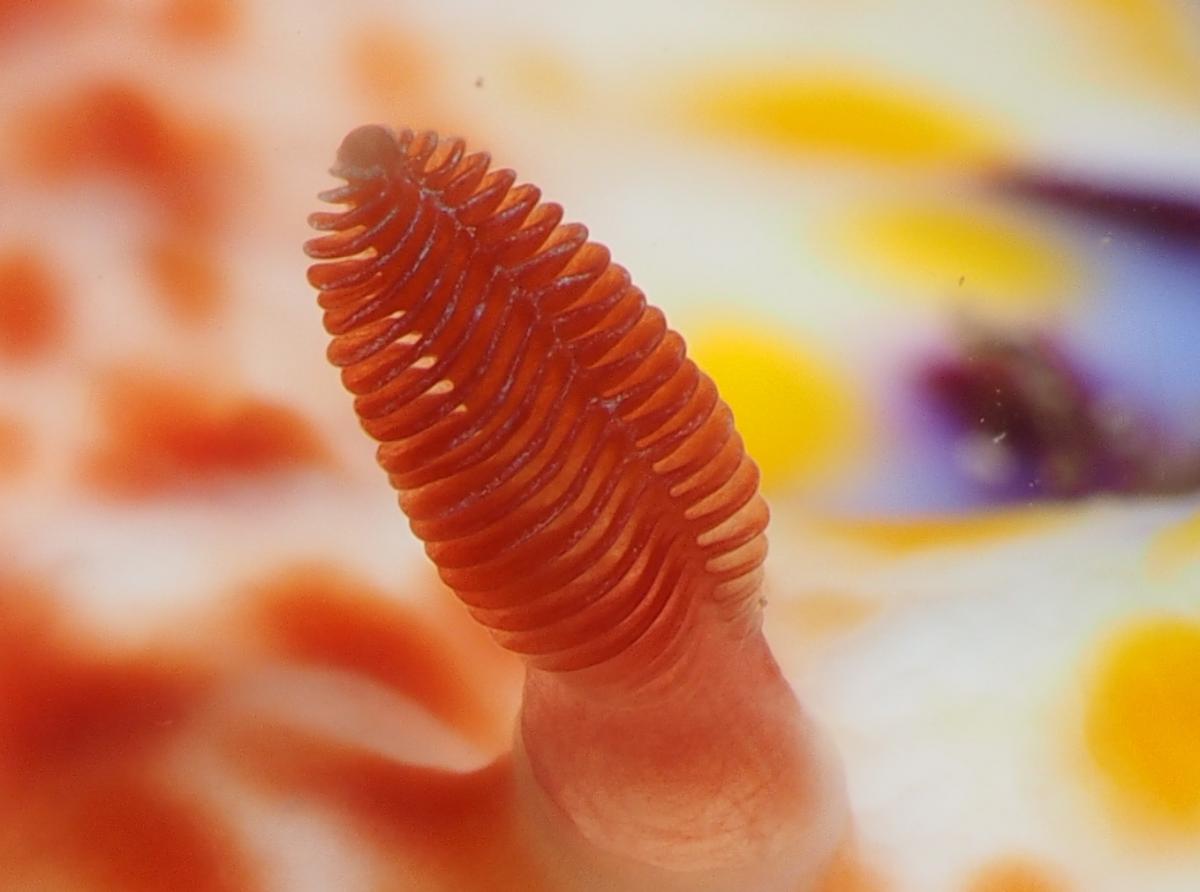
The only thing that is in focus is the left rhinophore the rest is blurred even at f/20. Good for special effect and for specific pictures?
The only thing that is in focus is the left rhinophore the rest is blurred even at f/20. Good for special effect and for specific pictures?
Exactly right. As a super macro subject this 25mm nudi is a giant. I use them as test subjects to get experience for focusing and lighting before my next trip to Bali where the subjects like the Amphipods at 1mm and Shaun The Sheep Nudi faces are only the size of the rhinophore in the picture. Our dive guide Parman from Aquamarine Diving Bali is one of the best and finds the smallest subjects like the Amphipods and Hairy Shrimps which without a macro converter are hard to see let alone photograph. On previous trips with only a macro lens, he would show us a tiny subject like the Shaun The Sheep at 3-4mm and we would get a couple of above shots and move on to a bigger subject. This time after seeing all the Shaun faces on Macro Underwater Photography site and the Amphipod pictures we specifically requested he find these for us. I was trying to show other people interested in super macro the capabilities and draw backs like wafer thin DOF on real world underwater subjects. The combination is good from fish portraits to super macro in one dive. Also you said the only other way to get that magnification is with a 100 or 105mm macro lens on a DSLR with a SMC and Multiplier. This combination of SMC and Multiplier costs approx AUD$1300 the CMC AUD$469. The CMC also works with my Canon 60mm where the Subsee+10 (or SMC) are too big so you have to move back reducing the max magnifcation with is also the case with the Oly 60mm with the +10.
I just found this topic and now I've managed to confuse myself. I have the E-PL5 with the PT-EP10 (OEM housing). I've got the 60mm macro and a SubSee +5 and those are awesome for small stuff. I've got the 9-18 and a Zen dome port which is decent for WA. But I've been known to use the 14-42mm + SubSee as an adequate "all around". This thread has me thinking about swapping the 14-42 with the 12-50. Now looking at the E-PL5 manual I see two things:
1) There is no zoom gear in the OEM system for the 12-50mm lens. Anyone try to modify the 60mm focus gear?
2) The UW tele/UW wide modes can be set to a button, but it looks like that changes almost everything about the camera setup, things I don't want to change (like flash mode, etc).
Does anyone use this combo? Can I use the UW modes to change the lens zoom and then switch the camera back to my own MySet settings for (instance) manual strobes?
Regarding the first question, if you want to access the 43mm macro mode on the 12-50 mm lens, the zoom gear is fiendishly complicated. That is because there is a push-pull action to shift in and out of macro mode, plush a twist action to zoom. I have only seen this from Nauticam, to go with their ports.
If you don't want access to the macro mode, then you may well be able to adapt a focus gear. There is also a company that makes them - search the massive E-M5 thread for "Austrian zoom gear".
I have no delusions of being able to access the 43mm macro mode. :-)
I'll look into the "Austrian Zoom Gear". If I don't get an answer to question #2, I may just buy the lens and try to answer these questions for myself. I have a trip to Cozumel coming up which is definitely not going to see a lot of use from my 60mm lens.
From this post: http://wetpixel.com/forums/index.php?showtopic=46536&p=329999it seems like #2 is possible. Use the UW settings to zoom the lens and then shift back to your own settings.
I'm going to give this a try without the zoom gear (Deep Shots UK also makes one for a bit less) and see if its limiting. If I find myself going back to the 14-42 + SubSee, then I will think about the zoom gear.
This is a very useful experiment. Thanks! I did something similar and my results agree with yours. However, I think the way you state the magnification is a little unusual. To my mind, magnification is the ratio of the sensor size divided by the actual, real world size of the image. So, when you show you get about 18mm at the closest focus range for the 60mm lens, the magnification is 17.3/18 = .96x. Olympus quotes this lens as a 1:1 macro lens, so a 1X magnification, so this is very close and reasonable for a field test.
I measured about 13mm (horizontal) with my E-M5 mkii, underwater with the Oly 60mm lens and INON 165mm diopter (said to be +6).
This yields 17.3/13 = 1.33X.
Again, thanks for all the tests, but I think your magnifications are different from what one would normally use. After all, the only thing that matters is that you will be recording the image on the m4/3 sensor, not a 35mm sensor. I should mention that the crop factor is a factor of about 2, so what is true is that one would need a 2X60mm 120mm lens on a 35mm camera to achieve the same magnification.
Another question I have been researching is what magnification loss occurs if one uses a dome port with the 60mm lens. I wonder because I find my Zen port VERY difficult to change. Even after lubricating with siliconne, I still need a strap wrench and a lot of effort to get it on and off. Anyway, according to my tests, if you use the Oly 60mm macro behind the Zen 4" dome, max image size is about 22mm. So in this case, you get 17/22 = .77X.
This is a 25% reduction in magnification, which might be acceptable in some situations. Perhaps there is image distortion too, so if anyone can comment on that, please do.
Also, any tips on how to make the Zen port easier to change? The flat port can be turned by hand!
That's a fair point - as macro ratios are usually defined you are correct - so just divide by 2 to get the technically correct ratios.
I stated these in terms of their 35mm equivalents to provide a sort of common sense reference for those accustomed to full frame. If the image is filled by something that is half the physical size of the frame, then it seems to be magnified 2x.

Terms of Use Privacy Policy Guidelines We have placed cookies on your device to help make this website better. You can adjust your cookie settings, otherwise we'll assume you're okay to continue.

A worldwide community for underwater imaging.