



2 minutes ago, Davide DB said:All of my shots are far away from shore at 70-90 meter deep. Most of the time no way to use a tripod.
For such deep dives tripod is surely not an option (I still can imagine that some crazy filmcrew would try it)
Video Gear and Technique / Archived topic
Started by Interceptor121 ·
Read-only discussion
2 minutes ago, Davide DB said:All of my shots are far away from shore at 70-90 meter deep. Most of the time no way to use a tripod.
For such deep dives tripod is surely not an option (I still can imagine that some crazy filmcrew would try it)
17 minutes ago, gobiodon said:I searched some tripod work (not mine) as a contrast. This is a recent video posted by backscatter:
[/url] You can also check the work by Ewan Sherman, which is mainly tripod work (just an example below)
https://www.seasickproductions.com/bali-close-up
Best examples you can find in the movies by Howard Hall
http://www.howardhall.com/short-videos/
For me those videos are way superior than your handheld footages. I agree that tripod cannot be used for many things and most of the time is impractical, probably the success rate is very low, but when it works the results are much much better.
Thanks for comparing me to Howard Hall those guys have budgets they are in a different game
For what concerns backscatter video that is the classic issue with macro video a set of static shots which for me are well taken but boring. I rather take some photos and do a slide show.
This is the reason why I never ever dive with a macro lens. You can't prepare the scene and do anything different than 1 shot. I prefer to take photos instead of 5 seconds of video with no action in it.
It is nice to have a critter but from those videos a normal person would not even know if this is big small where does it live? It is very technical for people in the sector and after a bit of excitement it goes away
If you have a lot of time what works is to go on the same scene and try all sorts of shots and then combine them
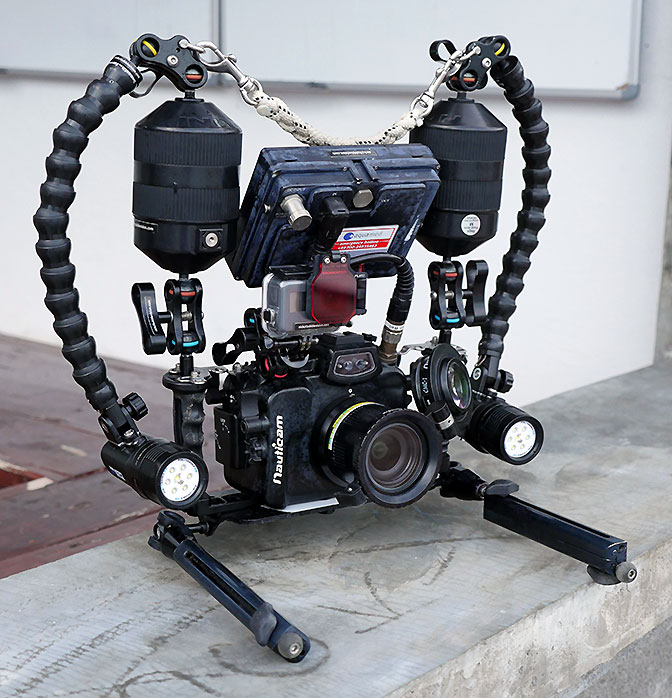
This is my macro rig but I would only rig something like that when I know there is going to be some bottom I can lay it on
Even so when I have an octopus or fish that swims I cannot really use it so it becomes an hindrance if you are not careful
16 minutes ago, Interceptor121 said:
Thanks for comparing me to Howard Hall those guys have budgets they are in a different game For what concerns backscatter video that is the classic issue with macro video a set of static shots which for me are well taken but boring. I rather take some photos and do a slide show.
This is the reason why I never ever dive with a macro lens. You can't prepare the scene and do anything different than 1 shot. I prefer to take photos instead of 5 seconds of video with no action in it.
It is nice to have a critter but from those videos a normal person would not even know if this is big small where does it live? It is very technical for people in the sector and after a bit of excitement it goes away
If you have a lot of time what works is to go on the same scene and try all sorts of shots and then combine them
As I remember from the Behind the mask interview with Ewan Sherman he used an inferior camera than you use. The TG-6 is really not that high-end.
I mentioned Howard Hall, because of the approach. Sure he is in a different league and his budget for a project is way beyond our ones, but the tripod cost is a negligible part.
It’s also the matter of personal preference. Some people find those static footages boring while I really enjoy them. Today in the ages of Tik-Tok and Instagram reels those long static footages by Howard Hall seems to be extreme slow and for many, especially for the young generations, boring.
Another thing is the way of doing videography. Tripod work is not compatible with the standard diving with a group.
31 minutes ago, Interceptor121 said:This is my macro rig but I would only rig something like that when I know there is going to be some bottom I can lay it on
Even so when I have an octopus or fish that swims I cannot really use it so it becomes an hindrance if you are not careful
It looks like a perfect macro rig
Just now, gobiodon said:It looks like a perfect macro rig
It is effective however if the fish moves you need to lift it as it can't pan.
Because you want it to be stable the set up is very negative so when you get an octopus it becomes really hard to track
I tend to use it only when I am absolutely certain I will have lots of frogfish and static life and sandy / flat bottoms when this is allowed by regulations
1 minute ago, Interceptor121 said:It is effective however if the fish moves you need to lift it as it can't pan.
Because you want it to be stable the set up is very negative so when you get an octopus it becomes really hard to track
I tend to use it only when I am absolutely certain I will have lots of frogfish and static life and sandy / flat bottoms when this is allowed by regulations
Another thing is that a keeper rate of the tripod work is much lower
Another thing is that a keeper rate of the tripod work is much lower
Interesting discussion.
I like Nick's Hope close-up to macro work on the non-IBIS Lumix GH4 on a Xit 404 tripod with twist-lock legs. Still moves around a little at times to follow the action (there's clearly some hand-held closeup shooting in there as well), but more than a pleasant watch in my opinion.
Or this older reel here:
A detailled description and pics of the GH4 rig used can be found here:
http://www.bubblevision.com/underwater-cameraman/equipment.htm
Here's a pic:
For slightly more recent work, Dustin Adamson / Ocean Shutter is also shooting close-up to macro on an non-IBIS Canon 1DX Mark II + and, yet again, a Xit404 tripod with twist clamp legs.
or
5 hours ago, bghazzal said:Interesting discussion.
I like Nick's Hope close-up to macro work on the non-IBIS Lumix GH4 on a Xit 404 tripod with twist-lock legs. Still moves around a little at times to follow the action (there's clearly some hand-held closeup shooting in there as well), but more than a pleasant watch in my opinion.
Or this older reel here:
A detailled description and pics of the GH4 rig used can be found here:http://www.bubblevision.com/underwater-cameraman/equipment.htm
Here's a pic:
For slightly more recent work, Dustin Adamson / Ocean Shutter is also shooting close-up to macro on an non-IBIS Canon 1DX Mark II + and, yet again, a Xit404 tripod with twist clamp legs.
or
You don't need Xit404 parts the difference between those two guys and a holiday diver is that they are always there
If you go to the same spot 1000 times and take a selection of your material will be great
You use the same equipment in your 1 week trip you are guaranteed not to achieve the same results it is just life
What XIT does is the ability to adjust the height. I don't find that an excessive issue to be frank once the rig is set it is set there is no movement while ideally you want a pan and tilt head which does not exist yet underwater
12 hours ago, Interceptor121 said:You don't need Xit404 parts the difference between those two guys and a holiday diver is that they are always there
If you go to the same spot 1000 times and take a selection of your material will be great
You use the same equipment in your 1 week trip you are guaranteed not to achieve the same results it is just life
Not so these two guys, Massimo.
Dustin Adamson lives in the USA, so all the shooting is basically regular holiday diving, 2 weeks or so - he does plan ahead a lot though, and does return frequently to the same spots a lot (esp. Philippines).
Here'an interview / profile with some details on his approach, if you're interested:
And Nick Hope is based in Thailand - as far as I know the Lembeh and other Indonesian videos were shot across different trips as well, rather than working as a live-in videographer.
Nick's more local work was on the Andaman sea, for instance.
---
To return to the discussion at hand, these are two examples of people using non-IBIS rigs on trays / quadripods for close-up and macro work rather effectively.
For comparison, here are some examples of their non closeup / macro work, so basically hand-held shooting with the non-IBIS cameras:
Nick Hope: (GH4 and older unknown cams)
"Reef Life of the Andaman"
Diving in Bali
What are you saying Ben?
That a tripod is better than handheld?
That is obvious
Those guys are trade not holiday makers and Nick has been both resident on a boat and local
They are not a representative case for a holiday diver and none of this means IBIS is not required
Or are you saying all dives are suited to a tripod approach??
There are also other types of dives where carrying any additional gear, like a tripod, becomes tedious.
For example long cave dives. My cave dives are max 3 hours, e.g. 1 kilometer in, 1 kilometer out. In addition to the bulk of gas cylinders, any additional drag with the camera gear does become taxing for the camera man. Luckily in team diving some of my mates understand this, and voluntarily might carry some of my stage tanks part of the way.
In cave shooting, I mainly concentrate on shooting scenes on the go instead of static or panning shots. This brings an additionally source of instability: your swim kicks. I does help a lot to learn a perfect trim, also a perfect trim during the kicks, i.e. no "galloping" effect. But even with a perfect trim, you actually accelerate and decelerate with each of your kicks. If I have used image stabilization, I have noticed that it might falsely react to this acceleration/deceleration and create unnecessary IS action which shows as a superfluous wave type wobble. Thus I actually have turned off IS to avoid this.
Lights on long arms do stabilize the camera set via their inertia. Also having a float/floats on top and heavier lights below your midline, will stabilize the set to some extent. However, whilst swimming, the floats and lights should be placed so that they create an equal amount of longitudinal drag/resistance for each swim kick. Otherwise your longitudinal kick will cause you set to tilt and lean during each kick.
I have noticed that for critical shots, it might be better to change to a modified frog kick or modified flutter kick, which reduces the longitudinal acceleration/deceleration. Of course in tight spaces, this comes naturally.
Another problem is that during long cave dives fatigue will affect your concentration resulting in unwanted movement in the footage.
The video below is from a 3 hour long cave dive. This actually was shot during ten separate dives of 2-3h duration due to the complexity of setting up stage tanks en route etc. There is no stabilization on the 5DIII camera nor the 16-35mm lense. I do admit that some shots are far from perfect. But for me, the main content of the video is the "being there" mood.
https://vimeo.com/176796652
https://www.vimeo.com/176796652
PS. How do I embed a vimeo video into a posting?
No IBIS doesn’t react at all to finning it only compensates micro shakes I use it for panning shots on monopod. Electronic stabilisation instead creates all sort of issues. Am talking about a 5 axis well implemented IBIS here not all cameras are equalThe issue affecting cave divers with edge pulling is due to lens correction that when combined with IBIS gives side effects on extremely wide rectilinear lensesThere are also other types of dives where carrying any additional gear, like a tripod, becomes tedious. For example long cave dives. My cave dives are max 3 hours, e.g. 1 kilometer in, 1 kilometer out. In addition to the bulk of gas cylinders, any additional drag with the camera gear does become taxing for the camera man. Luckily in team diving some of my mates understand this, and voluntarily might carry some of my stage tanks part of the way. In cave shooting, I mainly concentrate on shooting scenes on the go instead of static or panning shots. This brings an additionally source of instability: your swim kicks. I does help a lot to learn a perfect trim, also a perfect trim during the kicks, i.e. no "galloping" effect. But even with a perfect trim, you actually accelerate and decelerate with each of your kicks. If I have used image stabilization, I have noticed that it might falsely react to this acceleration/deceleration and create unnecessary IS action which shows as a superfluous wave type wobble. Thus I actually have turned off IS to avoid this. Lights on long arms do stabilize the camera set via their inertia. Also having a float/floats on top and heavier lights below your midline, will stabilize the set to some extent. However, whilst swimming, the floats and lights should be placed so that they create an equal amount of longitudinal drag/resistance for each swim kick. Otherwise your longitudinal kick will cause you set to tilt and lean during each kick. I have noticed that for critical shots, it might be better to change to a modified frog kick or modified flutter kick, which reduces the longitudinal acceleration/deceleration. Of course in tight spaces, this comes naturally. Another problem is that during long cave dives fatigue will affect your concentration resulting in unwanted movement in the footage. The video below is from a 3 hour long cave dive. This actually was shot during ten separate dives of 2-3h duration due to the complexity of setting up stage tanks en route etc. There is no stabilization on the 5DIII camera nor the 16-35mm lense. I do admit that some shots are far from perfect. But for me, the main content of the video is the "being there" mood.
https://vimeo.com/176796652PS. How do I insert a vimeo video into a posting?
This problem affects real estate videographers that use gimbals and in general if you want to use a rectilinear lens in caves you do need to turn IBIS off
IBIS today is much more sophisticated than it used to be and I have it always on with my monopod and my tripod Those are shots at 560mm equivalent to give an idea
Daily Roll 26 February 2021
For me a wildlife underwater camera without IBIS is worthless. If I don’t need it I can turn it off but I like it to be there it makes a significant difference to the keeper rate
Sent from my iPhone using Tapatalk
I
3 hours ago, Interceptor121 said:What are you saying Ben?
That a tripod is better than handheld?
That is obvious
Those guys are trade not holiday makers and Nick has been both resident on a boat and local
They are not a representative case for a holiday diver and none of this means IBIS is not required
Or are you saying all dives are suited to a tripod approach??
Neither, actually - I was simply giving examples of respectable macro work done with tripods, then handheld, with non-IBIS prosumer camera setups similar to the ones commonly discussed here.
This was intended as a follow-up to the discussion at a time where the possibilities and limitations of a tripod/vs IBIS were being discussed.
You brought the holiday maker / resident videographer going-to-the-same-spot-1000 times distinction into the mix, so I was just noting that from what I understood Adamson is based in Utah, so doesn't really fall in the resident videographer but is, from what I understood, actually shooting skillfully, on regular, certainly dedicated but rather short trips.
And also that as far as I know Nick Hope was and is based in Thailand, so doesn't really fall into the resident videographer category either for the Lembeh and other macro stuff that I'd posted - I may be wrong here, I admit I'm not sure what the background is here, but it doesn't really matter that much.
Now I'm not arguing that these two are not professional - especially in Nick's case - and I certainly agree that they have way more experience filming/diving than a so-called occasional "holiday diver", but the reason I had brought these examples up is that they are both working with non-IBIS prosumer cameras / equipment and getting good, workeable results, both tripod and hand-held, which I don't fully agree can be solely attributed to being resident professionals somewhere and having more footage to choose from.
Moving on from this, if I myself was considering equipement, I would certainly choose IBIS over non-IBIS if I had the choice, and wouldn't really consider any dedicated close-up work without some kind of support, tripod/tray or even monopod (if allowed, as you rightly mentioned, no-touch no-contact rules are indeed getting more common) , but also believe it is generally possible to get stable, workable shots without IBIS, even for a non-resident, amateur videographer, so would not be basing my choice solely on that criteria.
This might become a question that I might actually face if and when the GH6 comes out and there are some second-hand GH5s rigs floating around, but until then it's a purely vicarious interest only 
I do also like the idea of a bulkier, well balanced neutral rig that you can push around, but doubt that I will ever get to get close to one of those, as would probalby rather buy a house in rural Japan for the same price.
To end on a slightly tongue-in--ze-cheek note, maybe the solution to the IBIS/non-IBIS dilemna is simply.... the "underwater steadycam"??

Neither, actually - I was simply giving examples of respectable macro work done with tripods, then handheld, with non-IBIS prosumer camera setups similar to the ones commonly discussed here.
This was intended as a follow-up to the discussion at a time where the possibilities and limitations of a tripod/vs IBIS were being discussed.
You brought the holiday maker / resident videographer going-to-the-same-spot-1000 times distinction into the mix, so I was just noting that from what I understood Adamson is based in Utah, so doesn't really fall in the resident videographer but is, from what I understood, actually shooting skillfully, on regular, dedicated but rather short trips trips.
And also that as far as I know Nick Hope was and is based in Thailand, so doesn't really fall into the resident videographer category either for the Lembeh stuff that I'd posted - I may be wrong here, I admit I don't know what the background is here, and it doesn't really matter that much.
Now I'm not arguing that these two are not professional - especially in Nick's case - and I certainly agree that they have way more experience filming/diving than a so-called "holiday diver", but the reason I had brought these examples up is that they are both working with non-IBIS prosumer cameras / equipment and getting good, workeable results, both tripod and hand-held, which I don't fully agree can be solely attributed to being resident professionals somewhere and having more footage to choose from.
Moving on from this, if I myself was considering equipement, I would certainly choose IBIS over non-IBIS if I had the choice, and wouldn't really consider any dedicated close-up work without some kind of support, tripod/tray or even monopod (if allowed, as you mentioned, no-touch no-contact rules are indeed getting more common) , but also believe it is generally possible to get stable, workable shots without IBIS, even for a non-resident, amateur videographer, so would not be basing my choice solely on that criteria.
This might become a question that I might actually face if and when the GH6 comes out and there are some second-hand GH5s rigs floating around, but until then it's a vicarious interest only [emoji4]
I do like the idea of a bulkier, well balanced neutral rig that you can push around, but doubt that I will ever get to get close to one of those, as would probalby rather buy a house in rural Japan for the same price.
To finish on a slightly tongue-in--ze-cheek note, maybe the solution to the IBIS/non-IBIS dilemna is simply.... the "underwater steadycam"??
[emoji6]
On 3/12/2021 at 10:16 PM, bghazzal said:Not so these two guys, Massimo.
Dustin Adamson lives in the USA, so all the shooting is basically regular holiday diving, 2 weeks or so - he does plan ahead a lot though, and does return frequently to the same spots a lot (esp. Philippines).
Here'an interview / profile with some details on his approach, if you're interested:
And Nick Hope is based in Thailand - as far as I know the Lembeh and other Indonesian videos were shot across different trips as well, rather than working as a live-in videographer.
Nick's more local work was on the Andaman sea, for instance.
---
To return to the discussion at hand, these are two examples of people using non-IBIS rigs on trays / quadripods for close-up and macro work rather effectively.
For comparison, here are some examples of their non closeup / macro work, so basically hand-held shooting with the non-IBIS cameras:Nick Hope: (GH4 and older unknown cams)
"Reef Life of the Andaman"
Diving in BaliDustin Adamson (Canon 1DX Mark II )
Rolling in the Deep - #19 - Solomon Islands
Rolling in the Deep - #16 Tubbataha
Rolling in the Deep - #20 - Whyalla
I think Dustin's Tubbataha video is a good illustration of the principle. Overall, it's really smooth camera work, but without IBIS, there's still micro-jitters in the moving wide angle shots that are quite noticeable on a larger display. I'm not sure if a cinema-style housing which is more streamlined and with more mass would further reduce those types of micro-jitters compared to a DSLR housing, which is both smaller and not particularly streamlined, especially once you start adding external arms and floats to combat it being negative. I think I'm pretty good at getting my DSLR-style rigs neutrally bouyant and as trimmed as possible, but that's not to say they will stay in whatever angle you put them in regardless of the angle -- usually the center of gravity of a DSLR rig underwater is not the same as the physical center of the rig because you've got parts which are floaty (the arms) and parts that are negative (lights, the camera body, wet lenses, etc.). So it's not as stable as a well-designed cinema housing with adjustable weights on rails.
Thus, I think there's some value in IBIS to take care of the remaining micro-jitters, at least with DSLR-type rigs. These may not be apparent at phone or laptop screens, but they are when viewing the content on a TV or projector. That said, there's definitely also artifacts that can be introduced from IBIS. One type is edge warping from using rectilinear lenses wider than about 17-18mm equivalent. Another is weird jerks when the IBIS system and/or additional electronic stabilization reaches its limits because of too much movement and 'resets'.
I'd be curious to see some samples of wide angle footage from a non-stabilized cinema rig like a RED or z-cam that's not on a tripod.
Z2
View archived post in: Black corals and ripping current in Hawaii...
RED
All of Rafa's superb video are shot on Red
5 hours ago, Davide DB said:Z2
View archived post in: Black corals and ripping current in Hawaii...
RED
All of Rafa's superb video are shot on Red
The Z cam work is the typical 60 fps slow down that is painful to watch
Ripping current and where is it? Slowing down half speed or more completely removes the drama from the clip
35 minutes ago, Interceptor121 said:The Z cam work is the typical 60 fps slow down that is painful to watch
Ripping current and where is it? Slowing down half speed or more completely removes the drama from the clip
I completely agree with you on half speed shooting. These clips should be used with an eyedropper.
For the ripping current, it's only a title I guess. When you move with the current it's hard to reproduce the feeling in the video.
BTW I really liked the camera WB. Very nice colours for being at 50m away with no lights.
P.S.
I've never seen yoy give anyone a compliment. Can you give me examples of videos you liked?

Terms of Use Privacy Policy Guidelines We have placed cookies on your device to help make this website better. You can adjust your cookie settings, otherwise we'll assume you're okay to continue.

A worldwide community for underwater imaging.
