Skip to content

Video Gear and Technique / Archived topic

Canon EOS R5 C

Started by Davide DB ·

  • 74Posts
  • 74Replies

Read-only discussion

Canon EOS R5 C

74 posts
  1. On 5/13/2022 at 11:15 PM, dreifish said:

    New in-depth review of the R5 C looks quite promising. I like that you can adjust noise reduction in camera and looks like you can achieve really excellent dynamic range of 12.5-13 stops as a result, either in camera shooting in the 4k60p h.265 codec or in post applying noise reduction to the 8k60p raw files. 

    This is much better than the R5 (10.7 stops in 4k h.265) can do and better/equivalent to the z9 (12.6 stops in 4k60 h.265). In fact, the dynamic range matches the Sony A7SIII (12.4 stops in 4k h.265), A7 IV (12.9 stops in 4k h.265) & A1 (12.7 stops in 4k h.265) and the Panasonic S5 (12.1 stops)/S1H (12.7 stops) results, which is as good as it gets in a hybrid camera. It also matches the C70 (12.3 stops in 4k RAW, 12.8 stops in 4k XF-AVC), so in my view, there's really no reason to pick the c70 over the R5 C. It's a solid step up from the GH5II (10.5 stops) and GH6 (11 stops).

    Short of getting an Alexa or Red Raptor, you're not going to find a hybrid or video camera that achieves better image quality results. All with Canon's underwater white balance, which is also as good as it gets.

    I've pre-ordered the Nauticam housing with the USB-C battery pack, which should sort out the battery issues.


    I think you are looking at graphs wrongly the DR in log in 4K is 12.3 with noise reduction out of a total of 13.4 (11:54 in the video)

    GH6 sensor 1/4 of the size has 11.5 stops out of the same 13.4 at 5.7 and is not even oversampled and scaled to 4K

    So the difference is 0.8 Ev and you have not even oversampling on the GH6 vs a full frame sensor and no noise reduction either

    The Z9 in similar situation gave 11.6 Ev

    This is way way lower than the performance of the Lumix S1H and Sony A7IV which have rolling shutter but underwater you don't really pan and give over 12.5 stops each

    Gerald is doing his best to sell this camera but frankly canon and nikon are way behind the competition here in terms of pure sensor performance. Surprising for Nikon considering they are Sony sensor maybe their raw and codecs are not that good

    In raw obviously noise reduction goes away you drop a lot down and you need to apply noise reduction to massive 8K files this is a no go processing wise

    There is more to pure DR to a camera however considering the delta price between GH6 and A74 with the Z9 and R5C I see that they are going to be difficult to sell as pure video devices considering other options out there at £5k price tag

     

    Edited by Interceptor121
  2. 17 hours ago, Interceptor121 said:

    I think you are looking at graphs wrongly the DR in log in 4K is 12.3 with noise reduction out of a total of 13.4 (11:54 in the video)

    I was referring to the DR using Canon RAW in CLOG2 with noise reduction in post (12:52 in the video). That workflow gets you 13 stops out of a possible 16.1. 

    17 hours ago, Interceptor121 said:

    GH6 sensor 1/4 of the size has 11.5 stops out of the same 13.4 at 5.7 and is not even oversampled and scaled to 4K

    So the difference is 0.8 Ev and you have not even oversampling on the GH6 vs a full frame sensor and no noise reduction either

    Where are you getting the 11.5 stops figure? CineD (which I linked to) measured 11.0 at SNR 0.5 out of a total 14.4. https://www.cined.com/panasonic-lumix-gh6-lab-test-rolling-shutter-dynamic-range-and-latitude/

    So no, it's not a 0.8 EV difference, it's a two stop difference in noise and dynamic range. Which is what you'd expect from the sensor size, all else being equal..

    17 hours ago, Interceptor121 said:

    The Z9 in similar situation gave 11.6 Ev

    Yes, the Z9's dynamic range is disappointing. Though arguably none of this matters for underwater shooting, where you're generally not dealing with wide DR scenes and have fill lights.

    17 hours ago, Interceptor121 said:

    Gerald is doing his best to sell this camera but frankly canon and nikon are way behind the competition here in terms of pure sensor performance. Surprising for Nikon considering they are Sony sensor maybe their raw and codecs are not that good.

    You haven't substantiated this statement. Canon's sensor clearly appears capable of good DR with proper processing of the raw in post. The Nikon sensor is from Sony, so I doubt the Z9's poor DR performance has anything to do with the sensor. I agree with you that it's likely Nikon's processing pipeline. And the reason Sony and Panasonic put up good DR numbers ultimately comes down to noise reduction being baked in to their h.265 processing. 

    17 hours ago, Interceptor121 said:

    There is more to pure DR to a camera however considering the delta price between GH6 and A74 with the Z9 and R5C I see that they are going to be difficult to sell as pure video devices considering other options out there at £5k price tag
    Agreed that there's more to a camera than DR. In fact, I would say DR is not even all that relevant for underwater use. There's definitely a price delta between the GH6/A74 and the Z9 and R5C, but the camera body is the least part of it. The Z9 and R5C require bigger more expensive houses ($4500 vs $7100 in Nauticam-land). And neither the Z9 or the R5C can use the WWL-1, meaning you need a WACP-1 or WACP-2 if you go down the wet optics route. 

    That said, I don't really think the GH6 OR the A74 are what I would consider if I was willing to give up the 8k60p resolution from the R5C or Z9. I'd be looking at an A7SIII.

    • A74 doesn't do 4k60 except in APS-C crop, so that's a no go for a true hybrid.
    • GH6 has reportedly atrocious battery life, and there's no external battery in the housing to help
    •  
    • A7SIII is very capable. The body is ~1500 more than the GH6 or the A74, but that's a small delta once you add in rest of the system costs. It shoots excellent quality 4k60 AND 4k120 in full frame. DR is 1.5 stops better than the GH6, as is the low light performance. And you can use it with a WWL-1. 


  3. 3 hours ago, dreifish said:

    I was referring to the DR using Canon RAW in CLOG2 with noise reduction in post (12:52 in the video). That workflow gets you 13 stops out of a possible 16.1. 

    Where are you getting the 11.5 stops figure? CineD (which I linked to) measured 11.0 at SNR 0.5 out of a total 14.4. https://www.cined.com/panasonic-lumix-gh6-lab-test-rolling-shutter-dynamic-range-and-latitude/

    So no, it's not a 0.8 EV difference, it's a two stop difference in noise and dynamic range. Which is what you'd expect from the sensor size, all else being equal..

    Yes, the Z9's dynamic range is disappointing. Though arguably none of this matters for underwater shooting, where you're generally not dealing with wide DR scenes and have fill lights.

    You haven't substantiated this statement. Canon's sensor clearly appears capable of good DR with proper processing of the raw in post. The Nikon sensor is from Sony, so I doubt the Z9's poor DR performance has anything to do with the sensor. I agree with you that it's likely Nikon's processing pipeline. And the reason Sony and Panasonic put up good DR numbers ultimately comes down to noise reduction being baked in to their h.265 processing. 

    Agreed that there's more to a camera than DR. In fact, I would say DR is not even all that relevant for underwater use. There's definitely a price delta between the GH6/A74 and the Z9 and R5C, but the camera body is the least part of it. The Z9 and R5C require bigger more expensive houses ($4500 vs $7100 in Nauticam-land). And neither the Z9 or the R5C can use the WWL-1, meaning you need a WACP-1 or WACP-2 if you go down the wet optics route. 

    That said, I don't really think the GH6 OR the A74 are what I would consider if I was willing to give up the 8k60p resolution from the R5C or Z9. I'd be looking at an A7SIII.

    • A74 doesn't do 4k60 except in APS-C crop, so that's a no go for a true hybrid.
    • GH6 has reportedly atrocious battery life, and there's no external battery in the housing to help
    •  
    • A7SIII is very capable. The body is ~1500 more than the GH6 or the A74, but that's a small delta once you add in rest of the system costs. It shoots excellent quality 4k60 AND 4k120 in full frame. DR is 1.5 stops better than the GH6, as is the low light performance. And you can use it with a WWL-1. 


    I compared the same X265 codecs. X265 has motion estimation which on its own works as temporal noise filter

    The GH6 has 11.5 in X265 at 5.7K it is at the bottom of the CienD test the downscaling will add another 0.5 stops so at the end the Canon R5C is nothing special. You can see from the RAW how without noise reduction the sensor performance collapses but as I said I do not see significant use case for RAW video.

    Panasonic does not bake any noise reduction in VLOG since the S series and there is no noise reduction in the GH5M2 or the GH6 there was a long debate and complaints of users which has resulted in the zero setting we have now. Canon has lots of noise reduction including low ISO and Sony bakes it in the sensor at high ISO

    If you consider noise reduction than you need to apply this across the field you can't take it for one camera and not for another. I can apply noise reduction to my GH5M2 and get another stop and so what?

    I agree on the GH6 housing 

    I wrote Alex T here in UK right away with my considerations but the housing was already designedNauticam has screwed the housing of the GH6 @Edward Lai should rectify the situation. Aquatica contacted me and then went dead and did the same

    So this kills the GH6 for underwater video and this is a shame to be frank as at the current price tag is very cost effective

    I am also surprised Nauticam never considered an housing for the S5 which is well priced


  4. 12 hours ago, Interceptor121 said:

    I compared the same X265 codecs. X265 has motion estimation which on its own works as temporal noise filter

    Ah yes, I see. Should've read further in the CineD article. You're right, in H.265 at 5.7k you get 11.5 out of a possible 13.4 stops. Let's say you get .5 more stops if downsampling to 4k (I haven't seen any evidence that you do, but let's be generous) so 12 stops.

    The R5 C in 4k h.265 gets 12.3 stops according to Gerald's tests. (11:48 into the video). With custom noise reduction in camera though, he got 4k h.265 files with 12.8 stops of dynamic range (13:48 in the video). 

    So comparing like for like (4k h.265 files downsampled from full sensor generated in camera), the R5 C get about a stop better dynamic range.

    12 hours ago, Interceptor121 said:

    Panasonic does not bake any noise reduction in VLOG since the S series and there is no noise reduction in the GH5M2 or the GH6 there was a long debate and complaints of users which has resulted in the zero setting we have now. Canon has lots of noise reduction including low ISO and Sony bakes it in the sensor at high ISO

    If you consider noise reduction than you need to apply this across the field you can't take it for one camera and not for another. I can apply noise reduction to my GH5M2 and get another stop and so what?

    "Bake-in" is perhaps the wrong wording. I think we're talking about the same thing -- compressing the raw sensor data to LongGOP h.265 by itself applies some temporal and spacial noise reduction which you don't have in the raw files. Additionally, manufacturers may apply further noise reduction to the signal coming off the sensor before compressing it using LongGOP h.265 compression. But I think at the end of the day with similar noise reduction, all the current full frame offerings from Sony, Canon, Panasonic (and maybe even Nikon) end up with similar dynamic range.

  5. "Bake-in" is perhaps the wrong wording. I think we're talking about the same thing -- compressing the raw sensor data to LongGOP h.265 by itself applies some temporal and spacial noise reduction which you don't have in the raw files. Additionally, manufacturers may apply further noise reduction to the signal coming off the sensor before compressing it using LongGOP h.265 compression. But I think at the end of the day with similar noise reduction, all the current full frame offerings from Sony, Canon, Panasonic (and maybe even Nikon) end up with similar dynamic range.

    Nope the comparison is as is so the difference is only 0.3 ev
    Who let’s you think that the GH6 with noise reduction would not achieve the same or more? The ceiling is 13.4 for both so really there is very little factual base to say there would be a difference

    I don’t agree about the noise reduction point either.
    Sony has historically addressed noise reduction at high ISO on sensor and then in processing
    Canon instead has addressed noise reduction at low ISO as their sensor base is 800 and the lower ISO are a mix of noise reduction and digital scaling
    The GH6 had a similar behaviour where base iso is 800 or 2000 in vlog and lower values are scaled but there is no noise reduction so you have lower performance

    Noise reduction in software in the video pipeline instead is applied afterwards this is what you can tweak
    Generally noise reduction in camera is an issue as it reduces detail no matter how well is implemented more than in post where you perform scene analysis after the event


    Sent from my iPhone using Tapatalk
  6. 19 hours ago, Interceptor121 said:


    Nope the comparison is as is so the difference is only 0.3 ev
    Who let’s you think that the GH6 with noise reduction would not achieve the same or more? The ceiling is 13.4 for both so really there is very little factual base to say there would be a difference

    The ceiling for the R5 C in Canon RAW ST is 16.1 stops according to Gerald's testing. I.e. there's 16 stops visible on the xyla 21 test chart. However, the lower stops are incredibly noisy by default. Once cleaned up, Gerald was able to achieve 13 stops at SNR 0.5. You're referring to the ceiling for the R5 C in h.265 in CLOG 3, where the log curve is limiting the dynamic range artificially (presumably because Canon didn't want it competing with it's 'true' cinema cameras like the C70/C300MKII/C500). 

    Does the GH6 achieve better dynamic range in Prores Raw through an external recorder  than in its h.265 or prores 422 internal codecs? 

    19 hours ago, Interceptor121 said:


    Nope the comparison is as is so the difference is only 0.3 ev
    Who let’s you think that the GH6 with noise reduction would not achieve the same or more? The ceiling is 13.4 for both so really there is very little factual base to say there would be a difference

    I don’t agree about the noise reduction point either.
    Sony has historically addressed noise reduction at high ISO on sensor and then in processing
    Canon instead has addressed noise reduction at low ISO as their sensor base is 800 and the lower ISO are a mix of noise reduction and digital scaling
    The GH6 had a similar behaviour where base iso is 800 or 2000 in vlog and lower values are scaled but there is no noise reduction so you have lower performance

    Noise reduction in software in the video pipeline instead is applied afterwards this is what you can tweak
    Generally noise reduction in camera is an issue as it reduces detail no matter how well is implemented more than in post where you perform scene analysis after the event


    Sent from my iPhone using Tapatalk

     Sure. Noise reduction in post is more versatile but also more time consuming. R5 C gives you the option to shoot raw and do your noise correction in post. Frankly, given that it also lets you configure the amount of noise correction applied in camera, I'm not sure there's much sense in shooting raw for this purpose. You might gain .2 -.5 stops of dynamic range, but is it really worth the huge file sizes and extra processing time? 

    After my testing, I'm convinced that the 'raw' from the Canon R5 C and Nikon Z9 doesn't give you enough flexibility to adjust WB in post in underwater shooting scenarios. In both Davinci Resolve and Canon's own Cinema Raw Development app, you can only push WB to 15000k. There isn't enough latitude in the 'raw' files to achieve the WB correction you can achieve by doing a MWB in camera at time of shooting.

    But at least the R5 C gives you the option to shoot raw internally. The GH 6 doesn't. And as far as I know, Prores Raw also doesn't give you any fine control over WB in post either.

    I'm pretty disenchanted with RAW video codecs in hybrid cameras. The current implementation by Canon, Nikon and Prores Raw is not that flexible at all. You can't adjust ISO or white balance. If you really want a raw video workflow, only RED (and maybe BRAW on Blackmagic cameras) really gives you that. 

  7.  Sure. Noise reduction in post is more versatile but also more time consuming. R5 C gives you the option to shoot raw and do your noise correction in post. Frankly, given that it also lets you configure the amount of noise correction applied in camera, I'm not sure there's much sense in shooting raw for this purpose. You might gain .2 -.5 stops of dynamic range, but is it really worth the huge file sizes and extra processing time? 
    After my testing, I'm convinced that the 'raw' from the Canon R5 C and Nikon Z9 doesn't give you enough flexibility to adjust WB in post in underwater shooting scenarios. In both Davinci Resolve and Canon's own Cinema Raw Development app, you can only push WB to 15000k. There isn't enough latitude in the 'raw' files to achieve the WB correction you can achieve by doing a MWB in camera at time of shooting.
    But at least the R5 C gives you the option to shoot raw internally. The GH 6 doesn't. And as far as I know, Prores Raw also doesn't give you any fine control over WB in post either.
    I'm pretty disenchanted with RAW video codecs in hybrid cameras. The current implementation by Canon, Nikon and Prores Raw is not that flexible at all. You can't adjust ISO or white balance. If you really want a raw video workflow, only RED (and maybe BRAW on Blackmagic cameras) really gives you that. 

    For x265 in that video the ceiling is 13.2 from which it obtains 12.3 stops
    The GH6 has a ceiling of 13.4 in 5.7k x265 and 11.5 stops
    In effect this tells you the GH6 has more headroom
    You can’t extrapolate ceiling from raw and apply to another use case


    Sent from my iPhone using Tapatalk
  8. 16 minutes ago, Interceptor121 said:


    For x265 in that video the ceiling is 13.2 from which it obtains 12.3 stops
    The GH6 has a ceiling of 13.4 in 5.7k x265 and 11.5 stops
    In effect this tells you the GH6 has more headroom
    You can’t extrapolate ceiling from raw and apply to another use case


    Sent from my iPhone using Tapatalk

    It's not a different 'use case' -- the use case is "achieving the most dynamic range the camera is capable of for a 4k deliverable". If that's your goal, with the R5 C, the best workflow is to shoot in raw and apply noise reduction in post. That gives you a theoretical maximum of 16 stops of dynamic range, of which around 13 stops are usable (normalizing to SNR of 0.5) after applying noise reduction and downscaling to 4k. 

    With the GH5, if your use case is achieving the most dynamic range it's capable of, then presumably you'll film in 5.7k x.265 and get 11.5 stops at 5.7k -- maybe 12 stops when downsampling to 4k.

    The use case isn't "achieving the most dynamic range possible while shooting in h.265," but even if it was, Gerald was able to get 12.8 stops at SNR 0.5 by tweaking the in-camera noise reduction settings without loosing detail.  It's not "achieving the most dynamic range possible without optimizing your noise reduction settings in camera."  That's slicing things a bit too finely to try to make the point that the dynamic range is the same for the GH6 as it is for the R5 C or other full frame cameras.  It's not. There's at least one stop of difference. 

    Whether that matters or not is a different conversation, but I also feel it's a moot point. Almost no-one is cross-shopping these cameras against each other. And for underwater use, the housing choices Nauticam and Aquatica (and others likely) made leaves the GH6 quite handicapped in the battery department.

  9. 3 hours ago, dreifish said:
    It's not a different 'use case' -- the use case is "achieving the most dynamic range the camera is capable of for a 4k deliverable". If that's your goal, with the R5 C, the best workflow is to shoot in raw and apply noise reduction in post. That gives you a theoretical maximum of 16 stops of dynamic range, of which around 13 stops are usable (normalizing to SNR of 0.5) after applying noise reduction and downscaling to 4k. 
    With the GH5, if your use case is achieving the most dynamic range it's capable of, then presumably you'll film in 5.7k x.265 and get 11.5 stops at 5.7k -- maybe 12 stops when downsampling to 4k.
    The use case isn't "achieving the most dynamic range possible while shooting in h.265," but even if it was, Gerald was able to get 12.8 stops at SNR 0.5 by tweaking the in-camera noise reduction settings without loosing detail.  It's not "achieving the most dynamic range possible without optimizing your noise reduction settings in camera."  That's slicing things a bit too finely to try to make the point that the dynamic range is the same for the GH6 as it is for the R5 C or other full frame cameras.  It's not. There's at least one stop of difference. 
    Whether that matters or not is a different conversation, but I also feel it's a moot point. Almost no-one is cross-shopping these cameras against each other. And for underwater use, the housing choices Nauticam and Aquatica (and others likely) made leaves the GH6 quite handicapped in the battery department.


    You apply a ceiling of 16 to the other x265 case it doesn’t work like that
    When you apply noise reduction to raw you will end up in the same point it will just preserve a bit more detail
    When you compare A to B you need to use the same or similar case
    From all I can see the R5C is not on par with other cameras with Sony sensor and a small step up from micro four thirds cameras that cost half

    His idea to apply noise reduction to a monochrome step chart and use it as a base to draw conclusions is completely flawed as spatial noise reduction is not the only issue in video the other is temporal noise and the correction of temporal noise eats out a lot from your base. This is why the x265 start at a much lower 13.2


    Sent from my iPhone using Tapatalk

    Edited by Interceptor121
  10. CineD results a different story:

    https://www.cined.com/canon-eos-r5-c-lab-test-rolling-shutter-dynamic-range-and-latitude/[/url]

    The Canon EOS R5 C shows a mixed bag in our lab test. Rolling shutter values are quite good (but not exceptional), the internally recorded Canon 12 bit Cinema RAW Light LT is super noisy – so you have to plan applying noise reduction in post.

    The internally recorded 10bit 8K H265 CLog3 (no CLog 2 available yet) shows a real improvement over the Canon EOS R5, but dynamic range is still quite average looking at the competition from Panasonic and Sony in that price bracket.

    Latitude results show 7 stops, confirming the average dynamic range results. For a consumer full frame camera, 8 stops is the benchmark for now.


    Sent from my iPhone using Tapatalk


    Sent from my iPhone using Tapatalk

  11. 9 hours ago, Interceptor121 said:

    CineD results a different story:

    https://www.cined.com/canon-eos-r5-c-lab-test-rolling-shutter-dynamic-range-and-latitude/[/url]

    The Canon EOS R5 C shows a mixed bag in our lab test. Rolling shutter values are quite good (but not exceptional), the internally recorded Canon 12 bit Cinema RAW Light LT is super noisy – so you have to plan applying noise reduction in post.
     

    Hmm, interesting additional data point. Looks like the A1 is still the one to beat for 8K image quality.. if 30p is sufficient.


    Summary

    The Canon EOS R5 C shows a mixed bag in our lab test. Rolling shutter values are quite good (but not exceptional), the internally recorded Canon 12 bit Cinema RAW Light LT is super noisy – so you have to plan applying noise reduction in post.

    The internally recorded 10bit 8K H265 CLog3 (no CLog 2 available yet) shows a real improvement over the Canon EOS R5, but dynamic range is still quite average looking at the competition from Panasonic and Sony in that price bracket.

    Latitude results show 7 stops, confirming the average dynamic range results. For a consumer full frame camera, 8 stops is the benchmark for now.

  12. 4 hours ago, dreifish said:

    Hmm, interesting additional data point. Looks like the A1 is still the one to beat for 8K image quality.. if 30p is sufficient.


    No hardware will be able to decode 8k60fps 

    This whole 8K idea is a bit too early considering the fact 4K is just now picking up and is only covered by online streaming and no broadcast

    Obviously Tv is changing but the time until it becomes completely digital is very very long and anything that gets done needs to go on satellite and aerial

    Phones support HDR though so we need to see who gets there first 

    For me 4k60 is plenty to take and underwater output in 30p is totally fine things move slowly most times. If we talk about birds, squirrels rabbits ok even 120fps but fish is really slow in comparison

  13. On 7/8/2022 at 9:57 AM, Interceptor121 said:

    That is a definite mistake for the GH6 from Nauticam

    The camera has the best codecs to record on card and instead no battery pack and the usual M24 big cable that makes the set up much less sturdy

    I really do not understand the logic of doing a housing for a camera that is totally video orientated that is really for stills and for that reason I will not be investing in it despite I have the camera

    If a manufacturer wants to have a chat with me on how to design a proper video orientated housing for the GH6 they can give me a call

    I started discussions with aquatica but they too went out and made exactly the same mistake of nauticam

    It is very disappointing the lack of understanding of housing manufacturers and this seems entirely to depend on who they talk to when they design a solution

    So there is a battery pack for the R5C that has mediocre codecs on card but can record prores raw and then does not need the battery instead for the GH6 that has a relatively small battery pack and great codecs on card nothing

    I wrote all of those things early march

    https://interceptor121.com/2022/03/02/panasonic-gh6-my-preliminary-key-observations-for-underwater-use/

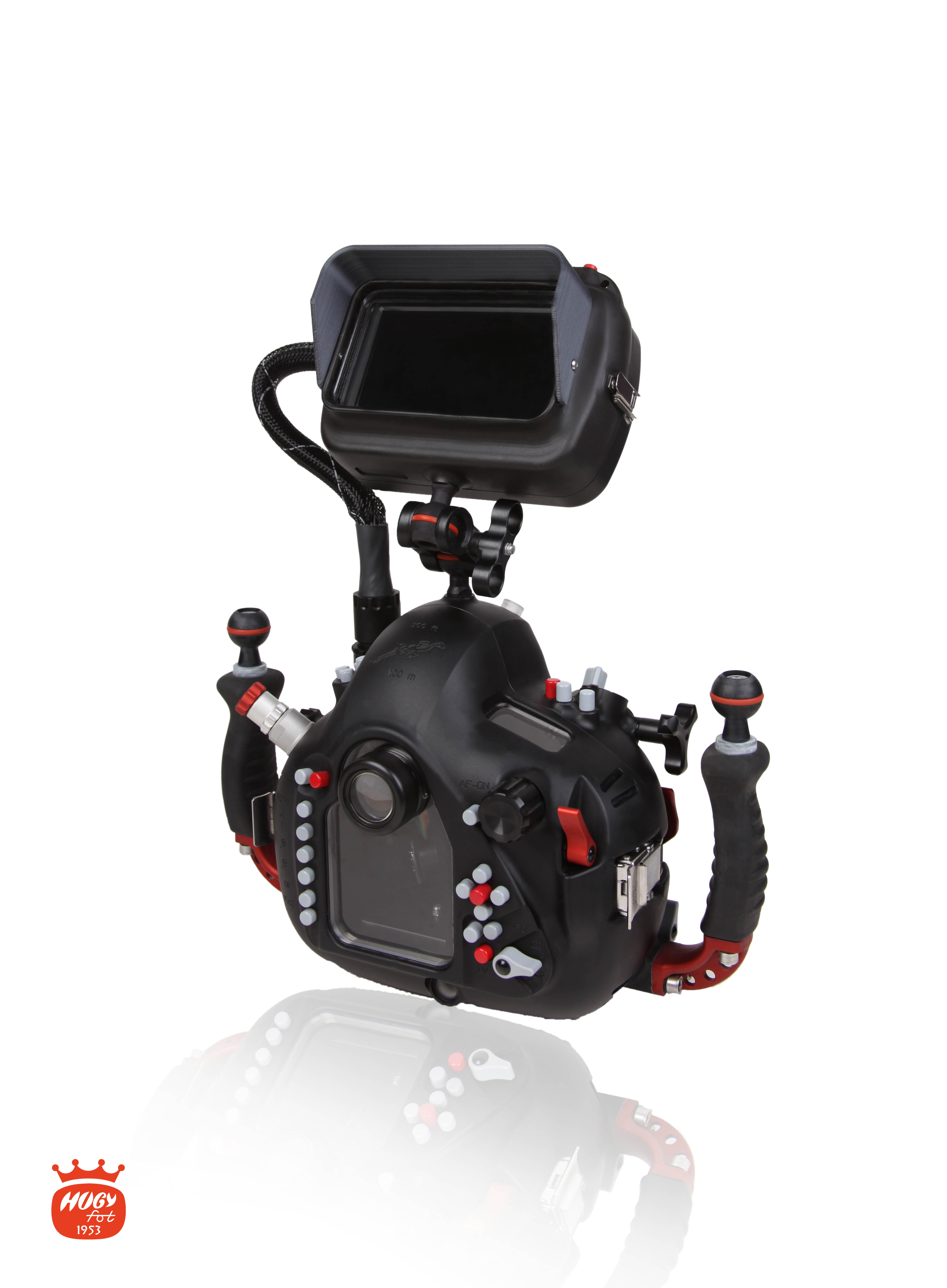
    i totally agree with you: GH6 Nauticam housing is a total nonsense. It should have been a cinema camera housing since GH5.

    I really don't understand who decide and design new products. One image says all on housing manufacturers design.

    Who is the filmmaker who use a monitor underwater in this way? And this is how they thought about their product. A Babel Tower!

    The harsh reality is that we are victims of photographers and WP is proof of that.

    monitor_DSLR_Logo_2.jpg


    Edited by Davide DB
  14. 2 minutes ago, Davide DB said:

    i totally agree with you: GH6 Nauticam housing is a total nonsense. It should have been a cinema camera housing since GH5.

    I really don't understand who decide and design new products. One image says all on housing manufacturers design.

    Who is the filmmaker who use a monitor underwater in this way? And this is how they thought about their product. A Babel Tower!

    The harsh reality is that we are victims of photographers and WP is proof of that.

    monitor_DSLR_Logo_2.jpg


    I do not know

    I had a long discussion on the handles that are bent forward and are useless but I was told this was the design feedback from 'experts'

    I then asked why the A7S3 for example does not have handles angled forward and did not get an answer

    You can of course use a longer arm and put the monitor back mounted the rig becomes elongated like a videocamera...

  15. 3 hours ago, Interceptor121 said:

    You can of course use a longer arm and put the monitor back mounted the rig becomes elongated like a videocamera...

    No you can't or just partially because the cable length and bulkhead position are chosen with that design in mind

  16. No you can't or just partially because the cable length and bulkhead position are chosen with that design in mind

    If the monitor has a mount top and bottom it is possible to put it behind the camera someone has done it already


    Sent from my iPhone using Tapatalk
  17. 18 hours ago, Interceptor121 said:

    No hardware will be able to decode 8k60fps 

    I can confirm that the Macbook Pro with M1 Max and 32 core GPU can play play back and edit 8k60fps Canon Cinema RAW LT footage perfectly smoothly.

    I agree that 60p is fast enough for underwater footage. 120p is largely overkill. 30p is fine most of the time. As for whether 8k is needed.. no, not yet. But it's all about future-proofing stock footage for me for natural history purposes. There, 8k does indeed have value.

    Btw, with custom manual white balance under a 50000 kelvin light -- A1 does produce slightly cleaner, less contrasty  files than the R5 C. Not that skin tones look great under such teal light..

    File A

    SonyA1_1.1.1.thumb.jpg.aa48b13eeb55a4c0faf7959a03fbfcb1.jpg

    File BCanonR5C_1.2.1.thumb.jpg.16496b4697736f3fcceb912ff657f0b0.jpg

  18. You are not going to produce those files as output of your process. You are likely to output x265 10 bits 420 with good level of compression or your files will be huge
    Those output files won’t play on majority of machines out there


    Sent from my iPhone using Tapatalk

  19. 9 hours ago, Interceptor121 said:

    You are not going to produce those files as output of your process. You are likely to output x265 10 bits 420 with good level of compression or your files will be huge
    Those output files won’t play on majority of machines out there


    Sent from my iPhone using Tapatalk

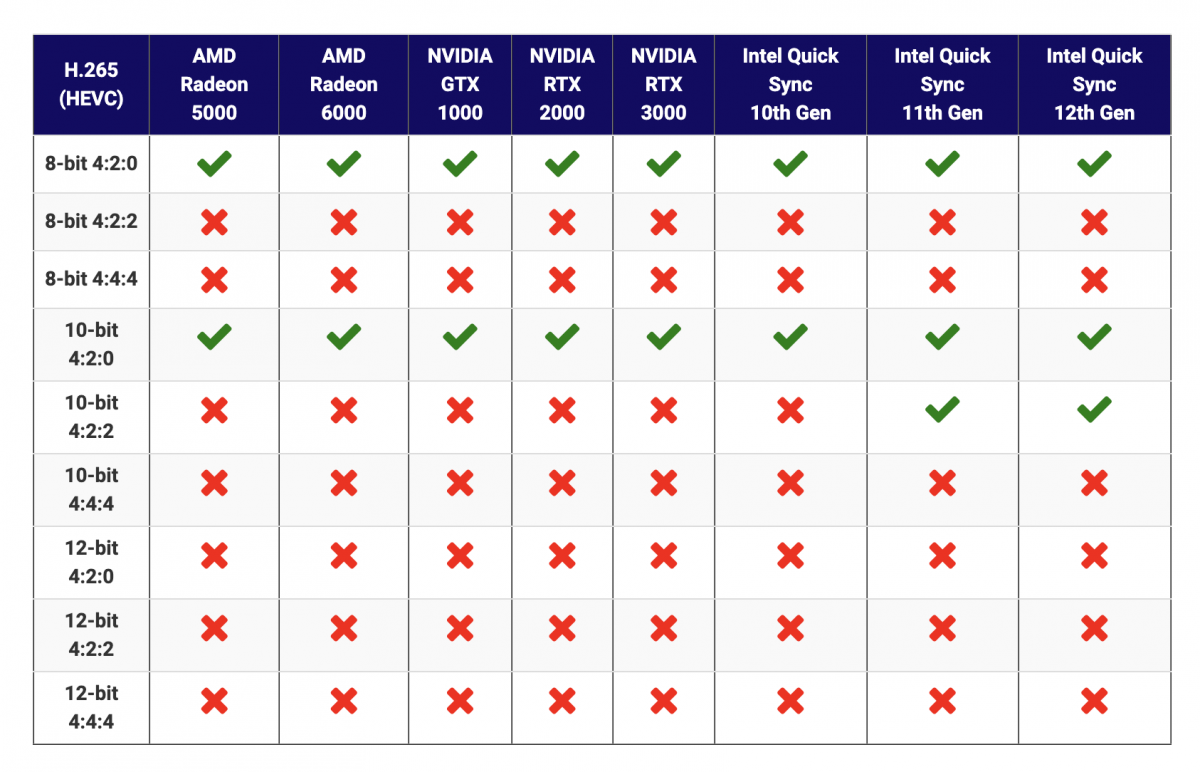
    If you mean 8k h.265 files in 10-bit, either 4:2:2 or 4:2:0 chroma subsampling, then yes, that's a challenging codec on most older machines. Newer generation processors and graphics cards though have dedicated decoder/encoder chips that make it manageable. Here's a good chart. You can also add M1 & M2 Macs to the list.. they actually have the fastest hardware decoders for h.265, both 4:2:2 and 4:2:0.

    1421482364_ScreenShot2022-07-13at11_41_15AM.thumb.png.f7cf14bc26f47ef6a6250fe61af3cbb2.png

    10 bit 4:2:0 files should play back fine on any machine from the past 3 years or so. 4:2:2 files are more troublesome. There you need a 11th or 12th generation Intel processor or an M1/M2 mac. 

    Edited by dreifish
  20. 2 minutes ago, dreifish said:

    If you mean 8k h.265 files in 10-bit, either 4:2:2 or 4:2:0 chroma subsampling, then yes, that's a challenging codec on most older machines. Newer generation processors and graphics cards though have dedicated decoder/encoder chips that make it manageable. Here's a good chart. You can also add M1 & M2 Macs to the list.. they actually have the fastest hardware decoders for h.265, both 4:2:2 and 4:2:0.

    1421482364_ScreenShot2022-07-13at11_41_15AM.thumb.png.f7cf14bc26f47ef6a6250fe61af3cbb2.png

    It is a bit more complicated than this

    Unless you play your file locally you will need to compress it. On wireless LAN you are looking at around 50mbps 

    In order to get the file so compressed you will need to apply many settings that will fry the machine for the encode

    When it comes to playback

    As no laptop have 8K resolution you will look at a screen with HMDMI 2.1 currently over £3K as the bandwidth of uncompressed RGB is massive

    For streaming to work reliably at 50 mbps it is also a very high requirement if you wanted to use an online service

    So the only platform that will actually playback your 8K file is going to be a Tv either from USB or HDMI 2.1 or from a very strong LAN connection 

    The rest of the devices will playback a scaled version of your file 

    But then why exactly did you shoot 8K I guess it is my question

    Today 4K works fine with Tv sets also in HDR bandwidth requirements are 15-20 mbps which is aligned to performance of most wireless LAN and internet connections

    I do believe there may be a case of scaling down to 4K for delivery more pixels can help but then I am ok to have the camera doing it internally for me

Account

Navigation

Search

Search

Configure browser push notifications

Chrome (Android)
  1. Tap the lock icon next to the address bar.
  2. Tap Permissions → Notifications.
  3. Adjust your preference.
Chrome (Desktop)
  1. Click the padlock icon in the address bar.
  2. Select Site settings.
  3. Find Notifications and adjust your preference.