Everything posted by DreiFish
-
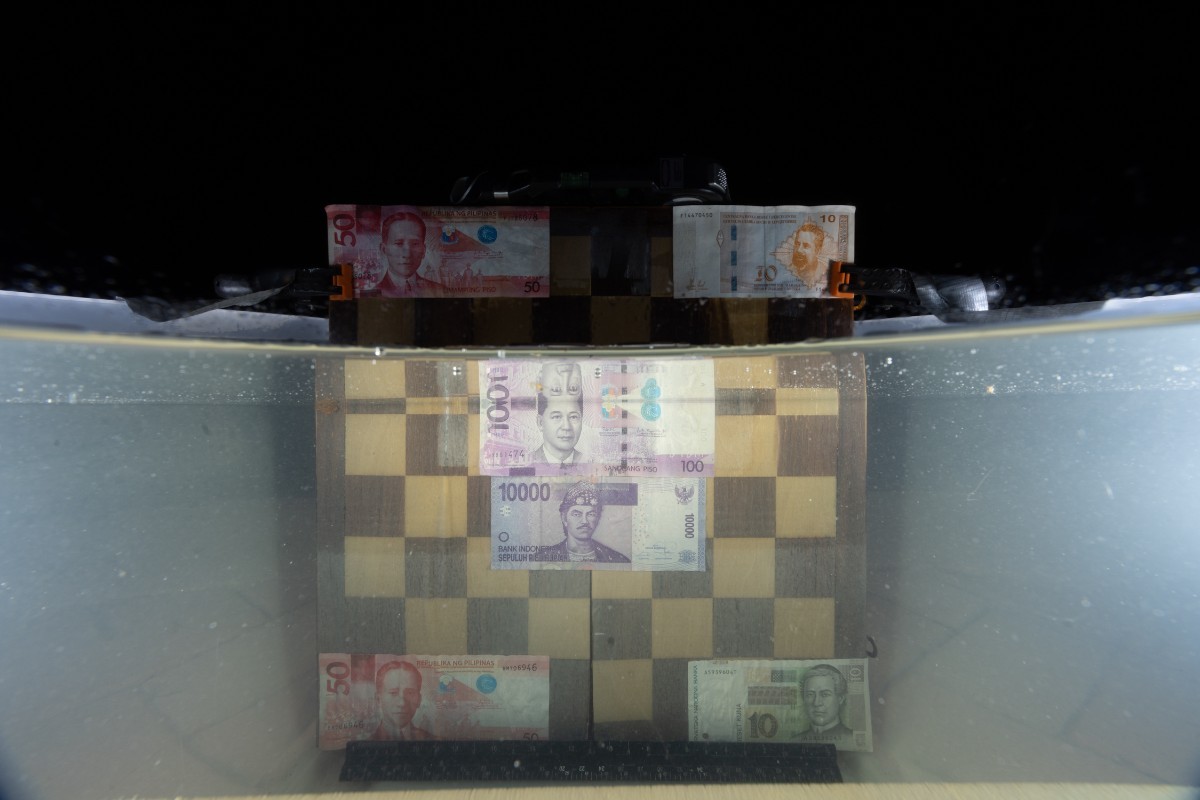
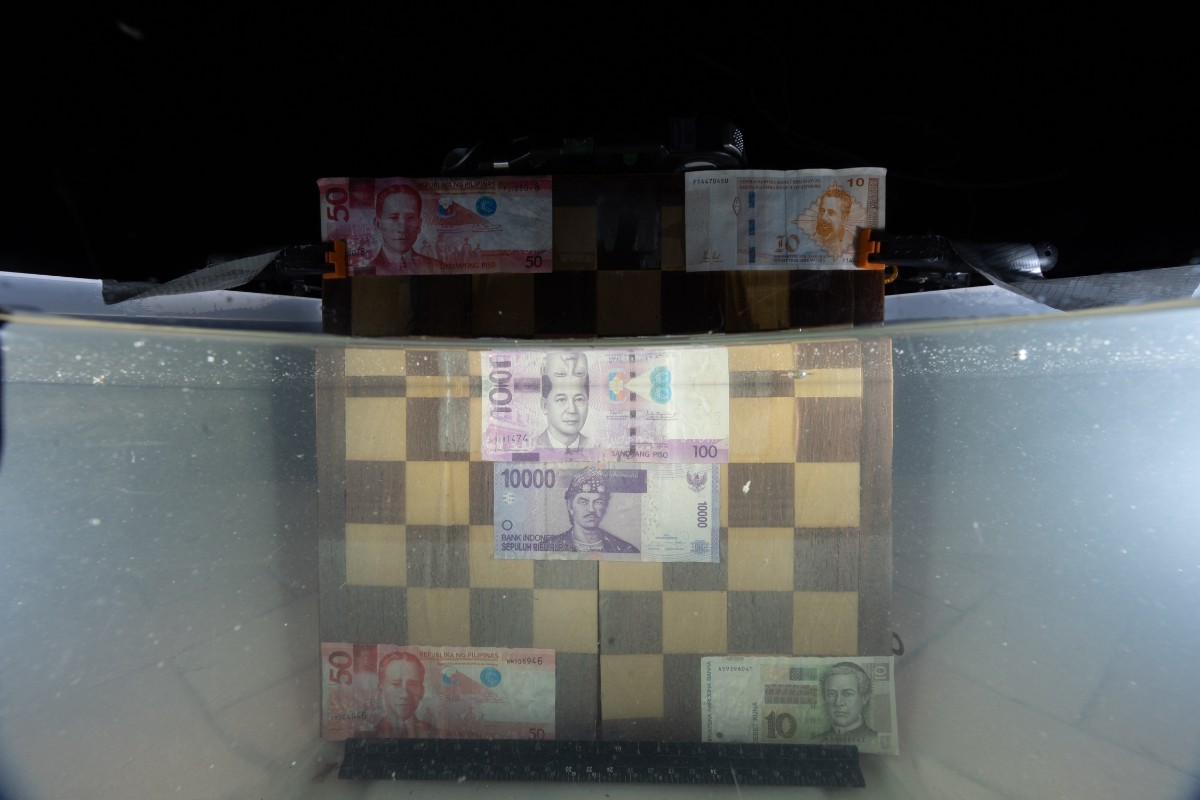
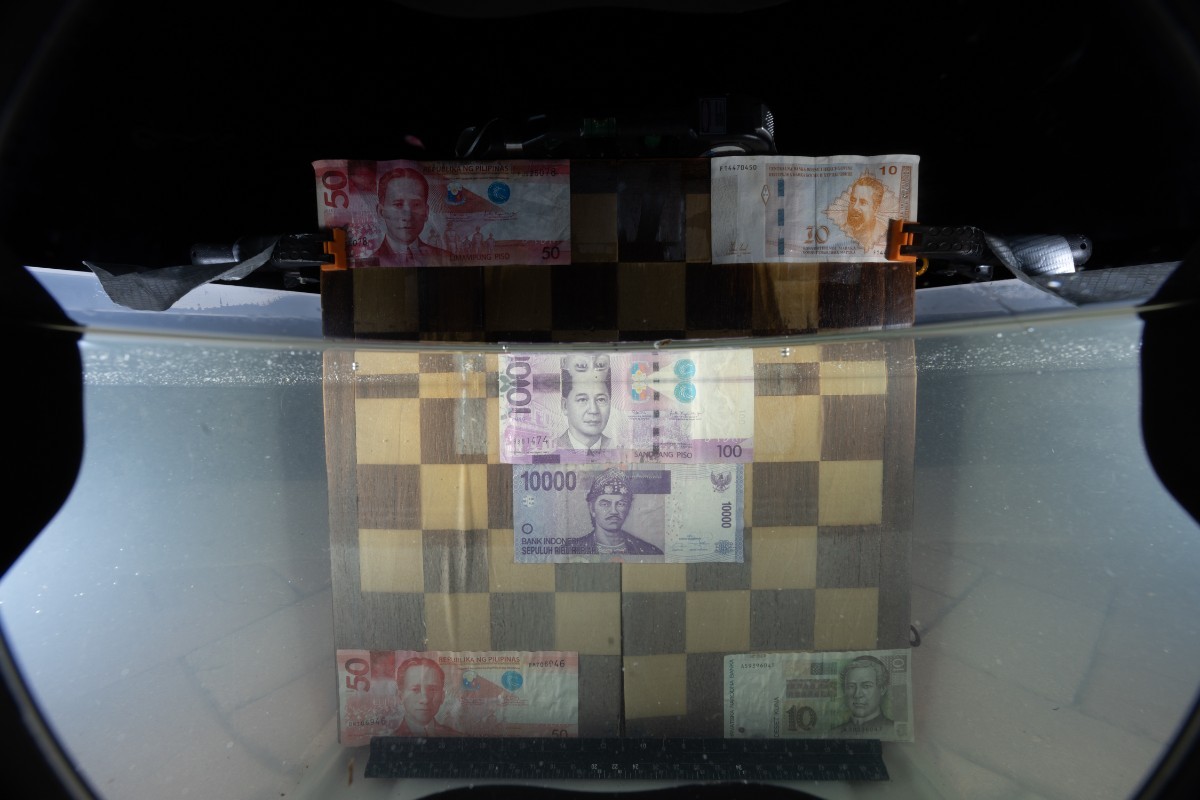
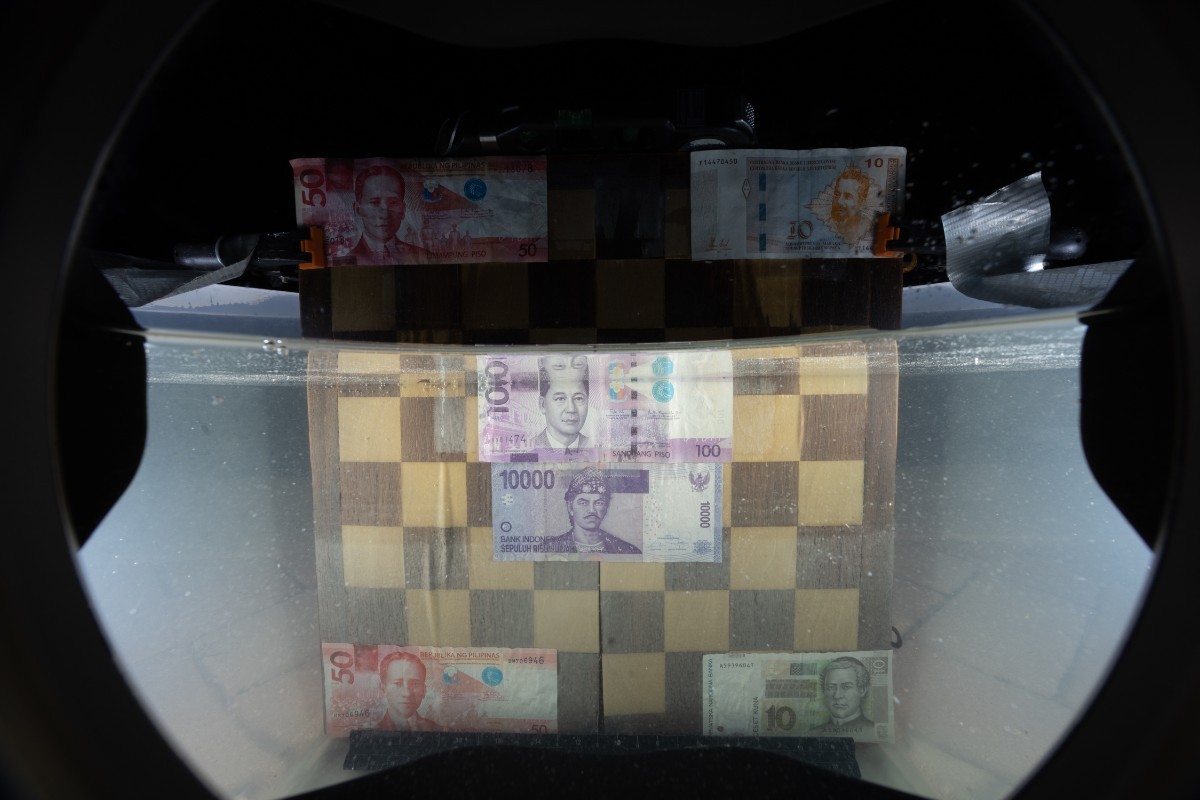
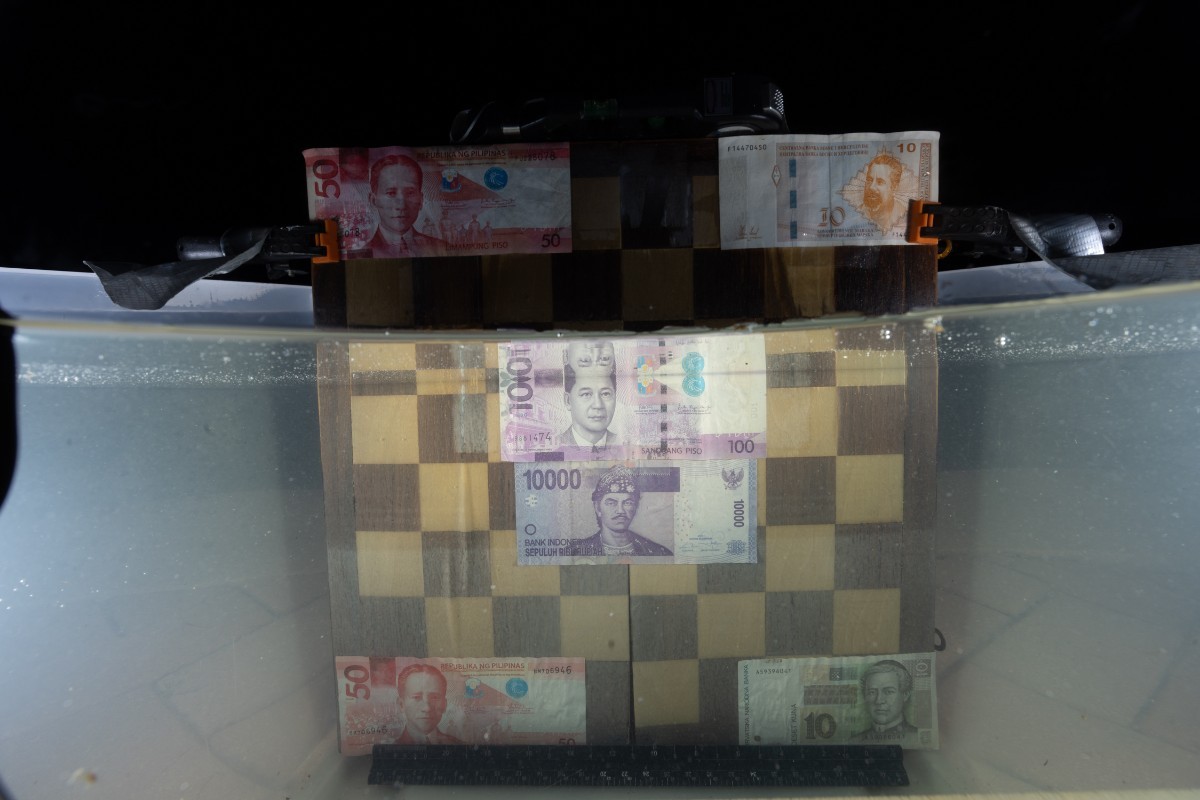
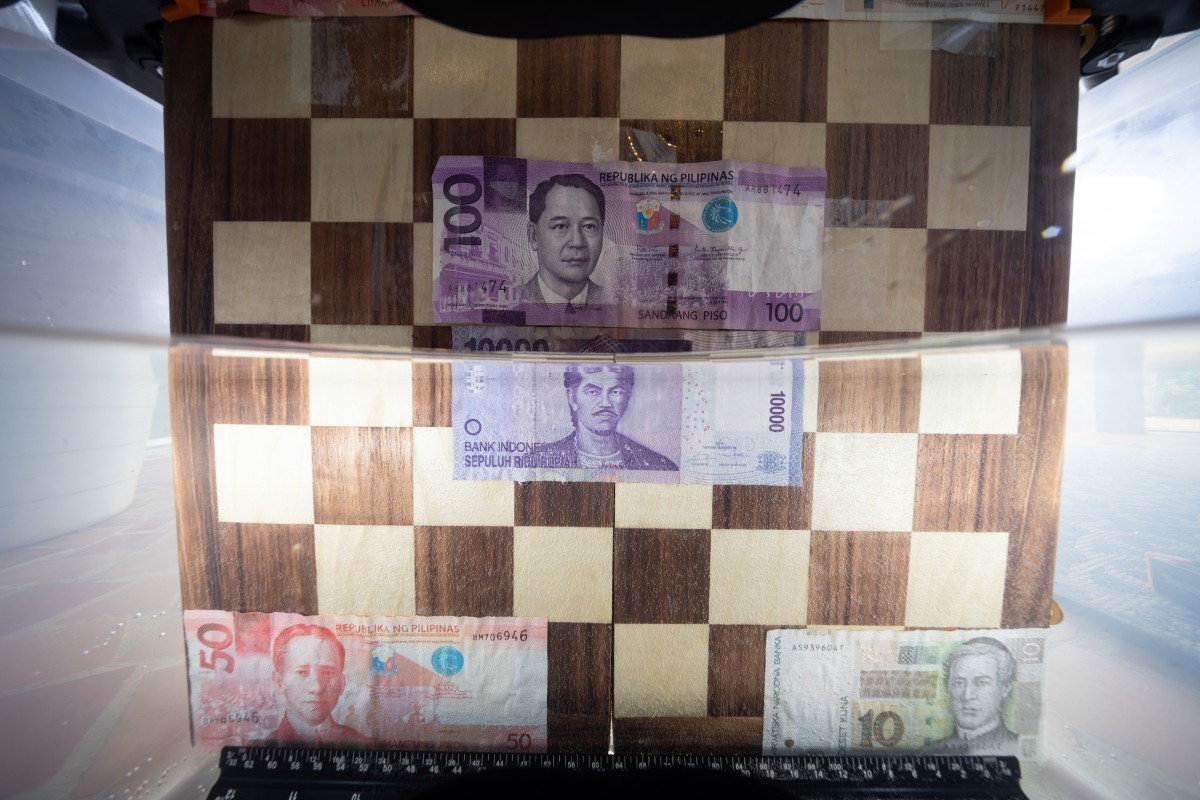
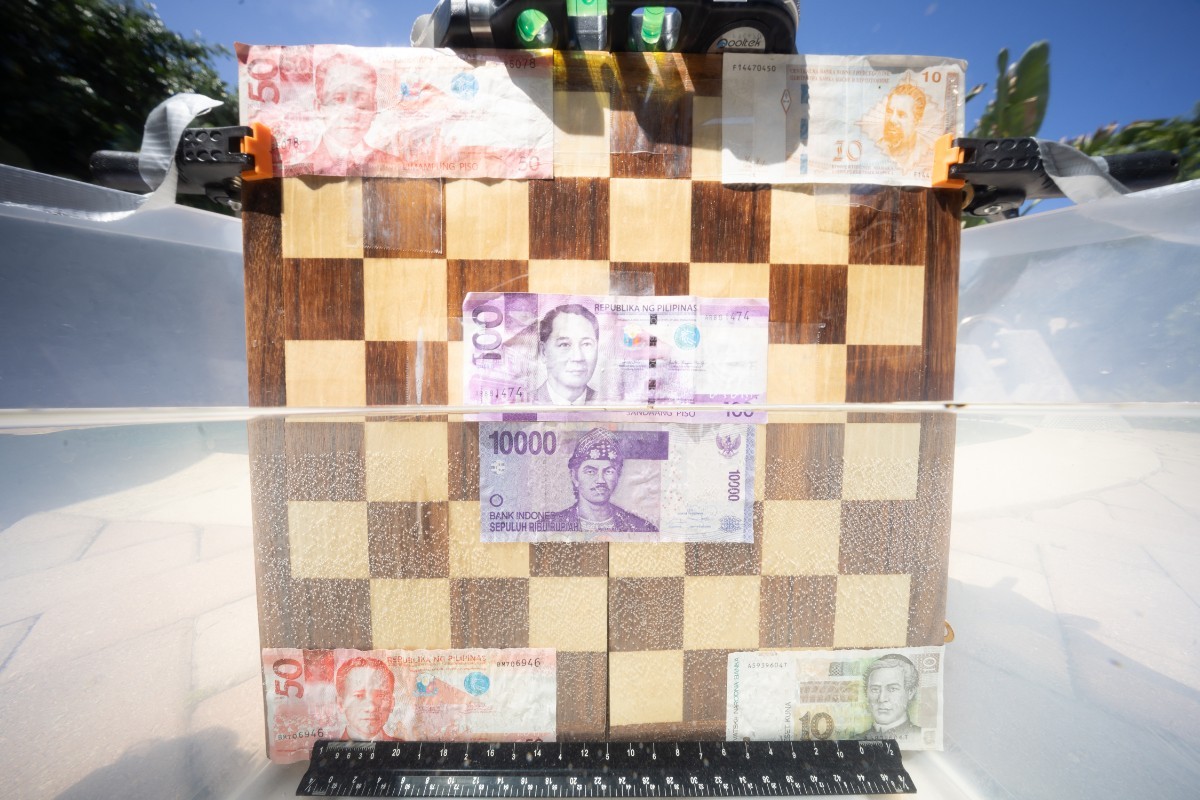
Nauticam recommends a 40mm extension for this combination. They also recommend the 230mm dome with a 55mm extension as an optically better option. But since I don't have a 230mm dome, I thought I'd try and see what the best extension is. Calculating theoretically from the lens entrance pupil location (and taking into account that the center of curvature of the 180mm dome is actually about 25cm behind the back flange, because it's not a true hemi-spherical dome, you get the following: So, a calculated extension of 55mm is needed for optimal image quality. Let's test this with a split shot of a checker-board. From top to bottom, 30mm, then 40mm, then 50mm and finally 60mm extension: 30mm and 40mm are too short. (portion of the checkerboard in air appears smaller than portion in water) 60mm is just a touch too long (checkerboard in air looks bigger than in water). 50mm is.. just about right, maybe a few mm too short. But the problem is you get vignetting from the dome shade (and the inside of the dome too). So.. basically 40 is your best option, as Nauticam recommends. Maybe 45 would work better, but it would probably vignette a bit. I don't have a 45mm extension to test. Or you can use the 50mm extension and zoom in a bit to avoid the vignetting. It disappears at a focal length between 16 and 17mm, which is still reasonably wide. Conclusion: 40mm is the go to. If you have a 45mm extension, give it a try. It might work without vignetting, or you might have to zoom in a bit to 15-16mm.

-
I took the Nauticam 180mm dome out of the closet. Turns out 10mm extension is way off.. it's hard to measure exactly with the calipers, but it looks like the conical extension on the back of the 180mm dome is more like 35mm from the back of the glass element. Nauticam lists this as being cut from a full sphere with a 110mm diameter, and the distance from the front of the glass to the back of the conical extension is closer to 80-85mm, which would indeed place the center of curvature about 25-30mm behind the back flange of the 180mm dome. Interesting... I need to redo my tests with the Canon 14-35 at the calculated extension of about ~60mm. Though I already know it vignettes with a 50mm extension because of the dome shade and the inside of the of the port itself. Nauticam recommends a 40mm extension with this combination, which theoretically places the lens entry pupil about 20mm forward of where it should be. But that may be the necessary compromise to avoid vignetting.
-
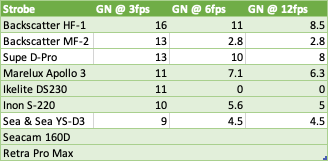
Finally got around to doing the 6fps and 12fps tests, and the results are excellent. The strobe puts out almost as much power for repetitive shots as the best-in-class Backscatter HF-1s. You can shoot 3fps and 6fps with the power dial maxed out at 9, and only need to step back to 7 for 12fps. I think these strobes offer a really attractive price-to-value proposition if you can get over the large strobe body, manual only, no HHS, modest light power and color temperature at full power. (the claimed 4800k is a pretty bold lie, but 6000k is pretty respectable.). Good build quality and they have a wide, even light beam because of the circular flash tube, excellent recycling times, short flash duration times, and great battery capacity. They're not unmanageably negative at -120g in the water. Optical slave sensor is a bit less forgiving to weak flash triggers and poor fiberoptic cables than other strobes, but with the right cables and triggers, it works fine. Overall, great price-to-value ratio at $750 (or less if bought overseas).
-
The loss of power is real, but keep in mind that the straight flash tube strobes start out with more power to begin with. Have a look at the images above, which are all shot at F22, ISO100, strobe on full power (with and without diffusers) and 1.4m distance from strobe to wall. As you can see, the diffusers reduce power, but the light output (Backscatter HF-1, Marelux Apollo III, Sea & Sea YS-D3) is still equal to or greater than the circular flash tube strobes (Ikelite YSD230 and Supe D-Pro).
-
Sounds like a better use case than for fast-action shark dives, where they've proved (for me) to be as much of a liability as a benefit. They might help illuminating the shark when it's shy and far away, but when they come close in the middle of the frenzy of action and you don't have time to remove the reflectors or move the strobe arms in, you end up with (or at least I ended up with) overexposed sharks at the edges of the frame and the center of the frame without illumination. Narrow flash beams are not the easiest thing to use in practice -- they require a level a skill and anticipation that at least I don't have 🙂
-
There's nothing wrong with subjective user experience, or paying more for a better user experience if you can afford it. My issue is that your comments come across as if "the Retras are just so much better and easier to use than any other strobes, so the price tag is justified." I fully agree with you that they're more of a joy to use than the z-330s (which I've borrowed for a few dives, but never owned). Just don't extrapolate that experience to every other competing strobe out there (unless you've tried them). Over my 12 year underwater photography journey, I've bought, owned and used 11 different strobes and 3 video lights (also used at times for photography): Sea & Sea YS-D1s (at least 4 of them); Inon Z-240s; Sea & Sea YS-D2s (the non J version) -- again, 4 of them, and all but one died prematurely; Seacam 150s; Backscatter MF-2s Retra Pro; and (in the last year) OneUW 160s; Supe D-Pro; Ikelite DS230; Marelux Apollo IIIs; Inon S-220s; Sea & Sea YS-D3; Backscatter HF-1s. Gates GT14 (15k lumen lights) Divepro G18 (18k lumen lights) I've also tried on a few dives: Inon Z330s; Keldan Video 8X Of these, the Inon z240s were the most frustrating to use because of the non-intuitive control scheme and small dials. I sold them primarily for that reason, and because the YS-D1s and D2s had more raw power. The Sea & Sea YS line also suffered to some extent from poor user interface, but I made do with them for many years, and got great results. Upgraded from those to the Retras primarily because of reliability concerns. I liked the light quality from the Retra Pros a lot, the controls, and the size (without the booster). Ultimately, what convinced me to explore greener pastures was the annoyance of dealing with 8 or 16 AA batteries combined with needing to change batteries after 2 dives. I think it's fair to say that during the last year I've been searching for my next primary strobe. And I'd like to think I gained a lot of insight and experience with the pros and cons of a wide selection of other strobes during that time. So yes. Retra's user ergonomics are great (batteries aside). But if you don't count notoriously annoying (because of user interface) strobes like the Inons, it's not particularly easier to get great pictures with the Retras than a number of other strobes. For instance, I never felt the YS-D1s or YS-D2s made it hard to get good images once you put a diffuser and warming gels on them. The Retras aren't magic. They don't make a bad photographer better. If anything, the wider light beam makes it more difficult to control backscatter for the inexperienced. The quality of the light from the Inon S-220s is not the same (beam coverage), though it's surprisingly decent and so is the power output. But you're setting up a strawman comparison. No one's cross-shopping Retra Pros with Inon S-220. A more meaningful comparison would be something like the Seacam 160d, OneUW 160, Ikelite DS230, Marelux Apollo III, or Backscatter HF-1. Heck, maybe even throw the Sea & Sea YS-D3 in that mix. When it comes to this group of competitors, the 'subtle' differences are even more subtle and hard to appreciate. And the Retras start having a number of significant shortcomings too. To be clear, I'm not trying to convince you of anything. My posts are for the benefit of other people in my shoes who may be wondering what strobe to buy or upgrade to. And there, my philosophy is that more information (especially quantitative, comparison information where it can be had) is a pretty valuable thing. Not to discount subjective experience, but that often comes with the big caveat that the person giving it may have only one or two other strobes to compare their new favorite to. I personally value quantitative measurements over subjective testimonials. That's a big part of how I make decisions. Others prefer subjective testimonials from people they trust or see as authorities on the subject. I don't discount that (because numbers don't capture everything, of course), but even there I'm more likely to give weight to someone like Alex Mustard who's worked with more than a handful of different strobes throughout his career... (Alex was influential in my decision to upgrade from the YS-D2s to the Retra Pros for instance). I don't think so. The HF-1s are the seventh strobe I've purchased with my own money in the last year. Why would I have something invested in rationalizing that purchase more so then my other 6 (more expensive) purchases that I've lost money reselling? Do I think the HF-1s are the best strobe out there today? Yes. With the slight caveat that I haven't run my comprehensive tests on the new Retra Pro Max or the Seacam 160Ds, and I'd love to test them and see if they're better. But I've arrived at that conclusion after scruitinizing Backscatter's tests with a fine-toothed comb and testing and handling a whole bunch of strobes on my own dime. Not as some ex-post-facto rationalization of $2000 I spent on two strobes and all the light modifiers. (which is still half of what a pair of Retras with the power vault would cost).
-
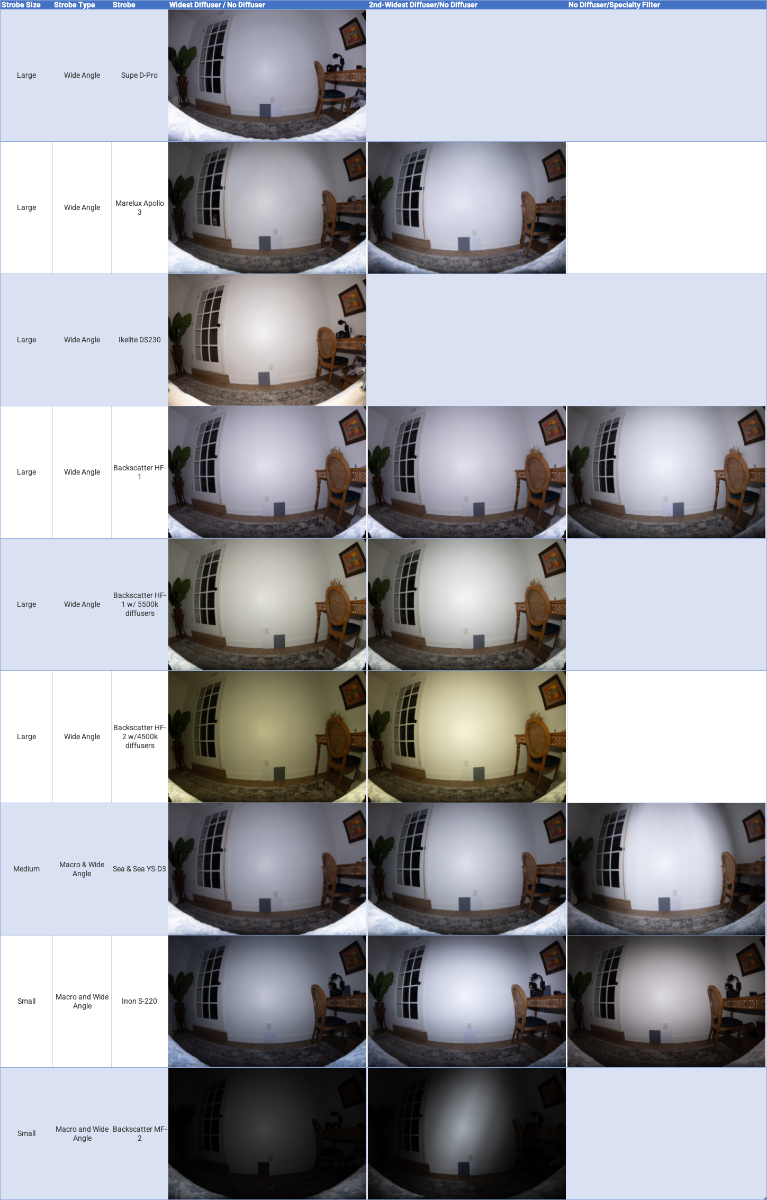
That would be awesome. Hope more manufacturers follow suit. In the meantime, this is the table I've compiled so far:
-
I've updated the spreadsheet with the Backscatter HF-1 test results.
-
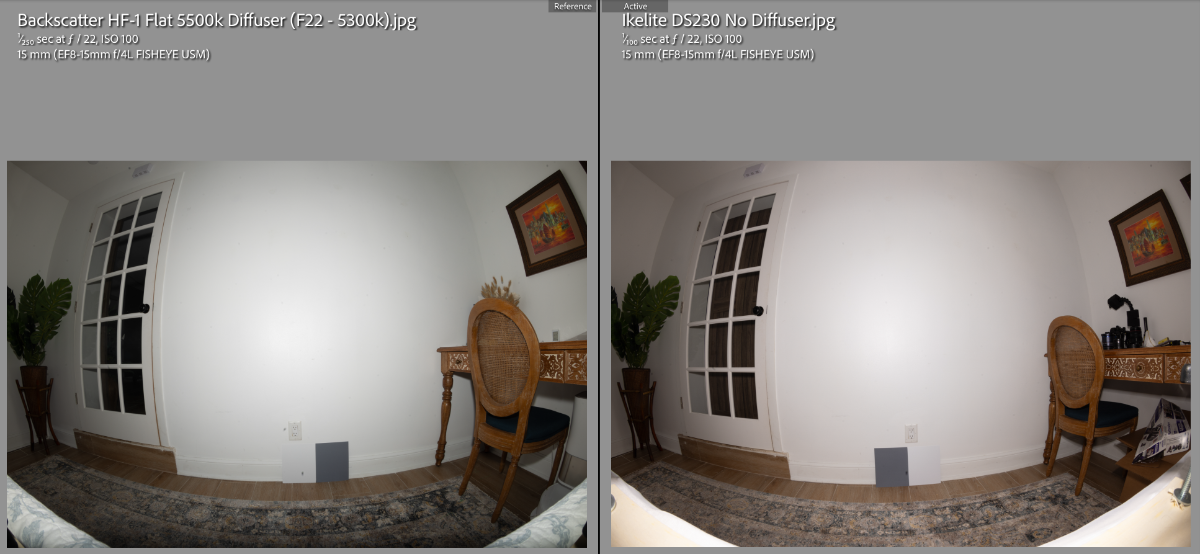
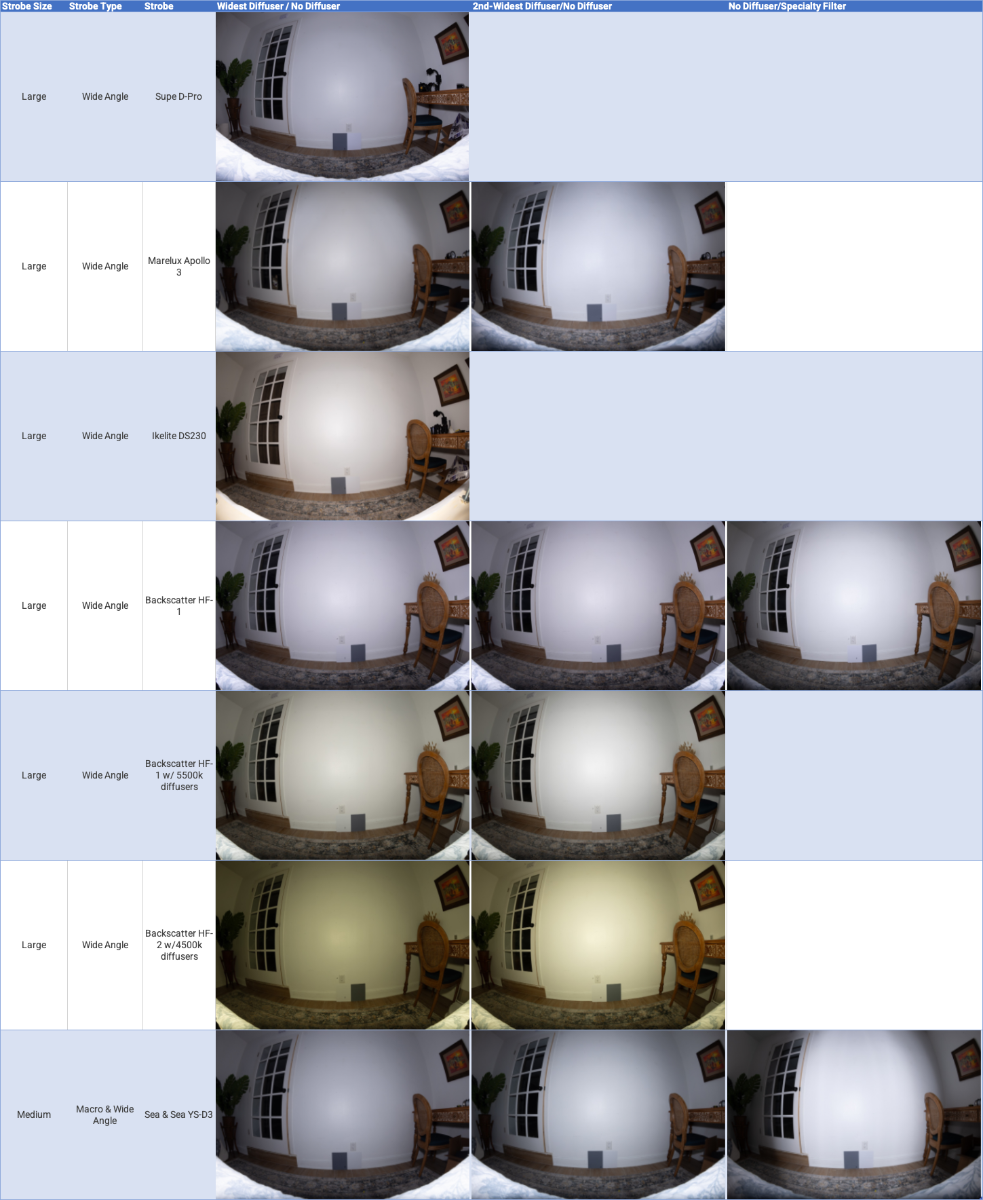
I think round tube flash strobes having way better quality of light than flat tube is something often quoted by people who haven't compared the two. It's an urban legend that should be laid to rest in 2024. I have done comparison testing of several round flash tube strobes, and several linear tube ones. So has Backscatter. My conclusions are that, once you add diffusers to the flat tube strobes, the differences in light quality are pretty hard to notice even in air -- and likely even more minor in water, which diffuses the light further. Here's proof:
-
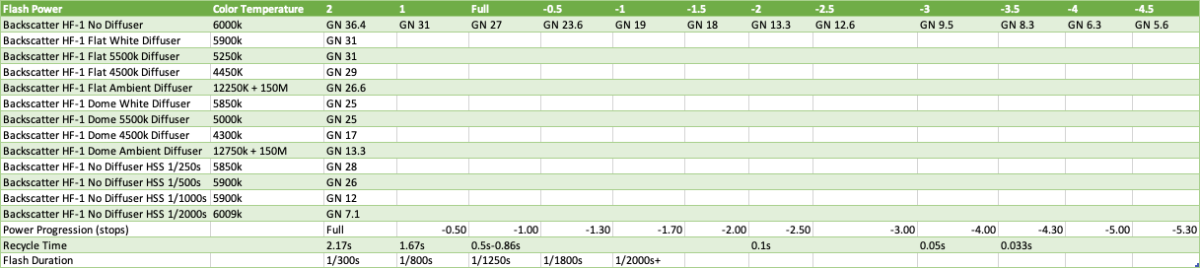
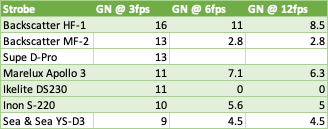
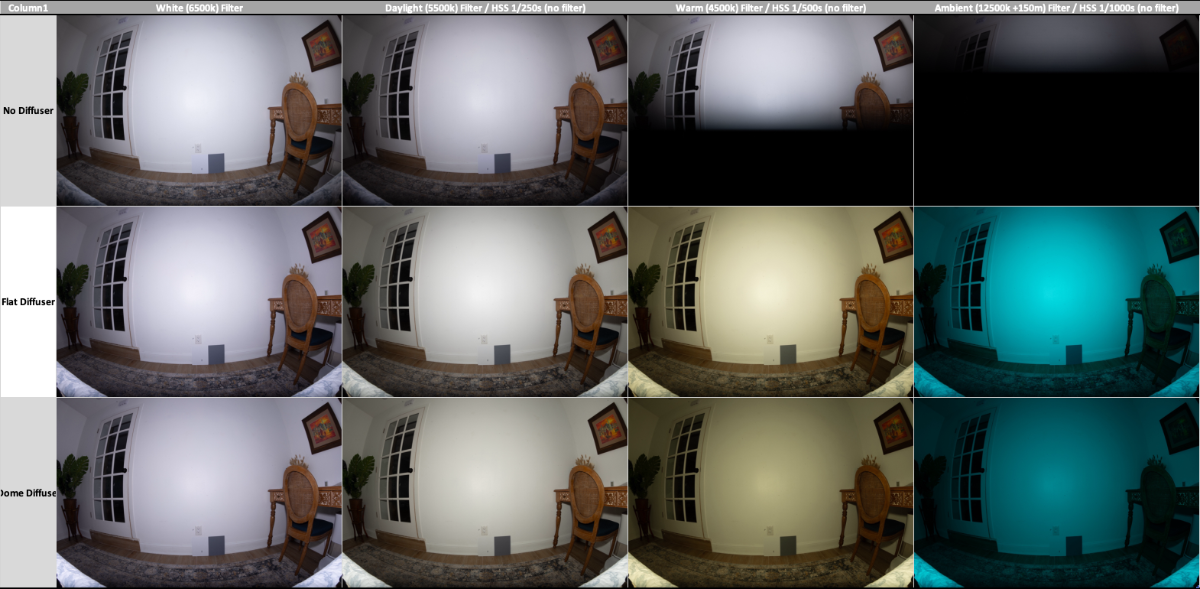
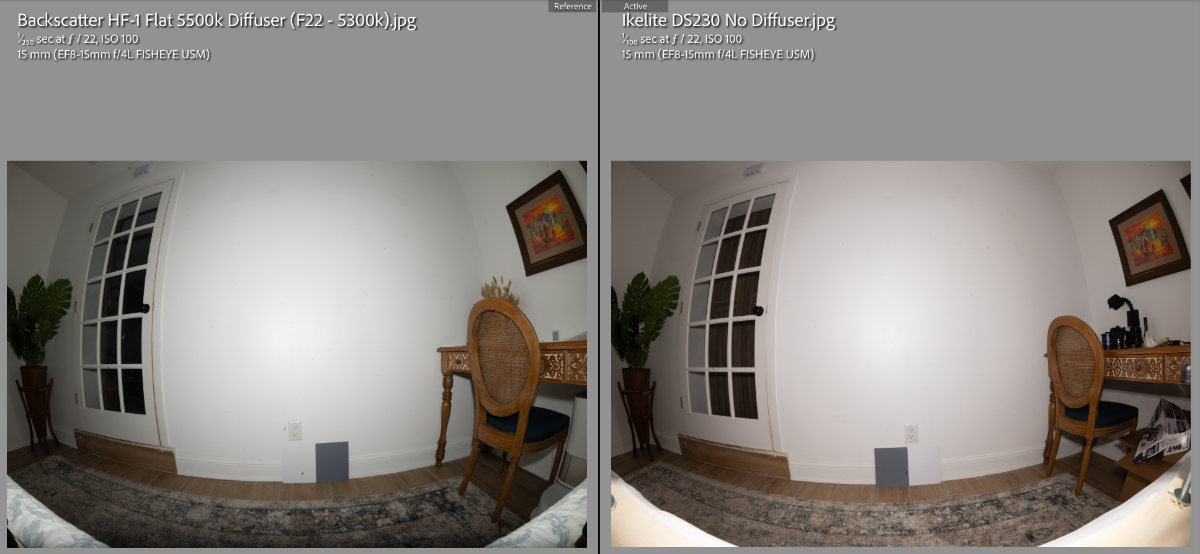
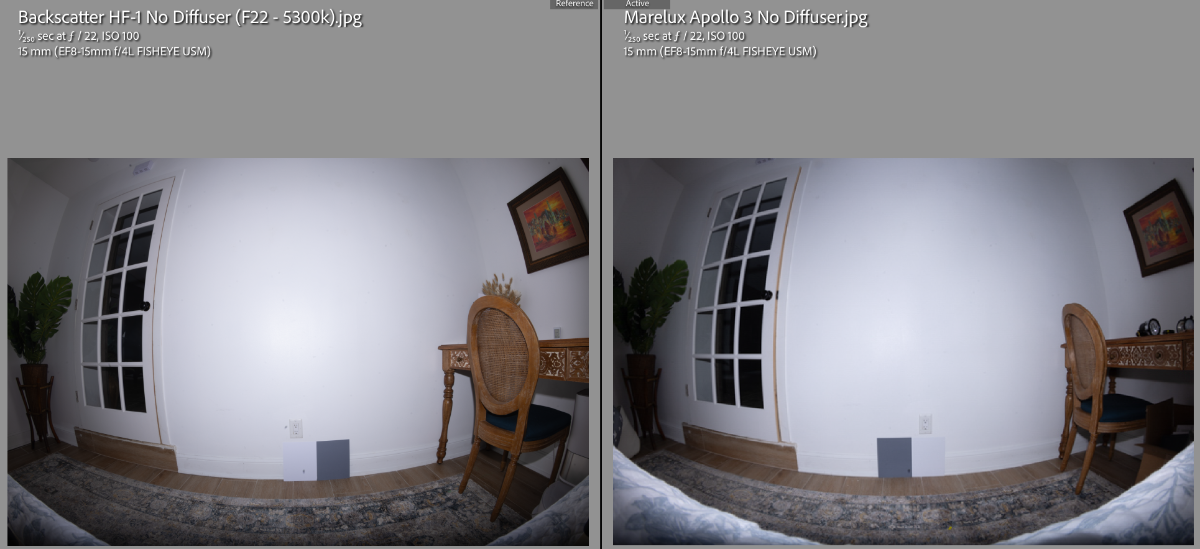
My Backscatter HF-1s (and diffuser package) arrived at last, and of course I had to do some comparison testing before getting them in the water. Here's the measurements, compared with the Marelux Apollo 3s, Ikelite DS 230s and Supe D-Pro (among others). Results fairly closely match Backscatter's advertised figures, but they do fall short slightly in terms of power output, flash duration and high-frame rate shooting. Max power for high speed shooting (measured on the 20th shot in the series): Illustrative beam spread, color temperature and illumination power in air (1.4m distance to the wall, 15mm fisheye lens, 1 strobe, F22, ISO 100, Color Temperature set to 5300k). Observations: It's the brightest strobe I tested, about 2/3 of a stop brighter (with no diffuser) than the Ikelite DS230, Marelux Apollo IIIs, and Sea & Sea YS-D3 If I had to guess, it's using 2 of the same flash tubes used on the Sea & Sea YS-D3. However, unlike the YS-D3, the beam is already wide and pretty soft with no diffuser. The YS-D3 cannot be used without a diffuser if you want to avoid significant hotspotting. Color temperature is already decent without diffusers at 6000k. Warmer than the Marelux Apollo IIIs, similar to the YS-D3, and but not as warm as the DS230s. Side by side with the Marelux Apollo III (both without a diffuser), it's brighter, more even, and warmer. You only lose about 1/3 of a stop of light with the flat diffuser, and 1 stop of light with the dome diffuser. Color filter wise, you can get to 5300k (which is pretty versatile) while only sacrificing 1/3 stop of power, and 4450k/4300k with the warm 4500k filter by sacrificing 1/2 a stop of light output. The sweet spot seems to be the daylight 5500k flat diffuser, which gets you great spread with minimal hotspotting, color temperature almost matching the Ikelite DS230, and a very respectable light output at GN31. Basically, it's comparable with the DS230 with this combination in terms of light quality, with much better recycling times, weight, and battery capacity. Not to mention cheaper. Here is the Backscatter HF-1 on the left, YS230 on the right. The color temperature is not so different, but the Ikelite does have a more reddish tint (vs more yellow on the HF-1) which could be beneficial for colorful reef scenes: The dome diffusers don't offer a great tradeoff. You lose an additional 2/3 stop of light compared to the flat diffuser, and beam evenness improves only marginally. Still, they're there if you really want the softest, widest dispersion of light. The ambient light diffusers are an interesting option, rendering light with a 12250-12750k, with a very strong magenta push (lightroom maxed out its magenta correction at 150. But you lose a full stop of light with the flat ambient diffuser and three stops with the dome ambient diffuser. The latter is basically unnecessary for this shooting style in my view, since you're using the flash for fill rather than to restore color, so hotspotting is not a major concern. Flash duration is probably best in class. It's 'only' about 1/300s (not the advertised 1/440s) at +2 power, but flash duration ceases to be a concern if you shot at +1 (1/800s) or 'Full" power (1/1250s). Despite the quick-firing flash tube, you do still lose a fair bit of power switching into HSS mode. 2/3 stop at 1/250s shutter speed, 1 stop at 1/500s, 3 stops at 1/1000s and 4 2/3 stops at 1/2000s. It's best in class for fast speed shooting. At 3fps, it's 2/3 stop brighter than the Supe D-Pro, and a full stop brighter than the Ikelite DS230 and Marelux Apollo III. At 6fps, it's 1 1/3 stop brighter than the Apollo IIIs (and 2 2/3 stop brighter than the YS-D3). At 12 fps, you still get a respectable GN of 8.5 - 2/3 of a stop brighter than the Apollo III. At the end of the day, it's basically better than the Apollo III in every way, and better than the Ikelite DS230 in most ways, though the DS230 still edges it out in power output and light quality if you absolutely must have a 5100k light temperature. When you consider that it's the cheapest of the big strobes, and only $100 more then the Sea & Sea YS-D3, I'm really struggling to see why you wouldn't pick this strobe as the best in class. There's very few areas where another strobe is better. And as a complete package at such an attractive price? This should be most people's end-game strobe.



.jpg.d1e714e65315650d765442ddecfef918.jpg)
-
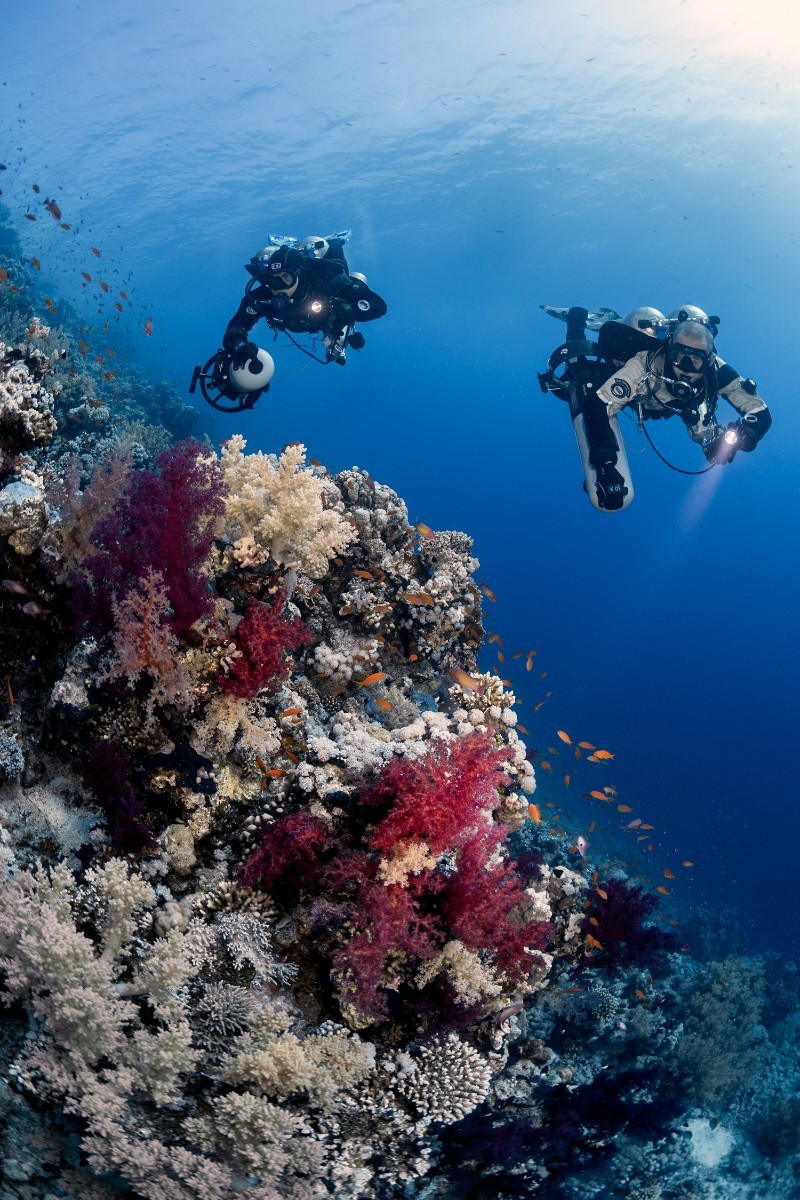
Alright Andrej. I'll take up your challenge. Let's ignore for a moment that at 50m, there's so little ambient light that you could've achieved the same results even with video lights -- not to mention a pair of Inon S-220s with the soft diffuser at $450/strobe (1/5th the price of the Retras). Sure, you can get great results with your Retras. But you can get equally good results and a soft, wide beam with other strobes too. Here's a shot I took recently at 30m with the Marelux Apollo 3s. Here's an example (not mine) of what the Backscatter HF-1 can do (a bit too red for my taste, but he had them only for 2 dives) And here's something a bunch of 10-year-old photos with a Panasonic GH4 and the original Sea & Sea YS-D1s. And this one? It's not even with strobes, but rather 15k lumen video lights. Just for completeness' sake, here's a shot taken with my old Retra Pros. The point? The Retras are good strobes, but there's nothing that makes them 2-5x better than a half dozen other strobes.
.jpg.a8f2fed6d97803611e12fc073a3b7dbd.jpg)
.jpg.ce1956a3a06cd8efbea22c7ea0afd348.jpg)
.jpg.def9c843e76d0fd3b23341b493b760da.jpg)
.jpg.ee46537380468fdb9c84da251a46dd94.jpg)
.jpg.c27cc38fa026a98cc05578f2ad5beb1f.jpg)
.jpg.b2366c5106b114d63fca6ef7a64c2410.jpg)
.jpg.af26bb7fd0b05ac589eb53a576d2c853.jpg)
-
It's not true for all products though.. Nauticam stuff for a while was 25-35% cheaper if purchased in Europe, even accounting for VAT. It still is, VAT exempt for export. But that I believe is due to the 25% tariffs that the U.S. has started charging on Chinese-origin goods. I purchased my Retra Pro strobes in 2021, after the global recession. And I got them for less than $1000 each. The doubling in price has happened in 2 generations and less than 3 years, not 6. Sorry.. but that ain't inflation, that's a deliberate move up-market in pricing from Retra's side. In the same 3 years, the number of features that Retra could claim were 'unique' has halved. HSS? Plenty of strobes do that now too. Wide, warm-ish beam coverage at a reasonable temperature? Ikelite DS230s and Backscatter HF-1s (with diffusers) have Retra beat. Many diffusers to modify the light? Backscatter HF-1. All aluminium construction? Supe, Marelux, OneUW. And the OG Seacam and Hartenberger strobes of course. Retra only went to lithium batteries after Supe, Marelux and Backscatter went there first. Good customer service -- queue Ikelite and Backscatter, if not others. The only unique features left for Retra are deservedly called gimmicks. Moisture alarm that won't save your batteries and makes no difference since the rest of the strobe electronics remain sealed. User-upgradable firmware that solves no actual problems. Did I miss something? Are they? I know at least one trying to sell his strobes to switch to the Backscatter HF-1s (I almost bought them). And for the others.. well, when you spend that much money on anything, it's human nature to try to rationalize that choice.
-
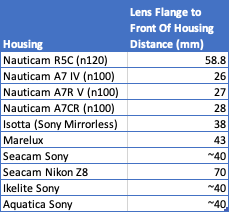
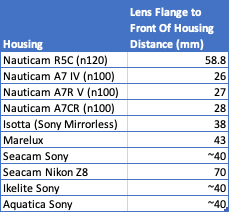
Could be, I was just guestimating based on my recollection of what the 180mm dome looks like (mine is sitting packed in a closet) and the 10-15mm shorter extension Nauticam recommends in its port chart when using the 180mm dome instead of the 140mm or 230mm domes which don't have any protrusion at the back. In any event, the 180mm dome is definitely not anywhere near a full hemisphere like the 140mm or 230mm domes. The pictures Phil posted look promising in terms of the 20-70s performance with the 140mm dome. Sounds like a potent travel combination together with the Laowa 10mm. Based on this, I would guestimate the Aquatica lens-mount to front of housing 'flange' distance to be around 40mm too. Below chart may be useful when converting port extensions from one housing manufacturer to another. So probably the extension needed for Aquatica is similar to Marelux -- i.e. 20 to 25mm. At least I'd take that as a starting point for fine-tuning. N100 + 35.5mm port adapter should produce the same flange distance as the n120 housings with no adapter, or at least within 1-2mm. This combination only vignettes slightly with the 140mm Nauticam dome at the top and bottom because of the dome hood, which is designed to accommodate a fisheye lens's more limited vertical field of view. Without the dome shade, there's no vignetting. With the dome shade on the left, no dome shade on the right. Both with Nauticam R5C (n120) housing and no extension. Something seems strange about this Phil. The Nauticam N100 equivalent to a 35mm extension on Marelux (i.e. total extension from lens flange of 40mm + 35mm = 75mm) would be 75mm - 26mm (Nauticam n120 flange distance) = ~50mm of total extension. That would be the 35.5mm n100 to n120 adapter + a 15mm extension ring. I've tried the a similar combination on Nauticam N120 (a 20mm adapter) and you get heavy vignetting. I doubt that vignetting would disappear by moving the lens closer only 5mm.. I suspect you need more than that. So it's interesting that there's no vignetting with your set-up on Marelux. Perhaps the Marelux lens mount to front of housing flange distance is closer to 30mm than the 40mm we've been estimating? Could you measure this?
-
Looks like the price in Europe for the Apollo III is still 1125 Euro -- a bit short of the 1500-1900 estimate 😉 Whereas the Retra Pro Max once you add the power Vault (532.40 Euro) would be.. drumroll.. 2302.40 Euro. Ouch. No idea why the Retras are even more expensive in the E.U. then they are in the U.S....
-
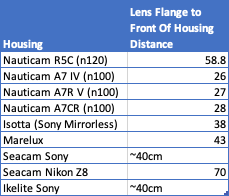
This sounds about right -- I had estimated it at 65mm based on my extension ring testing with the 140mm dome and Matty Smith custom 427mm dome (both of which are full hemispherical domes). Based on Phil's tests earlier in this thread, I didn't try the 180mm dome because it's not a full hemisphere and has a built in 10mm extension and a more narrow field of view, so I don't think it would be ideal. I've updated my chart here (ignore the I/P/FD figures, they're just made up to arrive at the lens-to-flange distance of 61mm): This matches my results using no extension on the Nauticam N120 housing (for Canon R5C). 5mm extension might theoretically work better if it were available, but 20mm vignettes, and I suspect 10mm would also. I have a problem getting my Nauticam N120 10mm extension ring (v2) to work with my domes and housing though, so no way to test. (There is no 40mm n100-n120 adapter) The 180mm dome has a built in 10mm extension that narrows in. This might work on the n100 housings with a 20mm n100 extension because of the shorter housing flange distance. But as far as I know, there is no 20mm n100 extension ring -- the shortest is 30mm. I suspect the 30mm + 180mm port would vignette worse than the 35mm n100-n120 conversion ring + 140mm dome. This is a great idea, Chris 🙂 I got the same results with the 140mm dome and no extension on Nauticam n120 (Canon R5C) -- the lens hood is visible at the top and bottom of the image. But you can get rid of that by removing the dome. There's no advantage in image quality from using the 180mm dome over the 140mm dome, and you lose field of view/get vignetting. This is because the 180mm dome is not a true hemisphere, and Massimo has estimated that it only really covers fields of view down to about a 16mm focal length. The Laowa 10mm needs a fisheye dome port like the 140mm or 230mm domes. The 8.5 inch acrylic dome is also not a full hemisphere, so it's a compromise in terms of using it with such a wide lens. I suspect you'd get better optical results with the 140mm dome. Have you tried using the 20-70 with the 140mm dome? The 20-70 has a 250mm MFD, so you will lose the ability to focus totally inside the dome at infinity, but that may not matter in practice? If the 20-70 doesn't work with the 140mm dome, your best option will unfortunately be to step up to the 230mm dome, which is closer to a true hemisphere and should support the 10mm extended field of view (especially without the dome hood).

-
If Aquatica is making a custom dome for it with no extension, then 25mm extension will probably be way too long and vignette. Sounds like the flange distance (distance between the lens mount on the camera and the front of the housing) on the Aquatica housings might be closer to the Nauticam N120 distance of 60mm. On Nauticam N120, you need either no extension or a 5mm extension that doesn't exist. Longer extensions like 20mm don't work because it vignettes. We could give you more advice if you just measure the flange distance on your Aquatica housing.
-
Thanks Andrej, I wasn't aware Anglerfish made a trigger with optical connection, thought it was electrical only. Great info!
-
Perhaps they are in the same league, but you can't conclude that just from the watt/s figure. It's just a measure of energy in, not light output out, which is what we mostly care about. There's significant differences in the efficiency of different strobes at converting energy in into light output that come from the choice of electronics, reflectors, flash tube, coatings and beam coverage. For instance, the old Ikelite DS160s are 160 watt/seconds, but a stop less bright than the new Retra Pro Max with its ~130 watt/seconds rating. And the Subtronic 270s report an underwater GN of 22, which may very well offer comparable light output to the Seacam 160d (reported underwater GN of 14) and OneUW 160s (reported underwater GN of 20) despite their much more economic 160 watt/second ratings. (This last part is conjecture -- I haven't tested the three strobes myself, and I'm not aware of anyone that has). But the main point is that watt/second ratings don't tell you anything more about light output than manufacturer's GN ratings. Both can be 'lying with statistics' or creative marketing. I'd encourage you to have a second look at the new Inon S-220s (brighter than the z240) and the Sea & Sea YS-D3, which is significantly brighter than the old Sea & Sea YS-250. Maybe the Ferrari vs. Renault analogy is apt when it comes to build quality and ergonomics, but not necessarily to raw power or efficiency. The better analogy might be a 1990s Ferrari vs. a 2024 Renault. Technology (and even ergonomics) has progressed a lot in cars in the last 3 decades, and the same is true when it comes to the technology in underwater strobes in the last decade. Purely a subjective impression, but it seems the Subtronic designs are getting a little long in the tooth.
-
Let's be clear: The Marelux Apollo 3s are fully aluminium construction. And the Backscatter HF-2s use aluminum for the flash head and heat sync, and plastic for the body to reduce weight. This is good engineering -- there's nothing inherently inferior with good quality plastics for this application. I mean, even Seacam uses plastic instead of aluminum for its port extensions to reduce weight with no loss of quality or durability. Similarly, while the Ikelite DS230s are a plastic built, I've never heard any complaints about durability or reliability as a result. Selective use of plastics to reduce weight (and cost) is a feature, not a bug. Please don't make misrepresentations about easily-verifiable facts: Ikelite DS230s are $1295 Marelux Apollo 3s are $1199 Backscatter HF-2s are $899
-
99% of the time (100% of the time in wide angle scenarios) you're shooting in full power in HSS mode anyway because HSS mode inherently puts out less light. Hyperbole. Sure, it's not a completely useless feature, but if there's water in the battery compartment, odds are you've already lost the batteries, moisture alarm or not. All of the strobes we've been discussing have isolated battery packs/battery compartments, so even without the moisture detection, you're not compromising the integrity of the strobe itself if you continue the dive. This falls into the category of 'over-engineered' in my book, increasing the price for no functional advantage. Theoretically beneficial, if you happen to have an issue that can be solved by a firmware update. Do you have actual examples Retra solving issues through firmware? Or other manufacturers having issues that could've been addressed by firmware that weren't because there was no ability for the user to upgrade the firmware? Backscatter HF-2 offers a wider range of diffusers and light modifiers. They will also offer an optical snoot specially designed for the HF-2, just like Retra. And of course, Retra's optical snoot is compatible with other strobes, so that's not an argument for buying the Retras. About the only unique accessory is the reflector, and that's only needed because of the lower power output. Other strobes like the Backscatter HF-2 achieve the same result (at higher power) simply by removing the diffuser. Customer support is a plus, to be sure, but even here I wouldn't say Retra is alone in this category. From every report I've seen, Backscatter and Ikelite are also very responsive when it comes to customer support. I assume Seacam is the same. I think the differences are critical even if you're not on a budget. As said -- I could afford any of these strobes. But what's Retra bringing to the table that other manufacturers don't, even if we assumed the price was equal? The user interface is great. Agreed. But Backscatter, Ikelite, Marelux, Seacam and OneUW are 90% of the way there too on user interface. Light quality -- on par (or slightly worse) than the Seacam, OneUW and Ikelite. Wider and softer beam by default than the Marelux and Backscatter HF-1s, but both those are 1-1/2 stop brighter. When you add the Backscatter diffusers into the picture, you get similar beam coverage at similar temperatures and still higher power. "And more" -- which more? "Differences are clear and significant" - how? Ikelite strobes work just as well with all the same features with other manufacturer's housings if you use the Ikelite TTL converters (which are reasonably priced and no more expensive than installing a 3rd-party optical flash trigger). Plus, with the electrical sync, you get more accurate TTL than Retra's optical sync implementation. And they work just fine in (manual mode) with fiberoptic connection if you get the $150 optical sensor. Plus, Ikelite gets you the option of off-camera use with an optical sensor connected to the strobe via electrical sync cable, all at quite reasonable prices. This makes them the best strobe in my view for placing on the back of a model's tanks and triggering reliably, especially combined with the highest overall power output at 5000k. The Retras? They offer no option for remote triggering, so you can't even use them off-camera reliably. Price is not my primary concern. Features are. And for the reasons I've explained above, the Retras fall short of other newer strobes here. I would agree.. perhaps a mod could split this exchange into a separate post? From my perspective, while price factors into it, the Retras fall short even if price is irrelevant. I also think there's room to expand further on the feature comparison we've started. Why cut the discussion short? Especially if we split it off into a different thread? More information is always better then less when making purchasing decisions -- at least, that's my preference 😄
-
Which detailed comparison are you referencing here, Jerry? The only credible comparison testing I've seen is from Backscatter, and it doesn't back up the "clear differences in quality and features" you're claiming. The Retras are well designed and well built, no doubt, but what features do they have that the Marelux Apollo 3s or Backscatter HF-1s don't? Battery capacity is no better, power output is between 1.5 and 1 stop less, recycling times are worse on the Retras, all have HSS and TTL. The HF-1s have more options in terms of diffusers, a credible video light built in, etc. The Marelux Apollo 3s have impressive remote-triggering capabilities and claimed consistent exposure between repeated shots. Beam quality and color temperature may be better on the Retras, but at the cost of reduced power output. And even on that metric, the Ikelite DS230s do better at 65% the price. Truth is, even money being no object, I'm not sure I would pick or recommend the Retras today over some of the other choices out there. I sold my Retra Pro Xs, and briefly considered getting a pair of the Retra Pro Max to replace them when the power Vault was announced. Then noticed the size and the minimal improvements to recycling times. Personally.. I just don't see enough pluses here to make this an end-game strobe. Are these really the best tool though? Sure, coming from a mediocre strobe like the Seafrogs SF-01 they offer a very real and noticeable improvement. But there's plenty of other contenders for the 'best strobe' crown these days.
-
Regarding the WWL-C performance, I too was a bit surprised that it was this bad. I've owned the WACP-1 before, and even with the (significantly older) EF 28-70 lens, the results were pretty good. So I'm not sure what's going on here -- it could be the WWL-C itself, but I suspect the biggest issue is the quality of the Canon RF 24-50 F3.5-F6.3 lens. Still, while the lens is comparatively worse, it doesn't mean it's incapable taking good images in the field. Here's an example that I find perfectly adequate -- after some editing 🙂 I too would love for manufacturers like Nauticam to actually test (at least their corrective optics). Getting them to test various lenses in different ports and post those results is probably never going to happen.
.jpg.61ab584c8c5225d76d927208e201f72a.jpg)
-
I'd love to, but don't have one. It should perform marginally better than the WWL-C (on par with the WWL-1 according to Interceptor 121), but I wouldn't expect night-and-day improvements. I'm more curious if the WACP-1 or WACP-2 really show a benefit from the larger glass elements and different optical formula (when it comes to the WACP-2). But, alas.. I sold my WACP-1. So unless someone wants to lend me one of these lenses.... The other factor to consider here is the 'taking' lens behind the wet optic. My tests are with the Canon RF 24-50 F4.5-F6.3 lens, which is a kit lens, and nothing to write home about in terms of optical quality. I would expect much better results with a proper modern lens like the Sony GM/G lines or perhaps Canon's RF14-35/15-35L lenses behind the WACP-2. Even the Sony 28-60 kit lens is pretty well reviewed.
-
I think the more 'on par' strobe from the Subtronic line is the Pro270. But this is definitely a big strobe, priced at $1350 (without VAT), and with dimensions to match -- 1200g, 90g negative, 110mm diameter by 180mm length. GN rated at 22, which is a stop brighter than the 160s, but pretty inefficient if it takes 270w to get that output. And that's all with an external battery pack, so extra weight and cost there. The 3AH external battery arm is $219 without VAT and weighs. It's only 21Wh, weighs 310g (-80g negative), and with such a high-powered strobe, that's only going to last you a dive or two. They do offer 9AH (64Wh) battery packs that seem to connect to the strobe via cable, but those are $552 without VAT and probably weigh a ton. So.. overall, Subtronic has an interesting modular design concept, but at the end of the day, nothing about the specs or the pricing particularly stands out from the pack.
-
Interesting Atus -- size and price wise, I always assumed that the Subtronic 160s were very similar to the Seacam 160Ds. The published dimensions, 70mm x 180mm make the length almost identical to the Seacams, but slightly narrower. 740g weight is great (I guess they left out the battery weight in the arm), but the -190g negative boyancy is.. bad. The power sounds like the real issue though. I haven't tested the Retras in my comparison, but Backscatter has them rated at GN22. If the Subtronic 160s are a half stop less bright, that's pretty unimpressive. It put them in the same camp as the Inon S-220s, and 1 1/2 stops less bright than the Sea & Sea YS-D3s that are smaller, lighter (especially when you account for battery weight in the arm), and almost neutral in the water. So.. they're ok for the price, but don't really compete in the same league as the Ikelite DS230, Sea & Sea YS-D3, Marelux Apollo 3 or Backscatter HF-1s, regardless of the 160Ws power output. (While I agree that manufacturer's GN ratings are all over the place, the Ws power rating also doesn't tell you much and isn't directly comparable. One 160Ws strobe can be up to a stop weaker than another 160Ws strobe depending on how efficiently it's implemented, reflectors, beam angle, color temperature, etc.. There's no substitute for comparative testing using a consistent methodology)