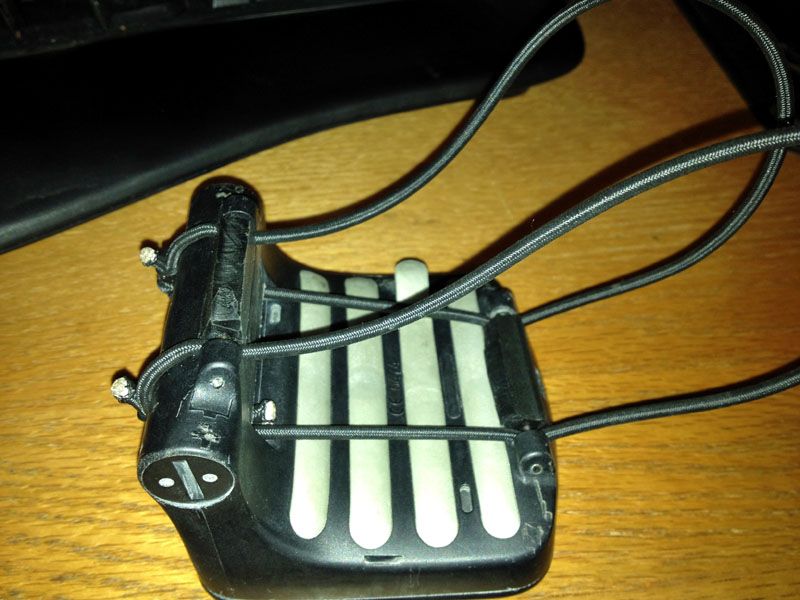
Strobes generate some sort of weak radio waves when firing, its normal to interfere with wireless air transmitter, if the frequency so happened to be close.
Anything that sparks high voltage to fire strobe will emit radio wave, even low voltage sparking will produce radio wave if you have the right tuner to home on the frequency.
Do a faraday cage thingy, it may help
http://en.wikipedia....ki/Faraday_cage
If DS51 seems to cut off wireless air transmission more often than other models, its shielding may not be as good as the other. Having small foot print and high power, its reasonable the EMI generated probably is higher from more advance power pack. Go to a radio shop and get his instruments to read the EMI of various strobes.
For those close to 200ish PSI and transmitter do not deliver air data, FYI, somewhere around 14 BAR the wireless transmitter will shut down because it consider that is the setting. Without this kind of setting, transmitter battery will be gone fast if someone set up a tank at night for next day diving, check pressure...say all good at 3000 psi and do not depressurize enough to zero PSI and goes to sleep. Also the wireless transmitter will be in sleep mode if there is an amount of 40 seconds where there is no pressure change ( no activity ), another battery saver mode for those scenario in a full service LOB , where the crews are so efficient, your new tank is rigged to your BCD as soon as u completed the dive and ready for use within the next 10 minutes.
NOTE:
- The Smart transmitter has a range
of approximately 1.5m/5ft.
- To maximize the life of the battery,
the transmitter turns itself off when
there is no pressure change for
more than 40 seconds. It also
turns itself off when the pressure is
14bar/200psi or less.
PAGE 15 of GALILEO SOL USER MANUAL
Don't u guys read the User Manual ???
Pairing a Galileo Sol for 1st time after battery change ( brand new is factory paired ) , the Computer must be very very close to the transmitter, touching it in fact. This is to make sure other diver's transmitter signal is not read by Galileo as demand for pairing because Galileo can handle up to 4 transmitter at the same time. So the computer only assume pairing is requested when the signal strength is strong ( hence computer and transmitter must be close, so very close ). Without this feature, if another diver uses a Galileo, his transmitter signal maybe received by ur Galileo and ur Galileo assumed the request for pairing........if this happens you wont be able to dive, but busy telling Galileo that u do not want ur girlfriend Galileo signal for pairing..he he he. There is no button on the transmitter to demand pairing mode, so signal strength of "X" amount is what Galileo reads as pairing demand.
The transmission is coded and also the transmission interval jumps out pf phase regularly, this prevent signal mix up ( coded ) or signal crash ( interval jump ) in event where plenty of other transmitters around your Galileo or 1 person using 4 transmitters option.
Dive safe.........
.




 I've had it for the last 20 months, no real problems and over 600 dives. On a dive a week or so ago the display went blank. After the dive I could not get the display back on. The battery was not the problem, though I removed and replaced, to see if that would reset it.