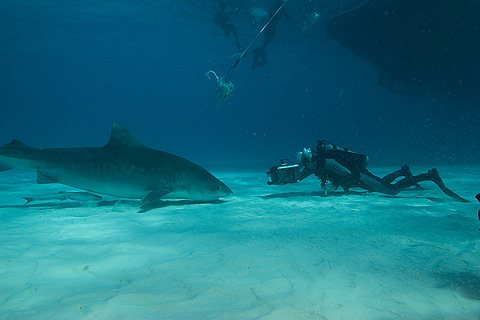
Really interesting discussion here... spent the last 1hr reading (and re-reading) some of the posts. I think the logical conclusion you come to is that many of us that practice u/w photography and build up some experience w/larger sharks end up w/a higher tolerance of close in shark behavior (than at least these spearos [won't make a generalization about all spearos]).
In getting to this point I can't help but think that when looking at a sport/activity that essentially breaks down to "kill/be killed" at the apex predator level (a mahi mahi isn't going to attack you as you try to spear it...) that this ends up being comparable to some of the recent research in gang violence.
Essentially in gang fights, the level of respect paid to opposing gang members who are armed (but w/something other than guns) is high (fear of the opponent is high), but once guns are introduced respect for the opponent decreases [fear decreases] (these are observed points from a recent LA gang task force study - the study data also showed that gang fights not involving guns had a much higher survival rate for all participants than those that involved guns... not surprising).
As underwater photographers we learn to respect sharks (and their behavior) both out of survival (ours) and for their natural beauty (however, I think we would all admit that the former is the primary reason, and the latter only comes as we get comfortable in their presence). Quick test: how many of us remember that feeling of fear/awe in seeing our first white tip reef shark? Compare that w/your knowledge now of such sharks... [at Cocos you start equating them to annoying "backscatter" if they slip into your hammer shots!.
When we dive we are essentially unarmed... would that respect for sharks change if we were armed (and could do physical harm to a shark if desired)?
Early scuba diving in the presence of both territorial and large (potentially aggressive) sharks did have divers carry powerheads as protection. The wary approach was based on both fear and a healthy respect of the unknown. Things changed as the level of experience of diving w/sharks increased...
As much as these guys argue they understand shark behavior, it seems like most of their (recent) experience has been w/sharks in situations where the shark was a competitor (for food, etc.), and they were armed. I'm now thinking their learning might be closer to what several folks on this forum have experienced (w/the same kind of sharks) if they entered the water unarmed and w/the goal of spending time in close proximity w/these animals.
BTW - this is not very different from the early Big Game safari hunting trips that as they morphed into photography trips the animals' behaviors became a little more understood (or at least somewhat more predictable given certain inputs, circumstances, etc.).
I will say that after being in the water w/2 Tiger sharks (in Tahiti) with a dead turtle carcass in the water the sharks were both more curious and more direct - but in this situation their curiosity was expressed in wanting to get close and bump us, not bite us (at least not initially - and neither of which we were going to allow).
Personally, although a Tiger shark is potentially bigger and a more voracious eater, it's the Oceanic Whitetip that I have a (possibly irrational) fear of. I understand that many u/w photographers spend time in the water w/these sharks in the Red Sea, but the one experience I've had (in the Maldives) was enough to have me look to get out of the water if approached by one of these animals (it followed us for the last 20 min. of a dive, then circled us through the ascent, and made 2 quick approaches through the group during the [shortened] safety stop - a couple of more minutes and several of us felt it was going to take a "test bite" out of something/someone)
- Matt