Skip to content

Photography Gear and Technique / Archived topic

Full Frame Upgrade for Hybrid Shooters - Sony A1 vs. Canon R5 C vs Nikon Z9 (AMA)

Started by dreifish ·

  • 68Posts
  • 68Replies

Read-only discussion

Full Frame Upgrade for Hybrid Shooters - Sony A1 vs. Canon R5 C vs Nikon Z9 (AMA)

68 posts
  1. 3 hours ago, hyp said:

    If you zoom in underwater your image quality goes down the drain, regardless of resolution. There is a reason people mostly use macro and wide angle lenses. Both allow you to get really close to stuff, so that you don't have to shoot through lots of water and also be able to use lights. Sometimes cool stuff is far away underwater, but no amount of money will make you able to film it at acceptable quality, because money doesn't beat physics. The long end of a 24-70 in a dome is the absolute farthest you should ever zoom in. Only in macro settings where you are already really close can cropping make sense, because you get more magnification and you are usually already really close, so it's not a problem shooting through extra water. I have a feeling though, that is not what you're after.

    If you see cool stuff that's far away underwater get closer or instead of recording with your camera, record with your memory. Image quality in there will be great!

    I actually love the 2.25 magnification that 1.5x crop plus 1.5x clear zoom gives because most of my cropping in post is for nudies that I find on the reef at the end of a wide angle dive. With this 2.25 magnification, my 28-60 standard zoom is now effectively 28--135 and macro becomes feasible without cropping in post.

    I usually don't need to zoom or crop in to stuff bigger than nudies because I get close enough to them. Or they get close enough to me.

  2. 12 hours ago, WK's Gone Diving said:

    I understand that the A7S3 is better than the A1 in low light. I don't question that. But I have seen the A1 perform in low light and it is good enough for me.

    Sony has a built in 1.5x APSC crop option. On the A1, this results in 21Mpixel resolution, which is above 4K standard. My understanding is that this 1.5x APSX crop option is not available on the A7S3 in 4K video mode as it results in resolution below 4K standard.

    I know that you don't crop. I cannot understand you stand but you are welcome to maintain it. Do you also object to zoom? I can engage 2x digital zoom on the A1, which should result in a 12Mpixel resolution that is above 4K standard. The A7S3 has minimal digital zoom ability that maintains 4K resolution.

    On balance, the A1 is my preferred camera. Your mileage may differ.


    Keep in mind that if your objective is to have less noise than with the GH5, then the A1 will provide roughly a 2 stop noise advantage -- that is, you'll get about 1/4th the noise you would get on the GH5. However, if you're shooting the A1 in APS-C crop, then you're using a smaller area of the sensor and magnifying that area more. That mean you're also magnifing the noise. So the noise performance of the A1 in APS-C crop will only be about 1 stop better than the GH5. Or another way to say it is you'll only get half the noise.

    If you further zoom in to a 2x crop, then effectively you'll have the same amount of noise on the A1 as you would on the GH5... that's just physics. There's no free lunch here.

  3. 6 hours ago, dreifish said:

    Keep in mind that if your objective is to have less noise than with the GH5, then the A1 will provide roughly a 2 stop noise advantage -- that is, you'll get about 1/4th the noise you would get on the GH5. However, if you're shooting the A1 in APS-C crop, then you're using a smaller area of the sensor and magnifying that area more. That mean you're also magnifing the noise. So the noise performance of the A1 in APS-C crop will only be about 1 stop better than the GH5. Or another way to say it is you'll only get half the noise.

    If you further zoom in to a 2x crop, then effectively you'll have the same amount of noise on the A1 as you would on the GH5... that's just physics. There's no free lunch here.

    Thanks for that explanation. The noise that comes with the zoom is fine with me. I'm so happy to have that zoom functionality!

  4. Keep in mind that if your objective is to have less noise than with the GH5, then the A1 will provide roughly a 2 stop noise advantage -- that is, you'll get about 1/4th the noise you would get on the GH5. However, if you're shooting the A1 in APS-C crop, then you're using a smaller area of the sensor and magnifying that area more. That mean you're also magnifing the noise. So the noise performance of the A1 in APS-C crop will only be about 1 stop better than the GH5. Or another way to say it is you'll only get half the noise.

    If you further zoom in to a 2x crop, then effectively you'll have the same amount of noise on the A1 as you would on the GH5... that's just physics. There's no free lunch here.

    That’s actually untrue. As the sensor gets smaller it is more efficient. Peak dynamic range follows crop factor but SNR doesn’t

    For example the GH5M2 has dxomark sport iso of 1152 the a7s3 2520 which is only 1.15 stops

    What sony does with their sony bionz is to apply noise reduction on the raw data this ends up in very clean footage with actually little latitude and dynamic range which looks pretty good straight out of the camera

    The A1 has actually a better snr performance in absolute terms however cropping will bring you back where you were

    Generally digital zoom and sensor crops have to be used when there is plenty of light not in low light

    I am shooting vlog at iso 3200 frankly I see excellent results which I wasn’t expecting

    The camera (GH5M2) retains colors in full significant step forward compared to the original GH5

    I would look at using that the housing is the same before going for dubious upgrades and it does 60fps at 200 mbps


    Sent from my iPhone using Tapatalk

  5. Here's my two cents to add to this thread.   I've recently bought a Z9, paired it with a Nauticam housing, 230mm dome port and 14-30, or macro port with 105s.   I took it on 37 dives in September and got to know it a bit, at least in stills mode.  Video overwhelms me, and I would have done more of it, but I spent most of the 37 dives getting to know the Z9 in stills mode.  I can at least confirm that Z9 video autofocus is capable, whereas with my previous camera (D850), it was not.

    Using the Z9 after years of D850 and D810 before that showed a few areas of obvious friction between the way things used to work and the way things work on the Z9.   Essentially a list of problems, issues and nitpicks, but for me they fell into two areas: viewfinder issues and autofocus issues.

    Subject detection simply didn't work underwater for 99% of the species I tried.   I have my Z9 set up with 3D Tracking on the AF-On button and three other AF modes assigned to Fn1, 2 and 3 buttons.   Only the 3D Tracking was worth using, though pinpoint might also work.

    Like I said, first priority was getting to know the Z9, and ultimately I reverted to emulating what worked on the D850.  This was with firmware 2.1, and already I've seen something in firmware 3.0 that solved one issue for me.  (I can assign ISO button to Fn4 now, meaning I no longer have to reach over with my left hand to push a lever on the right side of the housing while my right finger is turning the back dial to change ISO).

    I immediately had viewfinder issues when trying to shoot with strobes.  I also immediately had issues with switching between viewfinder and monitor.   I fixed the first issue by turning View Mode to Adjust for ease of viewing.   The second one remains a bit of a sore spot.  I just set the options to Viewfinder Only or Monitor Only and toggled the viewfinder button manually.

    As for autofocus issues, I found 3D Tracking on the Z9 to not be as good as on the D850, other than the ability to track all the way to the edge of the frame.  (Leads to better compositions and less cropping).   What I had problems with was shooting very close, very small subjects.  Specifically Wire Shrimp on Wire Coral with the 105s.   The Z9 often just tried to focus on the background.  I found it would focus a lot better if I had a good focus light on the target, but it definitely took more effort to achieve than the D850 did.  I'm hoping firmware 3.0 fixed that problem.

    I discovered a small issue with White Balance near 50 foot depth, where everyone says the Nikon stops white balancing (using Presets).  I can confirm that in video mode I started getting the 'unable to set white balance' message around 50 feet - but I mistakenly tried setting it in Photo mode and I was able to set the WB.  (I had switched to stills, then thought I switched back to video when I did the preset WB.)

    So there is something different about setting WB between video and stills mode, at least with firmware 2.1.  Someone, I think on DPReview when I posted about this there, did a quick test of some sort and said that hue was not adjusted in video mode, but it was in photo mode.   I don't know that this would make a big difference in depth capability, but it's something to try if one is shooting video around 50 feet with a Z9.  (I wonder if something like this happens with other Z cameras?)

    Once I got used to the AF system, it was about as much of a joy (in photo mode) as the D850.  I never did try some sort of auto area setting for skittish fish shooting.  Most of the time I tried a subject detection option, the subject I wanted was not selected, but the background often was.   The viewfinder eventually didn't bother me in that it was a lot like an optical viewfinder, but switching between viewfinder and monitor was tedious.  I wish I could set the camera to just show playback/image review on the monitor and everything else in the viewfinder.  I still haven't come on a situation where I think an EVF is an advantage over the OVF.  As best it seems inconvenient, though for doing things like image review, it's very good.  I just prefer image review on the monitor.  As noted, I had to change the default viewfinder setting (Show effects...) because it was blacked out when shooting flash at ISO 64.  Maybe the new firmware helps there.

    On the other hand, it was sometimes pretty convenient to compose and shoot using the monitor instead of the viewfinder.  Gave me more flexibility in where I could position the camera for a shot.  Like LiveView, but WITH autofocus.

    I shot macro at ISO 64, which I've done for the past 7 years with the D810/D850.   I shot a lot of ambient or mixed lighting with wide angle and used ISOs between 400 and 2000.   I thought a lot about trying to set ISO fixed at 500 and boost exposure in post, but I didn't try that.

    I was pleased to find that the higher ISO files from the Z9 seemed to have better white balance that those of the D850 below 15 feet or so.  (Above that the same).  All in all, I was pleasantly pleased that the Z9's files seemed at least as good as those of the D850's.

    Lenses - I'm not particularly thrilled with the 14-30, but it is definitely sharper than the 16-35.  But I wish I had those extra 5mm to zoom in that much more.   The 105 macro - it's a spectacular lens - is at least as good underwater as the 105vr f-mount.  A bit sharper, but otherwise feels pretty much the same.  Focus speed same. 

    VR on the Z9 seems effective on the 14-30, a lens which has no VR.  For stills mode I generally shoot at 1/160th, so that covers up some sins.   I didn't have any VR issues with the 105, but then I didn't with the 105vr either. And again, 1/160th.

    I also bought the 82mm Sea and Sea Internal Correction Lens, and it seems to improve the corners nicely.  I had the same on my 16-35, and I was sad the filter diameter changed from 77mm.  The new IRC cost over $700.

    I managed to damage my Z9 by improperly fitting into my Nauticam housing on a dive.  There is a spring-loaded plate that presses down on the button used to spin the shutter speed dial (upper left).  The plate is at an angle so the button slides under it.  Somehow I got the camera button to push against the side of that plate, and it basically mashed up the button so that it is now sort of half a button.   And during that dive, the camera was unusable because it was slightly canted and pressing two back buttons (Fn4 and Delete) down for the whole dive.  I got into menu mode (Fn4 assigned to My Menu) and couldn't exit it, so on that dive I couldn't take any images.

    I was prepared for the housing to be taller than my D8xx housings, but I did not expect it to be significantly thicker as well.   It is definitely bigger, and I think it is to have linkages to move buttons from one side of the housing to the other.  For instance, Fn1 and Fn2 are accessed by a convenient rocker lever - on the left side.

     

  6. On 10/26/2022 at 12:00 AM, Interceptor121 said:

    The camera (GH5M2) retains colors in full significant step forward compared to the original GH5

    I would look at using that the housing is the same before going for dubious upgrades and it does 60fps at 200 mbps

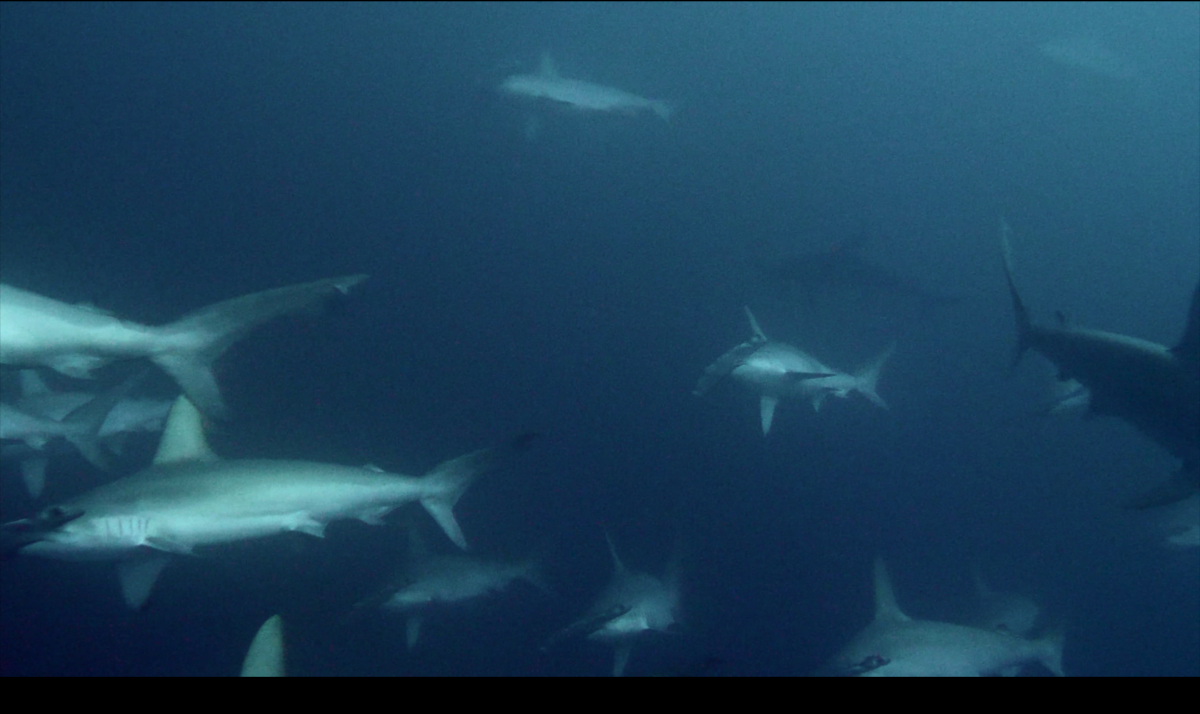
    It does not matter if you have the GH5, GH5M2, or GH6. They all have a MFT sensor, which is one quarter the size of a full frame sensor. in other words, a full frame sensor gathers four times as much light as a MFT sensor. The attached png  image is taken from a video I made during my last dive trip to Banda. The png is UNCROPPED as is the clip in the video. I was in the middle of a school of hammerheads and the video was shot in ambient light. The png shows most of the hammerheads swimming to my left but it also shows one swimming to my right. I was stationary in the middle of a school of hammerheads. Look at the upper right quadrant of the png and you will see shadows of hammerheads that were no further than 10 to 20 meters from me. The MFT sensor is simply too small to gather enough light to show more details of those shadowy hammerheads. My understanding is that because a full frame sensor is 4 times larger than a MFT sensor, it will gather 4 times more light than a MFT sensor. A full frame sensor will always perform better in low light than a MFT sensor. That is the primary reason for upgrading from the GH5 to the A1.


    banda screenshot.png

  7. It does not matter if you have the GH5, GH5M2, or GH6. They all have a MFT sensor, which is one quarter the size of a full frame sensor. in other words, a full frame sensor gathers four times as much light as a MFT sensor. The attached png  image is taken from a video I made during my last dive trip to Banda. The png is UNCROPPED as is the clip in the video. I was in the middle of a school of hammerheads and the video was shot in ambient light. The png shows most of the hammerheads swimming to my left but it also shows one swimming to my right. I was stationary in the middle of a school of hammerheads. Look at the upper right quadrant of the png and you will see shadows of hammerheads that were no further than 10 to 20 meters from me. The MFT sensor is simply too small to gather enough light to show more details of those shadowy hammerheads. My understanding is that because a full frame sensor is 4 times larger than a MFT sensor, it will gather 4 times more light than a MFT sensor. A full frame sensor will always perform better in low light than a MFT sensor. That is the primary reason for upgrading from the GH5 to the A1.


    433743050_bandascreenshot.thumb.png.628360874cb0765952ff8e4cfcc8c568.png

    It will all go to the bin if you shoot 100 mbps 420 and refuse to spend time in post processing


    It is like buying a pro camera to shoot jpegs


    If you look at Jim decker white balance tests they are made in 100ft visibility bright day sure any camera will be able to push other 10 meters with white balance

    Try the same on overcast day 50ft visibility and see what you get

    You wont get out of it with zero effort and low bitrate codec

    If you go full frame you need to go all the way max bitrate higher spec codec good optics Lights and adequate post processing you can only get super clean results in ideal conditions

    However hammerhead sharks etc unless baited are not in bright tropical reefs with 100ft visibility


    Sent from my iPhone using Tapatalk

  8. Just reading the first post of this thread there are a few errors

    The A1 has pixel binning in 4K not line skipping as result when you move from full frame to 4K there is a benefit on dynamic range

    Line skipping would not achieve that 

    The Sony has another significant benefit as the 4K60 is done by binning on sensor it can produce 4K RAW at 4300 pixel wide something the other cameras can't do

    You also used the Sony highly compressed long gop files instead of the all intra 300-600 mbps which would allow much more headroom in post

    Finally a V60 card can record maximum 480 mbps so it is normal that anything above requires a V90 card

    actually all those camera are much cheaper compared to my GH6 that records 1.9 GBPS on card 1900 mbps

    Edited by Interceptor121

Account

Navigation

Search

Search

Configure browser push notifications

Chrome (Android)
  1. Tap the lock icon next to the address bar.
  2. Tap Permissions → Notifications.
  3. Adjust your preference.
Chrome (Desktop)
  1. Click the padlock icon in the address bar.
  2. Select Site settings.
  3. Find Notifications and adjust your preference.