Skip to content

Shooting Technique, Workflow and Editing / Archived topic

Perspective on HDR

Started by loftus ·

  • 128Posts
  • 128Replies

Read-only discussion

Perspective on HDR

128 posts
  1. Ok,

    Here's the link: http://www.simplephotography.net/zmisc/HDR.pdf to an tutorial about how to make great hdr's from a single raw file. You will be surprised...

    I did NOT wrote it, but a man who does really great things with hdr pictures. I think he doesn't mind i mention the link, because it's 'findable' on the web.

  2. Ok,

    Here's the link: http://www.simplephotography.net/zmisc/HDR.pdf to an tutorial about how to make great hdr's from a single raw file. You will be surprised...

    I did NOT wrote it, but a man who does really great things with hdr pictures. I think he doesn't mind i mention the link, because it's 'findable' on the web.

    I don't think the question is whether the image can be manipulated in a HDR processor to get a pseudo-hdr image or not, the question is whether this is ideal or not. And the facts remain as Craig describes, so the quality of images produced is not as good, nor do you have the flexibility you would have with HDR produced with multiple images. The image shown in his tutorial is not an example of a great HDR image in my opinion. As I said earlier, there are other problems with HDR such as noise management, and failing to capture an initial image with a lot of information in the shadows, can only make this problem worse using a single image. I suggest you try some HDR using both techniques, single image pseudo-HDR and multiple image HDR and compare results. Each to his own of course, but my goal with HDR is not to create an effect, but rather to try to create the most realistic impression I can of being there.

  3. I don't think the question is whether the image can be manipulated in a HDR processor to get a pseudo-hdr image or not, the question is whether this is ideal or not. And the facts remain as Craig describes, so the quality of images produced is not as good, nor do you have the flexibility you would have with HDR produced with multiple images. The image shown in his tutorial is not an example of a great HDR image in my opinion. As I said earlier, there are other problems with HDR such as noise management, and failing to capture an initial image with a lot of information in the shadows, can only make this problem worse using a single image. I suggest you try some HDR using both techniques, single image pseudo-HDR and multiple image HDR and compare results. Each to his own of course, but my goal with HDR is not to create an effect, but rather to try to create the most realistic impression I can of being there.


    Of course i agree. It is 100 % right when you use a few photos, there's more information, that's obvious.

    I just wanted to post it's possible to create hdr effects this way. Like when there are moving objects, etc...

    i'm not arguing, that's for sure...


    keep shooting!

    (pics i mean :-) )

    Edited by jejochen
  4. My impression of the article:

    • he referenced the original ETTR article but mentioned nothing about the work necessary to make sure that the camera histogram is actually accurate. For a process so dependent on exposure that's a disappointing omission. It indicates to me that he has a lot to learn.
    • he mentions nothing about getting a neutral conversion out of Lightroom. ACR, by default, does not produce conversions that are optimized for HDR. Another indication that he has plenty yet to learn.
    • He mentions that the resulting "HDR" image has dynamic range well in excess of the monitor's capability. What he fails to realize is that the raw file does too. It isn't that he's created something new, it's that his tool isn't automatically solving his problem.
    • The final image he presents is not compelling. It's an ugly result and one that appears, from a small JPEG perspective, to be doable with just basic controls and an understanding of curves.

    I would say that the article is more an introduction to the tool and how you can learn to use it without taking multiple exposures. It is fine for that but it does not make a case for single shot HDR.


    Regardless of your definition of dynamic range and how much you think today's cameras offer, some scenes will always fit within those limits while others never will. HDR is about how to capture the most detail in those challenging scenes, it is not about how to create the characteristic look that results from the merging process and tone mapping to restrictive output devices. Personally, I would never want my images to have that characteristic look except the extent it is unavoidable. Merging images into an HDR only makes sense to me if there are multiple exposures giving me more usable detail. That said, if someone wants their image to look like a painting then any technique they use to achieve it is perfectly fine.


    Don't take this as a knock if HDR. I've seen some great images and I think the technique is very interesting. I wonder how to apply it successfully underwater. The first thing that comes to mind is strobes. HDR scenes generally aren't strobed. Most everything underwater is.

  5. I've seen some great images and I think the technique is very interesting. I wonder how to apply it successfully underwater. The first thing that comes to mind is strobes. HDR scenes generally aren't strobed. Most everything underwater is.

    I think a place to start underwater will be fairly sedate reef scenes in shallow water with a Magic Filter, that's my plan of action in a few weeks in Sipadan. Never having been there though, I'm not sure I'll find what I'm looking for.

  6. You will find muck and drift diving there, probably not the best location for multiple exposure shooting. The entrance to turtle cave might be interesting :)

  7. I have been setting my Nikon on continious slow with my YS250's at 1/4 power. They seem to recycle fast enough to keep up. But I do think a magic filter may be the best all-round answer as any particulate matter in the water which is lit up by the strobes is hugely intensified from the merge.

  8. You will find muck and drift diving there, probably not the best location for multiple exposure shooting. The entrance to turtle cave might be interesting :)

    What about the shore diving / house reef of Sipadan Water village?

  9. The house reef at SWV can be a great dive (good to have a DM) but is basically muck. Heading out to the left there will be a small patchy reef and to the right is a large sand patch. There are dock areas that you could shoot sunballs through. If your goal is experimenting I think you can find something that works. Sipidan Island diving generally involves currents and I'm not sure you'd want to commit to an ambient light setup for the whole dive. If you had the right strobe filters you could use the magic filters and still have strobe. I have no idea what that might be though.

  10. First up I'd say that Sipadan (particularly second dive of the day) on sites all along the side between white-tip avenue and turtle patch are excellent for filter photography. In fact Sipadan is definitely one of those destinations that really suits shooting with filters, particularly for reefscapes, turtles and bumphead parrots:


    SB02.jpg


    SB04.jpg


    SIP23.jpg


    I make this point because filtering strobes to work with the Magic filter won't work. It is not simply a case of have a strobe filter that is opposite to the camera's filter. What you need it a strobe filter that exactly matches the spectrum of the strobe light to the ambient spectrum - which of course changes dramatically as you go deeper. Unless you are going to shoot at exactly a known depth this is not going be a practical solution. You just can't keep changing strobe filters every 3ft you descend.


    There is more info here.


    So I'd suggest shooting strobes on the first dive (Barracuda Point) and then going over to filters for dive 2 - and requesting Turtle Patch or Mid Reef (don't forget you strobe synch blanking plugs so you can leave them on the boat). Spend the first half of your dive on the wall then come up into the coral gardens on top of the reef for the second half. Hopefully Malaysia will have changed their ridiculous restriction that all divers must be back on the surface after 45 minutes. I find it totally unreasonable considering the amount people pay to go there. Surprisingly, the diving media never make a fuss about it. But then some would say it is not that surprising considering how many full page Malaysia diving adverts there are in the magazines.


    Alex

  11. So I'd suggest shooting strobes on the first dive (Barracuda Point) and then going over to filters for dive 2 - and requesting Turtle Patch or Mid Reef (don't forget you strobe synch blanking plugs so you can leave them on the boat). Spend the first half of your dive on the wall then come up into the coral gardens on top of the reef for the second half. Hopefully Malaysia will have changed their ridiculous restriction that all divers must be back on the surface after 45 minutes. I find it totally unreasonable considering the amount people pay to go there. Surprisingly, the diving media never make a fuss about it. But then some would say it is not that surprising considering how many full page Malaysia diving adverts there are in the magazines.


    Alex

    Thanks for the info Alex; especially the reminder about the plugs. I've come pretty close to jumping in the water without them once. :blink:

  12. In my experiences with SWV, multiple dive trips to Sipadan itself are rare. You aren't going to be given an option to dive as Alex suggests unless you are a photo pro with your own boat. If you are drift diving Barracuda Point, you probably aren't going to want to be set up for ambient, HDR photography. I've been to SWV 7 times and, frankly, I've rarely gotten the opportunity to dive places that Alex suggests and I've never been afforded the luxury of dictating how the other 7 divers sharing my boat will dive. If I got to dive Sipadan Island all day I might be more will to forego strobes, too.


    I also don't agree with the rational for why magic filters aren't suitable for use with strobes. We never adjust filtration on strobes based on depth just as we don't adjust strobe light in general based on depth. When we use strobes, we accept that we can't control the balance of light in a mixed light situation and it makes no sense to suggest that now we must just because of a particular filter. Doing so suggests that complimentary filters can never be made to work.


    Accept, though, that you white balance to ambient without strobes and white balance to strobe with mixed. The results will be different but you can go on a dive prepared to do both.


    Strobe filters selected to match a lens filter can be fixed since the lens filter is fixed. Also, you don't have to provide an exact match to the lens filter. Warming/cooling effects aren't critical, color balance is.


  13. Most of the operators offer 2 dive/tank trips to Sipadan in the morning. Then PM dives at Kapalai and Mabul. I am talking about the second dive of a two tank trip.


    Doing so suggests that complimentary filters can never be made to work.

    Accept, though, that you white balance to ambient without strobes and white balance to strobe with mixed. The results will be different but you can go on a dive prepared to do both.


    Complimentary filters will always work as long as you shoot at a "standard" close-to-daylight white balance. However, at such settings, the colours in the background of your image are at the mercy of the filter. This is where Green/Mag works as cyan water colours look nice if you add extra Magenta (from the camera's filter).


    However a Magic filter will not have such a pleasing effect on the background. It will make your water yucky green (which it can often be at Sipadan anyway!).


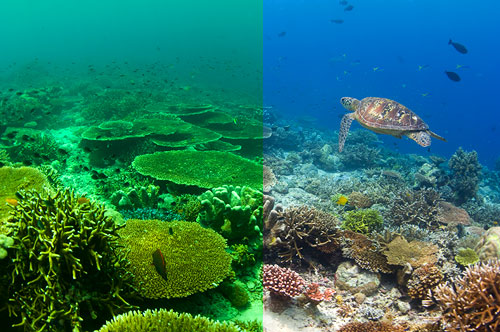
    Here is one of the shots from above - half processed at the custom WB above and half at "daylight WB" (5500K) in Lightroom. You can ignore the foreground colours as with a "Magic complimentary filter" these would be correct, but the background is what your water colour shots would look like - horrible.


    post-713-1223653681.jpg


    Alex

  14. Thinking about this further - instead of working - I guess you could make a complimentary strobe filter for the Magic filter + a white balance that would give nice blues. I'd have to think about that.


    Alex

  15. Thinking about this further - instead of working - I guess you could make a complimentary strobe filter for the Magic filter + a white balance that would give nice blues. I'd have to think about that.


    Alex

    What about starting with a Wratten 38A as you suggest on your site.

    As for which sites we'll dive etc I have no idea; hopefully there will be some flexibility as I will be with Mauricio Handler on a photog week.

  16. The Wratten 38A is basically the closest filter to simulating the passage of light through water. This strong blue filter is about the same as the filtering effect of 10m of seawater.


    Its also very hard to find in stock at a size to use as a strobe filter.


    Alex


    Ah, its pub o'clock - you can find me from now on in the Platform Tavern - where I will be happy to continue the discussion!

    Edited by Alex_Mustard
  17. I've never had a sample of a magic filter but I'm certain you could. The key is to realize that the result of strobe+magic filter will not be the same as magic filter alone since white balance is set to a different light source. It is easily confusing!


    The natural tendency is to think of a strobe filter that is the inverse of the magic filter so that white balance for the strobe will match. It's a great idea except that it's difficult or impossible. You have to separate the warming effects from the other effects and concentrate on what the result to blue water appearance will be, as you said Alex. I often now shoot wide angle with mismatched strobe and lens filters.


    The thing to understand, and has been said here before, is that the lens filter assists the camera in recording the scene whereas the strobe filter alters the color balance between ambient and strobe. You could shoot magic filter with an unfiltered strobe and fix the image with white balance correction in post. That will work (suboptimally) but I would rather add some strobe filtration to change the water appearance. The goal, in my eyes, would not be to enable strobes without altering the appearance of the magic filter shot, but rather to provide the option of shooting ambient or strobe and getting useful but different results. :blink:


    Jeff, it's good news to hear you are doing the trip with Mauricio since that suggests that the dives will be oriented more toward serious photography. I don't disagree with Alex at all about the suitability of certain diving to ambient photography, it's just that the best dives for that are the longest boat rides away from SWV. In my trips, the emphasis was always on the closer muck diving and I would not have wanted to sacrifice the few WA opportunities I got on experimentation. Sounds like you will not have those restrictions.

  18. I've been thinking of what jejochen said about single image HDR and I think to be fair, the term is an unfortunate term that has been thrown about, when in fact probably a more accurate term to use would be simply Tonemapping a single image. In effect one is simply performing the second step of the normal multi image HDR process on a single image to create a similar appearance. Effectively one is applying a curve adjustment process using the HDR software algorithm.

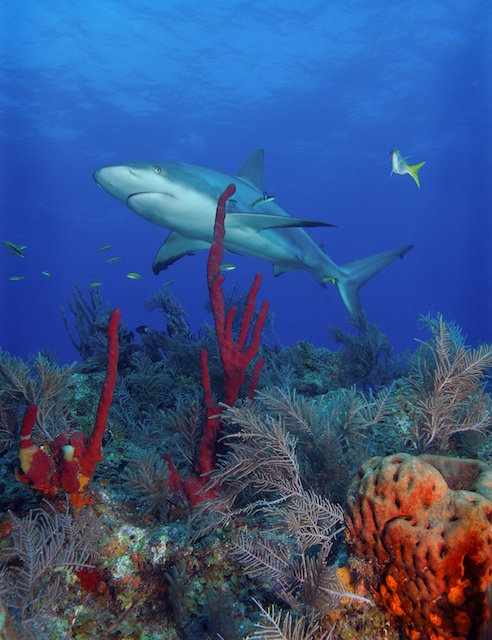
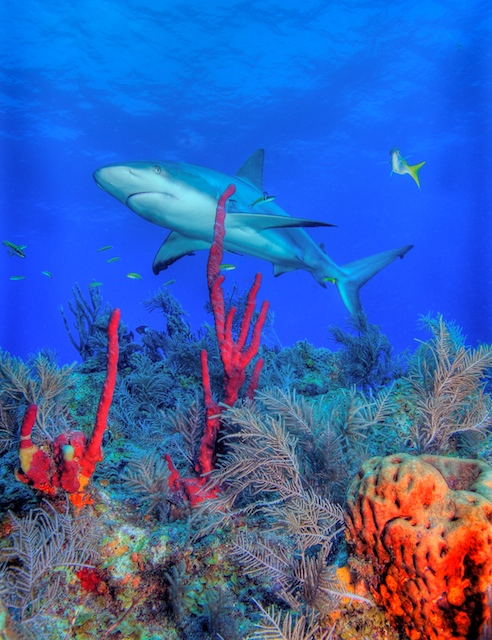
    Here are two examples of a single image underwater 'HDR' or Tonemapping. If you compare the histograms you can see the shift that the software, in this case Photomatrix, has applied. Originals on the left.

    post-5478-1223987413.jpg

    post-5478-1223987426.jpg

    post-5478-1223987999.jpg

    post-5478-1223988098.jpg

    Edited by loftus
  19. Since we have no way presently of viewing true HDR images, at this point there may be no reason (within limits) why single image tonemapping couldn't give the illusion of the compressed dynamic range done in tonemapping of multi exposures. However, i don't believe it can deliver the punch of a well shot series.

  20. Since we have no way presently of viewing true HDR images, at this point there may be no reason (within limits) why single image tonemapping couldn't give the illusion of the compressed dynamic range done in tonemapping of multi exposures. However, i don't believe it can deliver the punch of a well shot series.

    Yes, I agree; I think it's unfortunate though that it's not just called Tonemapping an image rather than single image HDR. I guess there is that HDR screen made by those guys in Canada. I think Drew mentioned this once before.

    http://www.bit-tech.net/hardware/2005/10/0...tside_hdr_edr/1

    I think the closest thing visually I have seen to HDR is large transparencies on a lightbox.

    Edited by loftus
Kraken Sports

Account

Navigation

Search

Search

Configure browser push notifications

Chrome (Android)
  1. Tap the lock icon next to the address bar.
  2. Tap Permissions → Notifications.
  3. Adjust your preference.
Chrome (Desktop)
  1. Click the padlock icon in the address bar.
  2. Select Site settings.
  3. Find Notifications and adjust your preference.