



Nice pic. I think this is an example where HDR works well and enhances the image particularly around the highlights, sunrays etc. Underwater this is particularly desirable, but unfortunately so far my attempts have been marginal due to the artifact issues with movement. I have a couple I did last week that I will post at some point.
- 128Posts
- 128Replies
Read-only discussion
Perspective on HDR
128 posts
-
-
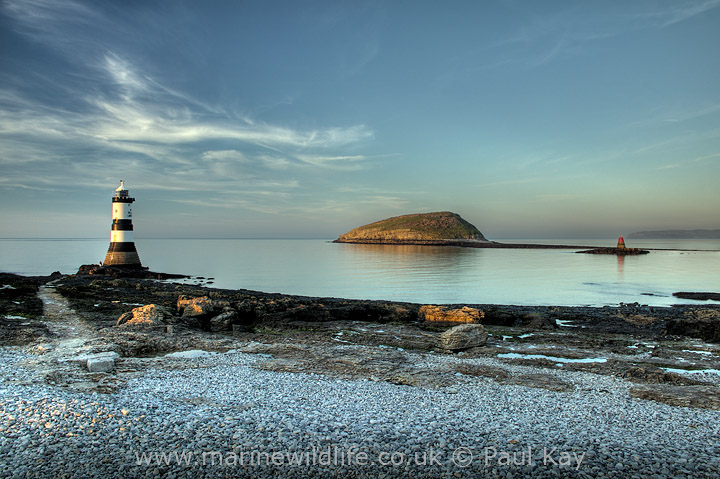
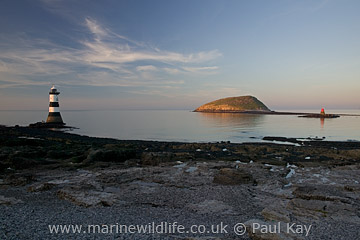
HDR is sometimes a very effective technique but is all too easy to overdo and IMHO tends to produce noise in tone mapped shadows which all too often look tonally flat aswell. To enhance many images HDR should not be noticeably used (IMHO) and the result should still look natural (or conventional if you prefer). Here's a shot which to my way of thinking works well and which, whilst enhanced by being shot as three exposures, converted to 32bit and tone-mapped, still looks quite natural. I've added a similar 'correct' exposure image for comparison (not the middle shot but part of a panorama). The HDR image shows more tonal detail in both sky and pebble shadow area but has little noise in the lifted shadows due to the detail it contains. Its a technique that I'd like to try underwater but movement remains a problem.
-
Nice pic. I think this is an example where HDR works well and enhances the image particularly around the highlights, sunrays etc. Underwater this is particularly desirable, but unfortunately so far my attempts have been marginal due to the artifact issues with movement. I have a couple I did last week that I will post at some point.
Do you mean artifacts like this?
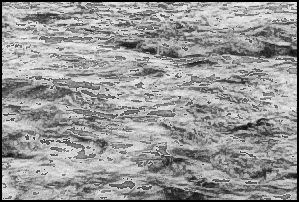
If so, I have been having some luck reprocessing such images and getting an artifact-free result. I would be happy to try and see what I could get out of the RAW .NEFs.
I haven't uploaded the "fixed" version of this image yet, but this is the full frame:

-
HDR is sometimes a very effective technique but is all too easy to overdo and IMHO tends to produce noise in tone mapped shadows which all too often look tonally flat aswell. To enhance many images HDR should not be noticeably used (IMHO) and the result should still look natural (or conventional if you prefer). Here's a shot which to my way of thinking works well and which, whilst enhanced by being shot as three exposures, converted to 32bit and tone-mapped, still looks quite natural. I've added a similar 'correct' exposure image for comparison (not the middle shot but part of a panorama). The HDR image shows more tonal detail in both sky and pebble shadow area but has little noise in the lifted shadows due to the detail it contains. Its a technique that I'd like to try underwater but movement remains a problem.
Beautiful image. I think HDR is like any technique that can be overdone (even sharpening can be overdone) and the trick is to make it look real while still enhancing the image. Until HDR monitors become standard, HDR techniques using HDR software will always be an exercise in compromise. As I mentioned earlier, maybe another thread, a useful technique is blending HDR with non-HDR layers if the HDR looks overdone.
-
Do you mean artifacts like this?
]
If so, I have been having some luck reprocessing such images and getting an artifact-free result. I would be happy to try and see what I could get out of the RAW .NEFs.
I haven't uploaded the "fixed" version of this image yet, but this is the full frame:
Are you improving these artifacts by blending in non-HDR layers or or you making different Photomatrix choices to reduce artifact?
I am struggling more with the underwater artifacts where the shimmering movement of sunrays etc generate artifact. It's a tricky problem, because this is one of the areas where I think HDR can most benefit underwater images. I am finding that converting to B&W is more forgiving as some of the color artifact becomes less noticeable in monochrome. I'll post some examples later. Have to work now?

-
Are you improving these artifacts by blending in non-HDR layers or or you making different Photomatrix choices to reduce artifact?
Mainly by making adjustments when converting from RAW to TIFFs before sending to photomatix - e.g. highlight recovery on the overexposed frame ... that kind of thing.
-
I am struggling more with the underwater artifacts where the shimmering movement of sunrays etc generate artifact. It's a tricky problem, because this is one of the areas where I think HDR can most benefit underwater images.
In my experience artifacts appear to occur when there is insufficient or spurious data for the software to successfully utilise - so detail in extreme highlights looks like being the problem area, as ever. Add in motion and the results are somewhat unpredictable. I tend to use longer exposures for HDR if possible as this helps smooth out hard, movement detail but even so I find that there can be problems. If you look at the shot I posted, the water has that smoothness associated with a slow shutter speed and this is somewhat enhanced by the effect of HDR.
-
I think one can get away with movement artifact of the water surface in topside HDR to a large extent as we are attuned to seeing some blurriness or movement in the water surface. The problem I am referring to in underwater HDR is the artifact generated due to the inability of the software to register all parts of the image due to unavoidable shifts in the image such as glimmering sunlight on the surface and sun ray movement.
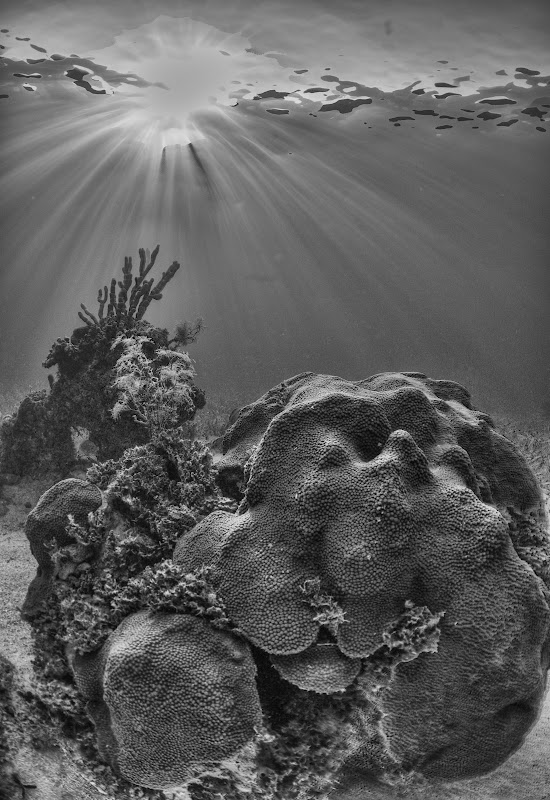
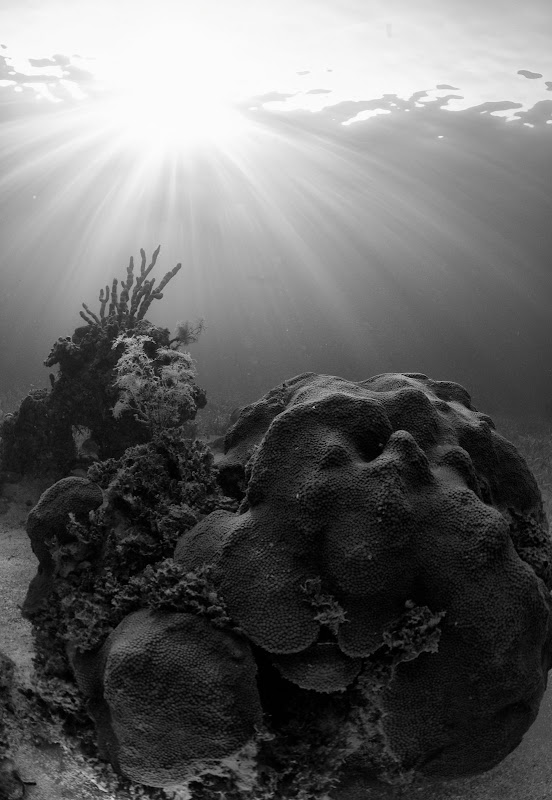
Here is an example taken last week. 3 image, 2 stop separation HDR converted to B&W. The surface and ray artifacts are clear to see. The coral head parts of the image and the non-artifact highlight areas I think nicely demonstrate the potential for HDR to enhance the tonal range of the image.
Second image is the single normal (middle) exposure image with identical B&W conversion settings for comparison.
-
I think you got a real good one here. I like it a lot.
What anti-ghosting setting are you using in Photomatix?
-
I think you got a real good one here. I like it a lot.
What anti-ghosting setting are you using in Photomatix?
Thanks, but like most of these so far, close but no cigar.
I've tried different settings; the best result was with artifacts setting to 'Moving objects / people Detection: Normal.
Using 'Background Movement' creates more problems in the coral.
-
Thanks, but like most of these so far, close but no cigar.
I've tried different settings; the best result was with artifacts setting to 'Moving objects / people Detection: Normal.
Using 'Background Movement' creates more problems in the coral.
Did you try with it off?
I also think you could boost the highlight smoothing slider to get a better/brighter center on the sun.
-
Thanks, but like most of these so far, close but no cigar.
I've tried different settings; the best result was with artifacts setting to 'Moving objects / people Detection: Normal.
Using 'Background Movement' creates more problems in the coral.
It is looking pretty good - the coral shows things well in the HDR image as compared to the standard exposure.
FWIW, I found myself for above water pushing ISO, opening f/stop and increasing shutter speed for the things I have been trying since it is handheld. Have you tried shooting at real high shutter speeds to see if it brings the issue down? Looking at the noise (or lack of noise) on the D700 shots, may be worth a shot the next time. Of course is not going to be perfect due to the reason you mentioned, but it may help.
-
Loftus
If you want an honest crit on the HDR shot then I would say that the contrast in the background (clear water) looks flat compared with the foreground. Its this balance which is often the problem with HDR and I find it difficult to produce a happy combination above water. The artifacts aren't too intrusive on screen but may well be in print - I'd say that some could be cleared in Photoshop - but is the balance that I find somewhat disconcerting. If I were shooting such images (which believe me I cannot do here in Wales at the moment!), I'd try bracketing the shot with more underexposures to see if the highlight detail will respond better to more detailed information... just a thought.
-
Loftus
If you want an honest crit on the HDR shot then I would say that the contrast in the background (clear water) looks flat compared with the foreground. Its this balance which is often the problem with HDR and I find it difficult to produce a happy combination above water. The artifacts aren't too intrusive on screen but may well be in print - I'd say that some could be cleared in Photoshop - but is the balance that I find somewhat disconcerting. If I were shooting such images (which believe me I cannot do here in Wales at the moment!), I'd try bracketing the shot with more underexposures to see if the highlight detail will respond better to more detailed information... just a thought.
Yeah I agree. I honestly spent no time on this image. I actually do have more exposures I could use, but then these would be further out on the time spectrum and would probably show even more movement artifact. Simply went through the motions with regard to combining the images etc and once I saw (which I have for many of these images underwater) that I had significant artifact, I have not really bothered to take it much further. Topside HDR takes a lot of work to get it right and make it credible, underwater even more so, if at all. But I'll keep trying, fortunately I'm not paying for film. I also have ideas for doing pseudo-HDR (one image) in the areas with movement, and then regular HDR on the non moving areas, and then combing the layers. I have so much stuff still to work through from my trip last week that it will take a while to get to it.
One other question to you guys - what do you think of the winning OWU image - do you think some type of HDR or pseudo HDR technique was used? Looks like it to me.
-
The last example, what benefits is HDR bringing you ?
You have a subject close up and then then an exposed sunball. Regular photography underwater has been dealing with this for years by exposing the sunball in camera and then using a flash to light the fore subject. There is nothing in between you are bringing out.
Even if there was subject matter in between to bring out, the details would be lost by the way that light travels through water. Changing exposures won't add colour back into it, and i am not even sure it will add more detail in.
An example of where it may be suited maybe a looking down at a 45 deg angle, a kelp Forest, something with a range to be brought out. But a typical underwater photo shooting up and into the sun with one single subject in the foreground is a pointless experiment for HDR imo.
-
The last example, what benefits is HDR bringing you ?
You have a subject close up and then then an exposed sunball. Regular photography underwater has been dealing with this for years by exposing the sunball in camera and then using a flash to light the fore subject. There is nothing in between you are bringing out.
Even if there was subject matter in between to bring out, the details would be lost by the way that light travels through water. Changing exposures won't add colour back into it, and i am not even sure it will add more detail in.
An example of where it may be suited maybe a looking down at a 45 deg angle, a kelp Forest, something with a range to be brought out. But a typical underwater photo shooting up and into the sun with one single subject in the foreground is a pointless experiment for HDR imo.
Giles, you clearly have a disagreement with the concept of HDR underwater, and that's fine. I disagree, despite the technical limitations we have to deal with underwater, and think you miss the point. In my first post on this thread, I quoted what I thought was an eloquent explanation of the concept. My goal with HDR in simple form, is to try to reproduce as realistically as possible the 20:1 tonal range that our eyes are able to perceive (underwater as well) with a camera and screen or print that reproduce significantly less than that. (12:1 is optimistic). You are correct that we have used strobe to compensate for tonal / color disparities up till now, but one can hardly claim that this resembles the way our eyes perceive it underwater. Using flash both above and underwater, creates an image that is different to available light only. As you know flash is only useful at the exact distance for that exposure and flash setting. Anything in front of this plane is overexposed, anything behind is under. This is certainly not the way our eyes see landscapes underwater. What about structures that are beyond the illumination distance of our strobe for example, that we simply settle for being underexposed in the background.
In the image I posted the tonal range and shadow detail within the coral in the foreground across the width of the coral as well as the coral in the background to a lesser degree, cannot be reproduced with a single exposure with or without strobe without totally blowing out the sunball.
This may be a pointless experiment for you, and you may not get it, but the few of us who are participating in this thread are quite happily experimenting and we post here for fun and discussion. The argument here is similar to the old film vs digital argument, and we know who won that. I happen to agree with the original article quoted in this thread, that when the technology catches up, HDR will be the standard. This is already the case to a large degree in the movie industry where HDR started.
I have never claimed that any of my 'experiments' underwater so far have been completely successful, but I think they clearly demonstrate some interesting possibilities. When I have an image that I think succeeds, I will post it in the Image Gallery, till then I will post in this Image Processing area for discussion.
-
Giles, you clearly have a disagreement with the concept of HDR underwater, and that's fine.
I don't disagree with trying a concept, especially not HDR, i have seen a few people use it remarkably well on land, and a LOT of people use it very badly. What I am expressing is the type of photo it is being used on in most of these example here which some happen to be UW are not good example of when an HDR image will benefit.
In the image I posted the tonal range and shadow detail within the coral in the foreground across the width of the coral as well as the coral in the background to a lesser degree, cannot be reproduced with a single exposure with or without strobe without totally blowing out the sunball... if you use a strobe you create the shadow detail, it is just a case of how you recreate natural lighting on the coral, people have been doing it for years.
I happen to agree with the original article quoted in this thread, that when the technology catches up, HDR will be the standard. This is already the case to a large degree in the movie industry where HDR started.Not true, Gustave Le Gray was merging negatives in the 1850's half a century before the film industry. Later on HDR as we know it today was done by Charles Wyckoff quite famously in the 1930's and later.
Whilst yes I am being critical and personally do not see the use or benefits of this, I was also pointing out something that I believe would be of use. That is finding the right sort of underwater image to use for HDR. It is the same with filter photography, you have to use different techniques or different rules for your shots. If i wasn't interested in what you are trying I wouldn't be commenting, If i ever get the chance I will try to add through example, which will probably be much worse than any of yours! It is not the result I am questioning it is the starting point.
-
I think your choice of subject to try is fine, any image where the dynamic range exceeds the 12:1 or so that our present technology can handle has such potential. I choose to approach the challenge for the time being of a shallow coral landscape, or my manatee attempt, with minimal extraneous movement (fish etc) and with very high dynamic range to include bright sun, highlights, midtones and deep shadows etc. Ideally it would be in clear water, no current, and with a Magic Filter to help with the color issues. Being able to stabilize the camera somewhere is of course a technical issue to consider. Topside, my favorite use of HDR is similarly lit scenes at sunrise or sunset.
As far as your assertion that strobe can take care of shadow detail, off course, that's the idea of using it, but only in the plane of the correct exposure for your strobe and camera setting, unless of course you used multiple strobes. It is impossible, in scenes like those I have depicted, to correctly expose every part of the image at all distances, with camera based strobes and a single strobe. This includes close coral, far coral, sunball, rays through the water etc. Maybe using the term correct exposure would be better served by saying more extensive tonal range from deep shadow to bright highlights wherever they exist in the image.
With regard to the history of HDR, I never said the movie industry in it's present form were the first, I simply said that in certain aspects of the movie industry, the development and use of digital HDR software technology has become at least routine if not the standard.
-
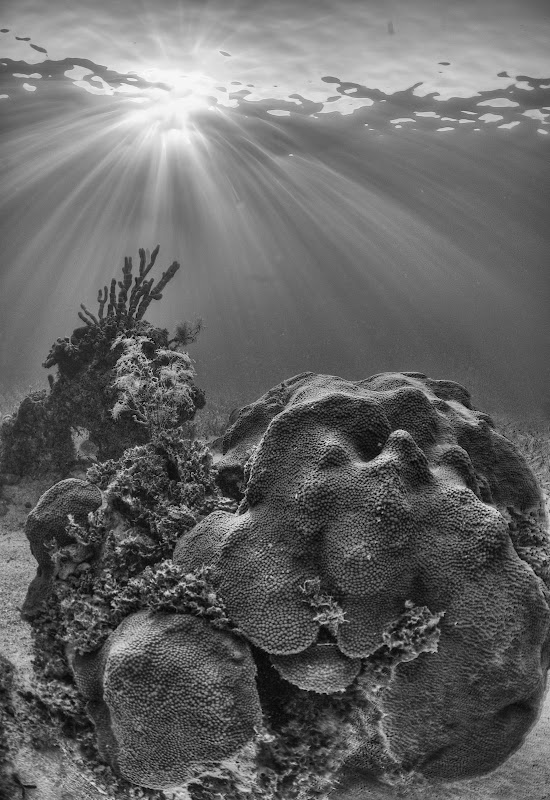
My last attempt. This is a version using a pseudo-HDR (same image adjusted 2 stops over and under before import into Photomatrix) for the sun and water surface, combined with the previously posted HDR version of the coral. Acceptable I think.
-
My last attempt. This is a version using a pseudo-HDR (same image adjusted 2 stops over and under before import into Photomatrix) for the sun and water surface, combined with the previously posted HDR version of the coral. Acceptable I think.
Yes that does look a lot better! HDR is one of those techniques which promises a lot but is difficult to get to work just as you think it should.

