Stephen,
I would love to do my own set of tests on this subject. But I'll wait until Harald comes up with a housing for Nikon's D700 as that camera has significant advantages over the D3/D3x. Most specifically an independent control for flash compensation which allows you to vary the output of any i-TTL strobe WITHOUT affecting either the ambient light exposure or the ambient light meter reading. The D700 also has grid lines that can be turned on (or off) which would help significantly with the alignment of a series of test shots such as these, eliminating variables in squaring the camera up in relation to the targets. It seems unlikely Harald will have a D700 for at least another couple months, by which time I will be in Australia and then onward to Indonesia for a few months. Maybe by DEMA?? So in all likelihood, I'll be shooting film for another year. Ten years with the same housings and cameras. Very economical.
That the 17-35 angle of view would change with a diopter is to be expected. Most lenses, especially wide-angles, that employ IF (intermal focusing) get SLIGHTLY wider as you focus closer. And since a diopter shifts the close focusing necessary for use with a dome from the prime lens to the diopter, the stronger the diopter, the closer to infinity the actual lens focus is with the dome.
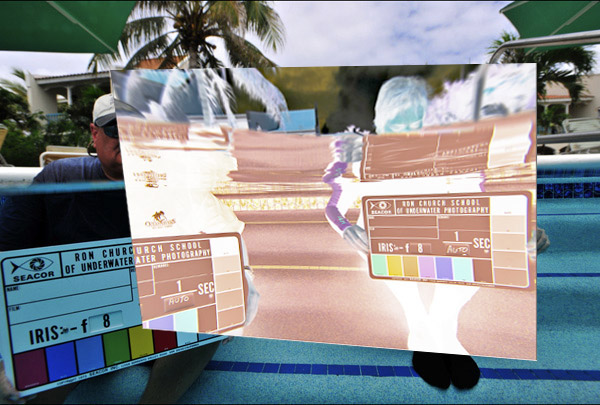
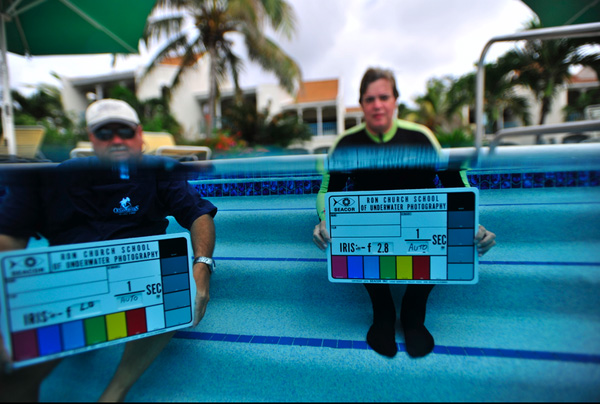
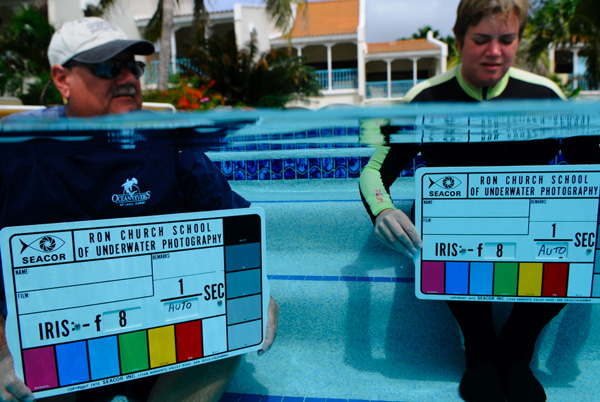
If diopter strength causes a diminishing in the the angle of view, which I agree it should because the actual focus of the lens itself is progressively farther and farther towards infinity on the focusing scale as diopter strength increases, then you would expect the size of the slate held by the woman on the right to get progressively larger and larger as the diopter strength used gets stronger and stronger, IF all other things, particularly shooting position, were equal.
In your test series, the size of that slate (I compared the length) increases between the no diopter and +1 diopter shots. In the shot with the +2 diopter, the slate length is slightly smaller that that of the no diopter shot which would suggest that the angle of view is increasing. And with the strongest diopter, the slate length falls between that of the +2 and no diopter slate lengths. This inconsistency in variation I still suggest is due to inconsistent water distances between the camera and that slate. Otherwise, the slate length should have simply gotten progressively larger as the diopter strength increased.
The size of the slate held by the gentleman on the left varies even more than that held by the woman. Which suggests that the position of his slate with respect to the camera varies even more erratically than that of the slate held by the woman.
I would still suggest that the better way to shoot true comparisons would be to hang identical targets against a flat wall in a pool. Then put the housing on a tripod and align two of the tripod's three feet on a line on the pool bottom that is parallel to the wall with the targets. After each optical change place the same two feet of the tripod in the same position on the "bottom line". The aim the housing, camera & lens so that the center of the "center focus" target is exactly in the center of the picture frame. Then use the camera's auto-focus to focus on that center point, ALWAYS focusing on something just a bit closer first so that the lens focus travels in the same direction until it locks onto the target. This methodology would give a much more consistent framework for testing and from which you could clearly say that any widening of the picture angle and any sharpness differences, center and edge, were due to difference in the optics. The same sort of test would also give you the best indication of which extension tube actually gives the best results with each optical combination.
It is be worthwhile making sure the camera and lens are as centered as possible within the housing and the port. One way to get a pretty good idea about this is to add several more extension tubes than are necessary while the housing is on land. The resulting vignetting of the image should be equal in all four corners of the frame. If they are, you are aligned pretty well. If there is more vignetting in any corner than the others, the camera's position in the housing is not really correct.
My own choice of extension tube lengths for the Nikon 17-35mm f2.8 lens is either 55mm or 60mm. I started with 55mm, but when I found that I liked a 60mm for use with the 24-85mm lens. And a 60mm tube as the base tube in the combination needed for use with the 70-180mm Micro-nikkor. I switched to 60mm as my primary extension tube for all three lenses as it meant I could leave that tube in place as I changed between the three lenses. I also the 60mm tube with a short flat glass with the new 105mm VR Micro-nikkor. Because I have both a lens release lever, and a port lock on my F5 housing, I can simply unscrew any outer port components, change the lens, and put on a new dome or port components for any of these four lenses without opening the housing body. It keeps things easier, especially when things get a bit rushed or hectic.
Fred
Fred





 Better than the morning paper reading through this thread. It would be great if a moderator could rename and pin this thread. The most interesting part to a non-technical enthusiast was how the diopter reduced the FOV. Kind of defeats the purpose underwater unless you really need corner sharpness. I guess to my untrained eye, the corners are an afterthought anyway. As a macro guy who has dabbled in WA, I wonder if the diopter also reduces your DOF. Stephen and all who added to the thread, kudos for doing this. Now..how much to get you to jump back into the pool with the entire Olympus line