Just as another data point for those interested in correctors, I have been using Rebikoff manufactured afocal correctors for many years for my 3D stereo work and find them to be an excellent tool. They have allowed me to get relatively wider angle stereo images with normal stereo bases (e.g., 65mm) which would be practically impossible with dual dome ports. Unlike the Carl Zeiss corrector system that Alex describes, the correctors made by Rebikoff are dual optics combined a single lens housing and the taking optic has to be placed within a few millimeters of the corrector's rear optic. Also, my particular units only accept taking lenses with a 35mm or greater focal length (measured in 35mm format). Any wider, and the taking lens sees the inside of the corrector. I understand that the Ivanoff/Rebkoff type correctors can be designed to accommodate wide field of view. Whether the Zeiss correctors are of this type and illustrate the principle is unknown to me.
Photography Gear and Technique / Archived topic
Full Frame SLR wide angle corrector port tests
Started by Alex_Mustard ·
- 116Posts
- 116Replies
Read-only discussion
Full Frame SLR wide angle corrector port tests
-
-
Interesting info. Did you buy them direct from Rebikoff or adapt them from an existing system?
-
First ocean dive with the optical port and I am super excited. Results look fantastic.
This is shot with the 20mm at f/2.8:
More pool tests this afternoon and then I'll post a more detailed update.
Alex
-
Today was my first dive with the port, pretty nerve-wracking because a) it is irreplaceable if damaged and b) I had only tried it in the swimming pool so far and didn't know if it could take the depth and potentially flood my housing and D4, which is also expensive!
Anyway, all worked and the port was great in the water. I spent the dive shooting subjects at a variety of apertures to get a better feeling for optical performance on real world subjects. I used the 20mm, which is very reminiscent of the Nikonos 15mm (although now with SLR viewing and autofocus)!
Here are some sample shots from my one dive, so far. All unropped with Nikon D4, 20mm, Subal housing, Seacam strobes:
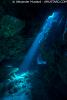
available light, f/5.6, 1/25th, ISO 2500
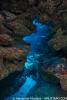
lots of depth of field, despite open aperture, f/7.1, 1/40th, ISO 800

CFWA, f/13, 1/160th, ISO 500
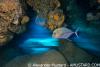
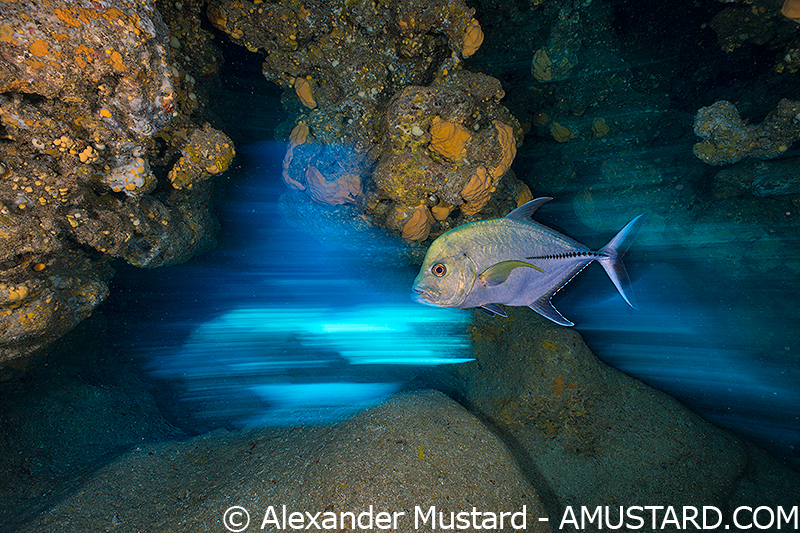
motion blur, f/14, 1/3rd, ISO 400
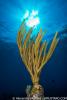
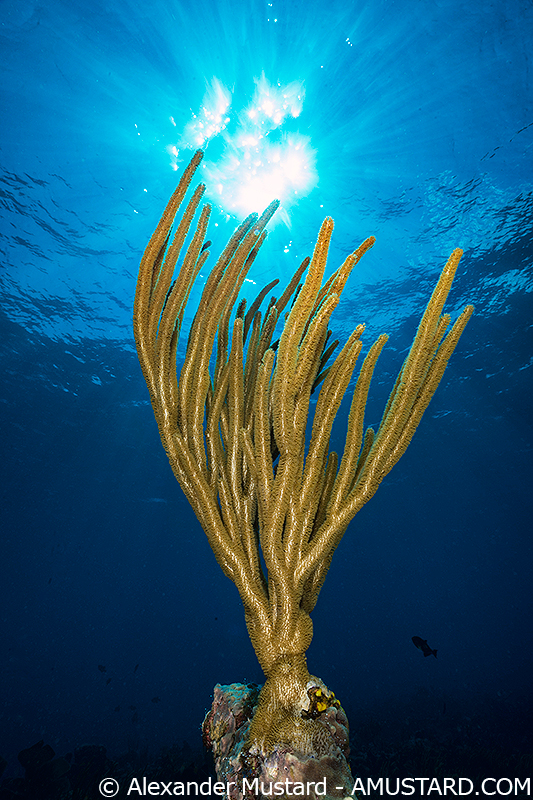
sunburst, f/20, 1/320th, ISO 250

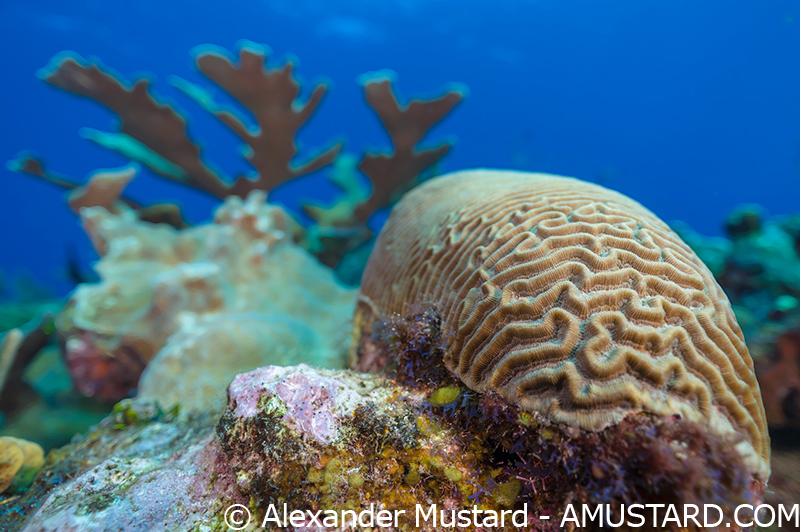
shallow depth of field, f/3.5, 1/320th, ISO 100
Alex
-
I also had the chance for a more rigorous pool test between dome and corrector port, this evening. I tested if there was any lost in angle of coverage compared with dome - as there was not.
Dome:

Corrector Port:

Also corrector consistently seems between 2 and 3 stops better in terms of corner sharpness. I.E. f/4 on corrector port had comparable corner sharpness to f/8 or f/11 on my best dome.
Alex
-
Hi Alex
This is looking very promising and exciting. Do you have any plans to sell them commercially and for other housings.
-
I love the motion blur picture.
--------------
Thanks for the update.
Pete
-
I am not planning to make these commercially, but I hope these tests prove and promote that the concept, and it is something that our community wants. Given the interest, I would hope that one or more of the existing manufacturers would take this on.
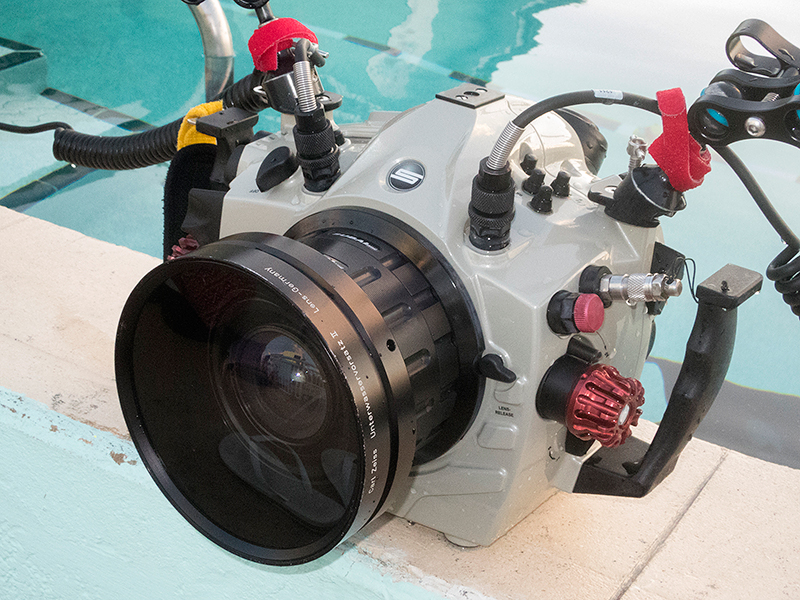
Here is the setup by the pool the other day, this is with Nikon 20mm f1/8 inside.
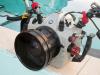
Alex
-
Looks like everything above f5.6 is brilliant. Love the Gorgonian with the sunburst. Not fond of the background blur with the 20mm, but I imagine that's the lens.
-
Alex,
In my opinion, this is the most exciting underwater photography news in many, many years. Ever since I sold my Nikonos cameras, including the 15mm and started using SLRs in 1990 I have struggled with sharpness when using wide angle lenses.
Many years ago I read an article written by one of the original members of the BSoUP. Back in the 60's, they had to make a lot of the kit themselves, because there was not much that could be bought. The corrector port was one of the things that was popular to make. They made them of acrylic material that was shaped (in a lathe, I presume) and then polished up. But the corrector was soon taken over by the dome ports as it was much easier to make.
Seing that the corrector is close to impossible to find, the only alternative appears to make one. The design is described well in many books. And its not new. Introduced by Gallileo Gallilei. The corrector uses the principle in the reversed way. Also used for optical viewfinders for rangefinder cameras.
From what I have been able to find out the formula for a Reverse Galileo telescope is Fp + Fn = d, where Fp is the focal lenght of the convex lens, Fn the focal lenght for the plano-concave lens, and d is the distance between them. The Rebikoff corrector will correct the magnification of 1.33 caused by the front port by adding a 0.75 magnification. Fn = 0.75 x Fp. I have attempted to calculate, using a +4 close-up lens (the Fp) as a starting point. The positive lens (a given) focal lenght is 25 cm. The plano-concave lens is 18.75 cm. The distance between the two is 62.5mm.
Do you know the focal lenghts for the two lenses involved on your corrector? And the distance between them? Does my figures make sense when compared to the real thing?
-
Great work!
I have also been musing on that corrective elements should be brought back into UW photography, á la Nikonos, but a general afocal solution is great! I'm very interested in what the practical / theoretical limits of FOV could be. Also convex front elements of ultra widangles probably cause problems with fixing the lens. I suppose the internal and external corrective lens distance and co-axial pracements are very very important.
Keep us posted, and I hope some manufacturers catch on!
Cheers
/O
-
I am slowly building up a collection of shots of different subjects shot with this lens. Many of the subjects here in Cayman are more suited to the fisheye, so I have not been using the set up that much. Took it to the stingrays this morning.
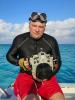
Shot stills and video and will try and upload the video when I find a CF card reader!
Alex
-
Very interesting thread - I'll keep following...
I also had the chance for a more rigorous pool test between dome and corrector port, this evening. I tested if there was any lost in angle of coverage compared with dome - as there was not.
Dome:
Corrector Port:
Also corrector consistently seems between 2 and 3 stops better in terms of corner sharpness. I.E. f/4 on corrector port had comparable corner sharpness to f/8 or f/11 on my best dome.
Alex
What happend to the very corners?
They seem to have a much stronger vignetting.
Wahrmut
-
Here is a video taken with the UW corrector port today, which is just a quick clip, but shows the lack of distortion with the lens and corner of the frame performance.
-
This is great info Alex-many thanks for sharing it.
Optics seems to be the "next frontier" in the industry at the moment. The good news is that I know of one manufacturer who is currently developing a commercial product that is similar, in performance at least, to Alex's corrector port (although it will probably use the Nikkor 50mm lens). The project is still in the prototype phase, but I am very confident that there will be a product for sale in the near future. I should point out that it is likely to be expensive! Once it is out, Wetpixel will be testing and using it!
As it happens, I was recently able to shoot pool test shots of the 20mm Nikkor with a 9" dome in the Bahama and was very impressed with its corner sharpness too.
Adam
-
What happend to the very corners?
They seem to have a much stronger vignetting.
Wahrmut
Hi Wahrmut,
I don't yet have a proper mount for the internal lens of the corrector port. So I have to stick it to my camera lens with blue-tac. When I do this carelessly (for the pool tests) I get some vignetting in the extreme corners. I have commissioned two replacement lenses which are bigger and won't have this problem. The simple solution was ready for this trip, but does not work that well. So I am still using the original lens, which is a bit small and therefore vignettes if I fit it carelessly.
I am mainly using the 20mm for now, but have tested the Nikon 24-70mm, 16-35mm and 17-35mm with the port too. The 24-70mm is troublesome because of the barrel-length changes during zooming.
I am only posting uncropped photos in this thread - as posting cropped ones (even if the crop improves the photo) would be misleading with regards to port/lens performance.
Here is a photo taken with the port and 20mm, of an eagle ray feeding, that I have already shared on Facebook. Again, uncropped.

Nikon D4 and 20mm lens. Subal ND4S housing, Alex corrector port,2 x Seacam 150 strobes, 1/250th @ f/11, ISO 320.
Alex
-
Hi Alex,
Did this lens come from a movie camera housing or a stills camera and which housing was it designed for?.....if stills what film format? I am just fascinated to know where the adaptor originated from and how old it might be? If the design truly can be used with any lens (excluding fish eye) then it is a very interesting trial indeed!
Mark
-
Hi Wahrmut,
I don't yet have a proper mount for the internal lens of the corrector port. So I have to stick it to my camera lens with blue-tac. When I do this carelessly (for the pool tests) I get some vignetting in the extreme corners. I have commissioned two replacement lenses which are bigger and won't have this problem. The simple solution was ready for this trip, but does not work that well. So I am still using the original lens, which is a bit small and therefore vignettes if I fit it carelessly.
Thanks for the plausible explanation, Alex!
Cheers,
Wahrmut
-
Optics seems to be the "next frontier" in the industry at the moment. The good news is that I know of one manufacturer who is currently developing a commercial product that is similar, in performance at least, to Alex's corrector port (although it will probably use the Nikkor 50mm lens). The project is still in the prototype phase, but I am very confident that there will be a product for sale in the near future. I should point out that it is likely to be expensive! Once it is out, Wetpixel will be testing and using it!
Seems strange choice of lens. Sure a wide angle would be better? Not convinced about stretching a 50mm to a wide angle for stills (with presumably a water contact front element) will be that great for high resolution shooting. Probably OK for sub 10MP applications, like 4K video.
Did this lens come from a movie camera housing or a stills camera and which housing was it designed for?.....if stills what film format? I am just fascinated to know where the adaptor originated from and how old it might be? If the design truly can be used with any lens (excluding fish eye) then it is a very interesting trial indeed!
My glass came from an old medium format, scientific photogrammetry survey camera. But all my tests so far show it should work on a very wide range of lenses.
I have probably done my last dives with the system now. So will pull together a selection of images.
Alex
-
This is really exciting stuff Alex. Great job. Can you spill the beans a little more about the exact construction of the lens, setup, optimum lens to port distances you have found etc. Is this essentially a flat port with a dioptre type lens element rather than a flat glass. Got thrown a bit when you discussed the lens threads; is there a component that screws to the lens as well?