Skip to content

Photography Gear and Technique / Archived topic

Nauticam NA-A7c housing

Started by Phil Rudin ·

  • 124Posts
  • 124Replies

Read-only discussion

Nauticam NA-A7c housing

124 posts
  1. Rv- viewfinder wise not apples to apples because of the 3:2 format v. the M4:3 format but yes they fall into the same size range.

    28mm on FF or 14mm on M4:3 has an approx. AOV of 75 degrees and is as wide as you would want to shoot behind a flat port. On full frame sharpness will suffer more.

    10cm is about 1:2.8 on full frame and 15cm is about 1:4.1, as I said above on the lobster shot you get shots more in the 1:5 to 1:6 range or 18 to 21cm range on the long side.

  2. Thank you Phil! I decided to get the A7C instead of the A6400. I have the SEL90 for macro. What lens do you recommend for wide angle?

  3. 13 hours ago, Rv said:

    Hello Phil,

    This set up looks like very interesting for me.

    You have compared the viewfinder with the Nex7 but what about the comparaison with the Olympus EM5 (mark 1) ? Is it as small or smaller with the standard housing viewfinder ?

    What I would like too is a good TTL converter for this housing.

    Without any wet lens, just with the 28-60 behind his flat port, haw is image quality ? What is the smallest subject to fill the frame 10 or 15 cm ? And how is the corner sharpness at 28 mm for big subjects like groopers ?

    Hervé

    The specs for the Sony 28-60 give a maximum magnification of 0.16x  so a full frame 36mm across the subject would be 36/0.16 = 225mm across using a dome divide that by 1.3 to get about 170mm across at maximum magnification in a flat port.  

    The trick is that max magnification might be in the middle of the zoom range rather than at 60mm .  But using 170mm gives you an indication of what can be achived.   

    Behind a flat port 28mm is listed as acceptable in the corners - it won't be as good as a dome,  the trick is your acceptable and my acceptable might be different.

    I would also add a caveat that you need a well fitting port.  The 28-60 is very short and some housing lines may only have a flat port that fits all macro lenses, in the extreme this may mean it will vignette a  little at 28mm.  This is particularly important for wet optics.  So some research is required.

  4. On 2/5/2021 at 12:54 PM, Lewis88 said:

    I absolutely agree. The question is if the extra cost of going FF is really needed for most of us.

    From a prior post, it sounded like the a7c w/28-60 and housing would be right in the same ballpark as a (crop sensor) Z50...


    A prior post also mentioned the high MP count of the a7rIV and pointed out that the 28-60 w/WWL-1 will work with that (or any other a7-series) camera. It is more money than the a7c, but I have found the high MP count of the a7rIV to be VERY useful to me for getting photos without a macro setup that would have otherwise required a macro setup. Having 61MP to crop from can be VERY handy. Alternatively, switching the camera to APS-C mode, to yield a net effect of 1.5X the focal length, still produces 26MP images. 

    The rIV housing is bigger than the a7c housing. But, the port and WWL-1 is still all the same size.

    If my rig were stolen and I had to buy al new, I would still (just me, personally) go with a little bigger size and a bit more money to have the rIV with its higher MP count. If, for some reason, I really felt a need to have a smaller package, I would definitely go with the a7c setup over any crop sensor setup. The Sony 28-60 lens plus the WWL-1 and a CMC-1 (or CMC-2) - as a kit - does not get AS wide as a true wide angle setup with a big dome. And it does not work for AS small macro stuff as a true macro setup. But, it will go from "pretty small" to "pretty wide" and all points in between quite well. That is good enough for me - especially for flying to travel.


  5. I have been ask a bunch of questions about all things A7C and today my 4000 word review has posted in UWPMAG.com issue #119. This is a free PDF download and I suggest you read the review if you have an interest in the Sony A7C. I intensely did my review using only the Sony FE 28-60mm "kit" lens with the WWL-1, WACP and one and two CMC-1 lenses. Some of the macro is in this thread. After reading the review I would be happy to answer any questions. 

    The attached image is with the 28-60 at 28 using the WACP. This is an A/V light shot at ISO-400, F10, 1/125th sec.


    untitled-01199.jpg

    untitled-119-3.jpg

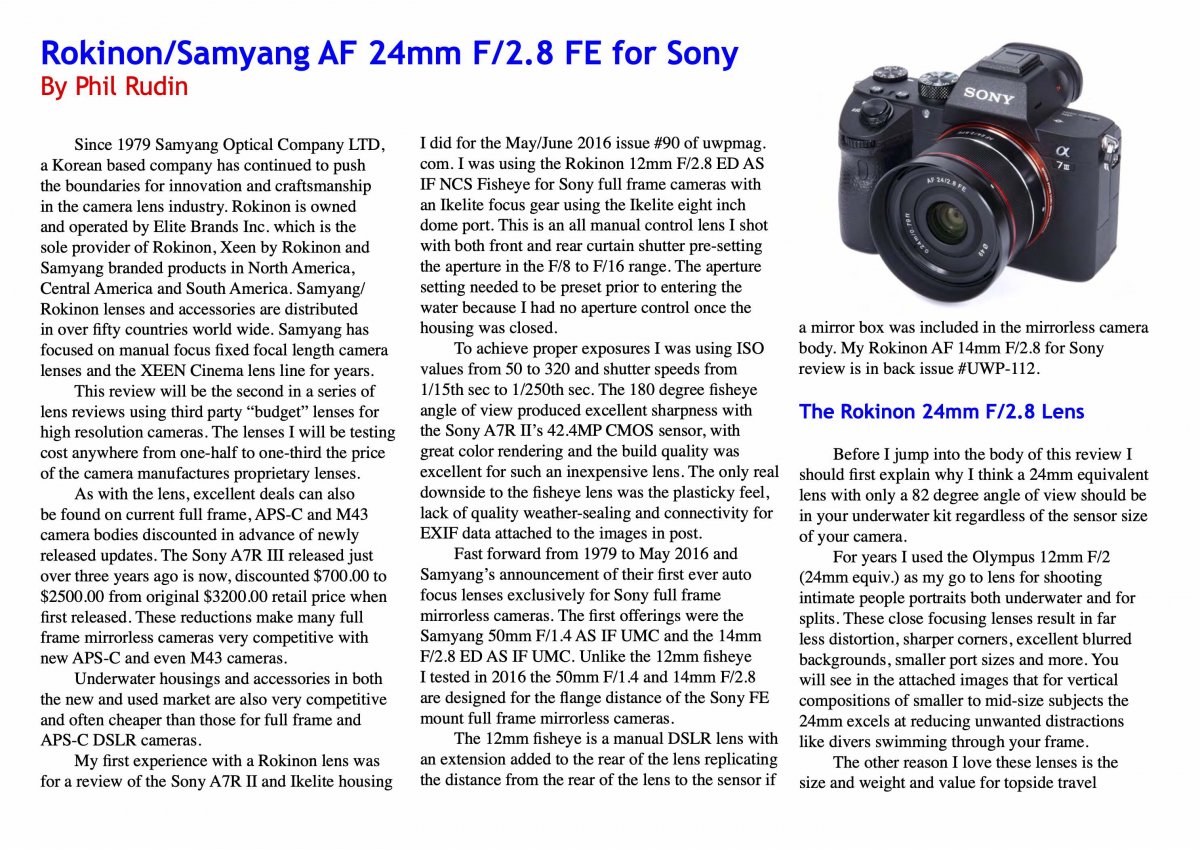
  6. You actually have several compelling choices of 24mm lenses for sony FE full frame. The new Sony FE 24mm F/2.8 has excellent weather sealing, an aperture ring on the barrel and a programable button. These are all useful above water but useless in a housing. The lens is also $598.00 new. I would also suggest Looking at the affordable Rokinon 24mm F/2.8 and the Tamron 24mm F/2.8. Tamron is now on sale for $199.00 and the Rokinon on sale runs around $250.00. I reviewed the Rokinon 24mm for UWPMAG.com issue #116 and I suggest you take a look at that review for some insight into how useful the 24mm is underwater.

    Sony and Rokinon focus to 24cm, Tamron focuses to 12cm which is 1:2. The Rokinon is quite good and well worth the price. All three lenses should work behind the ZEN 170mm or Nauticam 180mm ports. 

    You may also want to checkout my review of the Rokinon 18mm F/2.8 which will also work with the 170/180mm ports, it is in the current issue #119 at uwpmag.com, the magazine is a free PDF download with all back issues.

    Bottom line is I would own the more expensive Sony FE 24mm if my main goal was above water use with occasional U/W use, otherwise I would be choosing the less expensive options. Of the four lenses the 18mm is the most useful underwater   

    116:Rok24.jpg

  7. 1 hour ago, Phil Rudin said:

    Bottom line is I would own the more expensive Sony FE 24mm if my main goal was above water use with occasional U/W use, otherwise I would be choosing the less expensive options. Of the four lenses the 18mm is the most useful underwater    

    I agree on the 18mm. The Batis 18mm is insanely sharp on land and UW has great FoV for rectilinear without too long of a focus distance. It's on the pricier side though

    Definitely one of my favorite lens.

  8. I reviewed the Zeiss Batis 18mm F/2.8 back in issue #92 using an A7R II and ZEN 200mm port which is the port I had at the time. The lens works well with Nauticam 180mm optical glass port and a 20mm extension. Because the lens has a 77mm thread I have also be using it with the S&S correction lens of the same size. I have also been testing the pricy Sony FE 24mm F/1.4 with a 20mm extension since the lens came out. This lens has also been added to the Nauticam port chart with 40mm recommended with the N120 / 180mm port and 70mm of N100 extensions with the N100/ 180mm port. The N100 port works best. I have been using it with the Nauticam 230mm port so less extension needed. 

  9. 3 hours ago, Phil Rudin said:

    Bottom line is I would own the more expensive Sony FE 24mm if my main goal was above water use with occasional U/W use, otherwise I would be choosing the less expensive options. Of the four lenses the 18mm is the most useful underwater   

    What if you factor in using the WWL-1(B)? It seems like the "ultimate" system would be the A7c with the new upcoming FE 24mm prime? The F/2.8 is nice above water but doesn't matter much under water.

    Thoughts?

    - brett

  10. In a nut shell WWL-1 & B is designed for 28mm, not 24mm lenses. The Sony FE 28-60mm lens is the best lens for WWL-1. Read my A7C review in the current issue of uwpmag.com magazine.  

  11. 8 minutes ago, Phil Rudin said:

    In a nut shell WWL-1 & B is designed for 28mm, not 24mm lenses. The Sony FE 28-60mm lens is the best lens for WWL-1. Read my A7C review in the current issue of uwpmag.com magazine.  

    Of course! My brain spaced out for a bit there with the 24 mm FF equivalent on the APS-C for the WWL-C and the 28mm on the FF for the WWL-1(B).

    That article is definitely on my list to read. I downloaded it 1-2 weeks ago but "life got in the way" along with a MOD3 cave rebreather course which I recently completed.

    Thanks, Phil.

    - brett

  12. I have been ask a bunch of questions about all things A7C and today my 4000 word review has posted in UWPMAG.com issue #119. This is a free PDF download and I suggest you read the review if you have an interest in the Sony A7C. I intensely did my review using only the Sony FE 28-60mm "kit" lens with the WWL-1, WACP and one and two CMC-1 lenses. Some of the macro is in this thread. After reading the review I would be happy to answer any questions. 

    The attached image is with the 28-60 at 28 using the WACP. This is an A/V light shot at ISO-400, F10, 1/125th sec.


    untitled-01199.thumb.jpg.d387d60727223069dac35c3547922221.jpg

    untitled-119-3.jpg.6838e2b022f21b3a32d2f9cbe5c8c0fd.jpg

    I read the excellent review. Thanks for the review. I was asking Backscatter to quote a Nauticam macro rig with kit lens and CMC lens since you used it for you review but they suggested SMC for FF instead. I’m pretty new to UW macro but would like to leave room to grow to super macro. Would you suggest SMC or CMC?


    Also what light/strobe do you recommend to keep the weight and size down for travel? And how many? I will mostly take macro and normal flat port range for bigger subjects like rays, turtles. Thank you


    Sent from my iPhone using Tapatalk

  13. The port charts for Nauticam now include data for their macro lenses, the Sony chart lists the CMC-1 and 2 for use on the 28-60: 

    https://drive.google.com/file/d/1gbXTQdKsic9to1uhgZMlkM3lJxMFHNQM/view

    The CMC-1 is about equivalent to a +15 diopter and quite powerful.  It needs to be on the 28-60 because that lens does not focus that close. 

    The quoted magnifications for these lenses are CMC-1 - 4.5x, CMC-2  - 2.8x, SMC-1 - 2.3x and SMC-2 - 4x.  I'm assuming these magnifications are on the same basis and the magnification refers to the increase of magnification over the base lens maximum magnification.   For example a 1:1 macro lens would achieve about 2.3:1 with the SMC-1.  Nauticam seem to recommend the SMC for use with macro lenses that can already achieve 1:1 and the CMC with  compact lenses to allow them to get close to 1:1, with some exceptions, so best to refer to the port charts. 

    You said you want to have the flexibility to do super macro later, this  does not seem feasible with the 28-60 lens, where the CMC-1 I believe will give you the maximum achievable magnification and if you want more you need to switch to a macro lens and add diopter to that setup.  You might be able to use the CMC-1 with the 90mm macro but it would be very limiting with very high magnification and short working distance, so you would probably need to buy a less powerful diopter to use with the 90mm macro lens.

  14. @Phil Rudin Thanks for your big review in the lateast uwmag.

    I just wonder how good the new Sony 20mm F1.8 would perform with a 180mm Port on this setup. Its just a shame that we have so many possible lens + port combinations and nobody can't test all of them ;).

  15. Great to see the A7C housing, thanks for posting! 

    I've used the Samyang 18/2.8 on my A7iii for underwater for some time. I've really enjoyed it for the price point and weight. Pair this with the A7C and you have a tiny package! 

    -Dave

  16. 4 hours ago, JYk said:

    @Phil Rudin Thanks for your big review in the lateast uwmag.

    I just wonder how good the new Sony 20mm F1.8 would perform with a 180mm Port on this setup. Its just a shame that we have so many possible lens + port combinations and nobody can't test all of them ;).

    I don't see why anyone would chose that lens UW when WWL-1 is compatible with the sony system? If you're looking for rectilinear, you could get the 16-35mm f4 with a bit wider range and zoom capabilities.

  17. The port charts for Nauticam now include data for their macro lenses, the Sony chart lists the CMC-1 and 2 for use on the 28-60: 
    https://drive.google.com/file/d/1gbXTQdKsic9to1uhgZMlkM3lJxMFHNQM/view
    The CMC-1 is about equivalent to a +15 diopter and quite powerful.  It needs to be on the 28-60 because that lens does not focus that close. 
    The quoted magnifications for these lenses are CMC-1 - 4.5x, CMC-2  - 2.8x, SMC-1 - 2.3x and SMC-2 - 4x.  I'm assuming these magnifications are on the same basis and the magnification refers to the increase of magnification over the base lens maximum magnification.   For example a 1:1 macro lens would achieve about 2.3:1 with the SMC-1.  Nauticam seem to recommend the SMC for use with macro lenses that can already achieve 1:1 and the CMC with  compact lenses to allow them to get close to 1:1, with some exceptions, so best to refer to the port charts. 
    You said you want to have the flexibility to do super macro later, this  does not seem feasible with the 28-60 lens, where the CMC-1 I believe will give you the maximum achievable magnification and if you want more you need to switch to a macro lens and add diopter to that setup.  You might be able to use the CMC-1 with the 90mm macro but it would be very limiting with very high magnification and short working distance, so you would probably need to buy a less powerful diopter to use with the 90mm macro lens.

    Thanks for the info. Uhm so the Backscatter sales guy did not know his stuffs then. I think I’ll go with the CMC1. I have the SEL 90mm lens too. I may try the kit lens first before getting the port for the 90mm. What macro wet lens can be used with the 90mm?


    Sent from my iPhone using Tapatalk
  18. 6 minutes ago, imacro said:


    Thanks for the info. Uhm so the Backscatter sales guy did not know his stuffs then. I think I’ll go with the CMC1. I have the SEL 90mm lens too. I may try the kit lens first before getting the port for the 90mm. What macro wet lens can be used with the 90mm?


    Sent from my iPhone using Tapatalk


    I had asked the same questions to the guys at Reef Photo a couple of months ago and they gave me the same answers that @ChrisRoss gave you here. In other words, they DO know their stuffs. :) They also have awesome customer service.

     

    And, Reef Photo's Return Policy will allow you to return something for a full refund. Backscatter's Return Policy does not allow for refunds. You can only return an item for credit or exchange - even if it's brand new and unopened. Just an FYI there.

  19. 15 minutes ago, imacro said:

    What macro wet lens can be used with the 90mm?

    I use a Weefine WFL05S (+13) with mine (on an A6300, so it's cropped); it gets frame width from ~24mm to ~15mm.

Kraken Sports

Account

Navigation

Search

Search

Configure browser push notifications

Chrome (Android)
  1. Tap the lock icon next to the address bar.
  2. Tap Permissions → Notifications.
  3. Adjust your preference.
Chrome (Desktop)
  1. Click the padlock icon in the address bar.
  2. Select Site settings.
  3. Find Notifications and adjust your preference.