



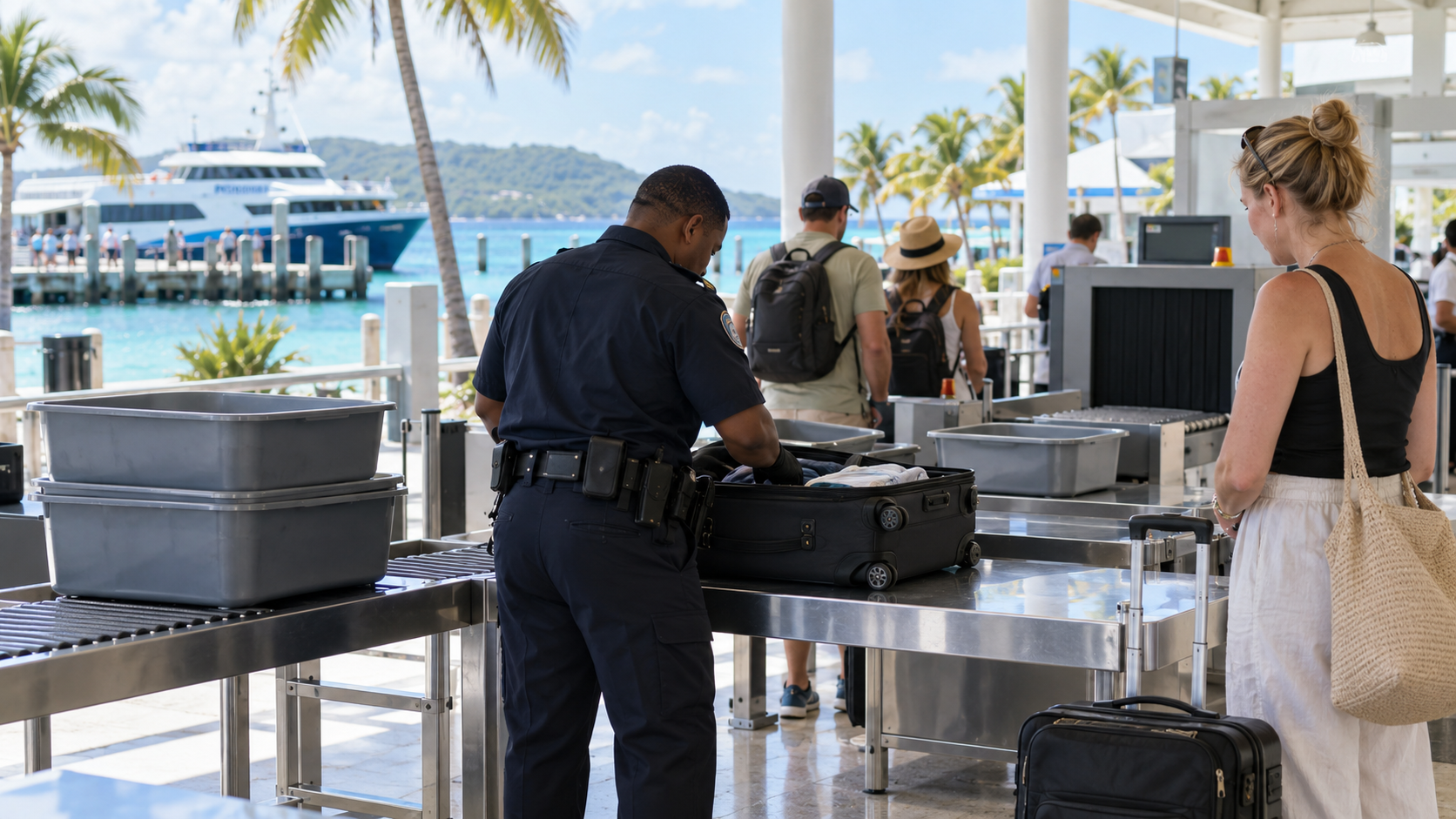
Underwater camera housings traveling with their corresponding cameras are to be treated as photographic accessories, while dive computers are to be classified as sporting equipment, according to Cozumel tourism officials following meetings with Mexican Customs. Broader questions about strobes, ports, wet lenses and whether the interpretation applies throughout Mexico remain unresolved.
September 21, 2026 — WaterPixels
There may finally be some movement in the long-running dispute over how Mexican Customs treats the specialized equipment carried by visiting divers and underwater photographers.
Following meetings between Mexican Customs officials, the Quintana Roo Tourism Secretariat (SEDETUR) and representatives of the diving industry, Cozumel tourism officials say two particularly important pieces of equipment now have clearer treatment when visitors enter the destination: dive computers and underwater camera housings.
According to Elías Farah Ceh, Cozumel's Director of Tourism and Economic Development, dive computers brought by tourists are to be classified as sporting equipment rather than laptops or tablets during Customs inspections.
For underwater photographers, an even more significant clarification concerns camera housings.
Farah Ceh said that underwater camera housings will be considered camera accessories when they travel with the corresponding camera.
If a housing is transported separately from its camera, however, it may instead be counted against the passenger's duty-free merchandise allowance and could become subject to tax if the applicable allowance is exceeded.
The clarification was reported September 19 by Mexican news outlet Ruptura 360, following a meeting in Cancún involving Customs personnel, SEDETUR and representatives of Cozumel's diving community.
Customs shown how modern dive equipment is actually used
The issue appears to have gone beyond a conventional meeting between government and tourism officials.
During the discussions, experienced diver Alberto Friscione reportedly demonstrated equipment used for both ocean and cave diving, helping Customs personnel distinguish specialized dive equipment from ordinary consumer electronics.
That distinction is particularly relevant to dive computers. Although today's units may resemble sophisticated smartwatches or electronic devices, their primary function is as life-support-related diving instrumentation, tracking information such as depth, dive time, decompression status and other parameters needed during a dive.
Treating such a device as a laptop or tablet can therefore create problems when Customs officers apply passenger allowances intended for conventional electronics.
The same problem has affected underwater photography equipment.
To someone familiar with underwater imaging, a camera housing is clearly part of the system required to operate a camera underwater. But Mexico's published passenger-baggage rules refer more generally to cameras and “photographic material,” leaving considerable room for interpretation when Customs encounters housings, ports, strobes and other specialized components.
The latest Cozumel clarification appears to address at least the housing portion of that problem.
Quintana Roo confirms underwater photography equipment is being discussed
The Government of Quintana Roo has separately confirmed that underwater imaging equipment is part of the current discussions with Customs.
In a September 18 statement, SEDETUR said representatives met with Cancún Customs officials and members of the nautical and diving sectors specifically to review the equipment now being brought into the Mexican Caribbean by visiting divers.
That review included equipment used for cave and cavern exploration as well as specialized underwater photography and video equipment.
Cancún Customs chief General Luis Antonio Balcázar Bustos participated in the meeting along with senior officials responsible for legal affairs, passenger services and Customs operations.
According to SEDETUR, the meetings are intended to produce several improvements:
better training for Customs personnel;
direct communication between Customs authorities and representatives of the diving sector; and
clearer information for tourists arriving with specialized equipment.
Additional Mexican reporting published September 21 says those efforts are continuing as officials work to establish procedures that make entry into the Mexican Caribbean with personal and specialized diving equipment more predictable.
SEDETUR Secretary Bernardo Cueto Riestra said more than half a million tourists visit the Mexican Caribbean annually to dive, making resolution of these issues particularly important to the region's tourism industry.
Complaints and cancellations put pressure on officials
The discussions follow a period of increasing frustration among international divers and underwater photographers.
WaterPixels has followed reports involving Customs treatment of underwater imaging equipment in Mexico since 2024, including complaints associated with Cancún, Cozumel and Los Cabos.
More recently, local Cozumel business representatives have said uncertainty and disputed Customs charges have contributed to cancellations by visiting dive groups.
The issue gained additional attention this summer as individual divers and underwater photographers began publicly calling for travelers to avoid Mexican dive destinations until the Customs situation was clarified.
The current discussions between Customs, tourism officials and the dive industry appear to be a direct attempt to reduce that uncertainty.
Important questions remain
The latest development is encouraging, but underwater photographers should be careful not to interpret it as a complete resolution of the Mexican Customs issue.
WaterPixels has not yet located a published national directive from Mexico's National Customs Agency (ANAM) formally stating that the camera-housing interpretation applies at every Mexican port of entry.
The current information comes from Cozumel tourism officials describing agreements reached during discussions with Customs.
It also addresses only part of a typical underwater imaging system.
Questions remain concerning equipment including:
dome and flat ports;
interchangeable lenses;
underwater strobes;
video and focus lights;
wet wide-angle and macro lenses;
external viewfinders;
extension rings and gears;
strobe arms and related accessories.
A serious underwater photography system can contain all of these components while still involving only one personal camera.
How Mexican Customs classifies that complete system remains the key question for traveling photographers.
There is also an important geographic question.
Are these interpretations being used only in Cozumel and Cancún, or will Customs officers apply the same criteria in other Mexican entry points, including Los Cabos?
Until that question is answered by ANAM or another federal authority, travelers should not assume that procedures will necessarily be identical throughout Mexico.
WaterPixels has requested official clarification
WaterPixels has sent a detailed bilingual media inquiry to Quintana Roo Tourism Secretary Bernardo Cueto Riestra and Cancún Customs, asking for clarification directly from the authorities involved.
Among the questions we have asked:
whether a camera housing traveling with its camera is officially considered part of the personal photographic system;
how ports, strobes, lenses, wet optics, lights and other underwater imaging accessories should be classified;
whether limits exist on the number or value of those accessories;
whether these interpretations apply nationally;
what procedure travelers can use to challenge an assessment they believe was made incorrectly;
whether an ATA Carnet is expected for recreational photographers;
and when the proposed clearer equipment guidance will be published.
We have also asked officials to clarify the status of the temporary Customs arrangements reported earlier this summer and reports of new complaints after September 1.
At the time of publication, WaterPixels had not yet received a response.
For now, the recognition that an underwater housing accompanying its camera should be treated as a camera accessory, and that a dive computer should be treated as sporting equipment, represents a potentially meaningful step toward resolving the problem.
The larger question is whether those interpretations will now become clear, written and consistently applied Customs policy across Mexico.
This report is based on official statements from the Government of Quintana Roo and SEDETUR, recent Mexican news coverage, and documented reports from the WaterPixels community. WaterPixels has requested additional clarification from SEDETUR and Cancún Customs and will update this story as new official information becomes available.
-
 6
6
-
 4
4


Recommended Comments