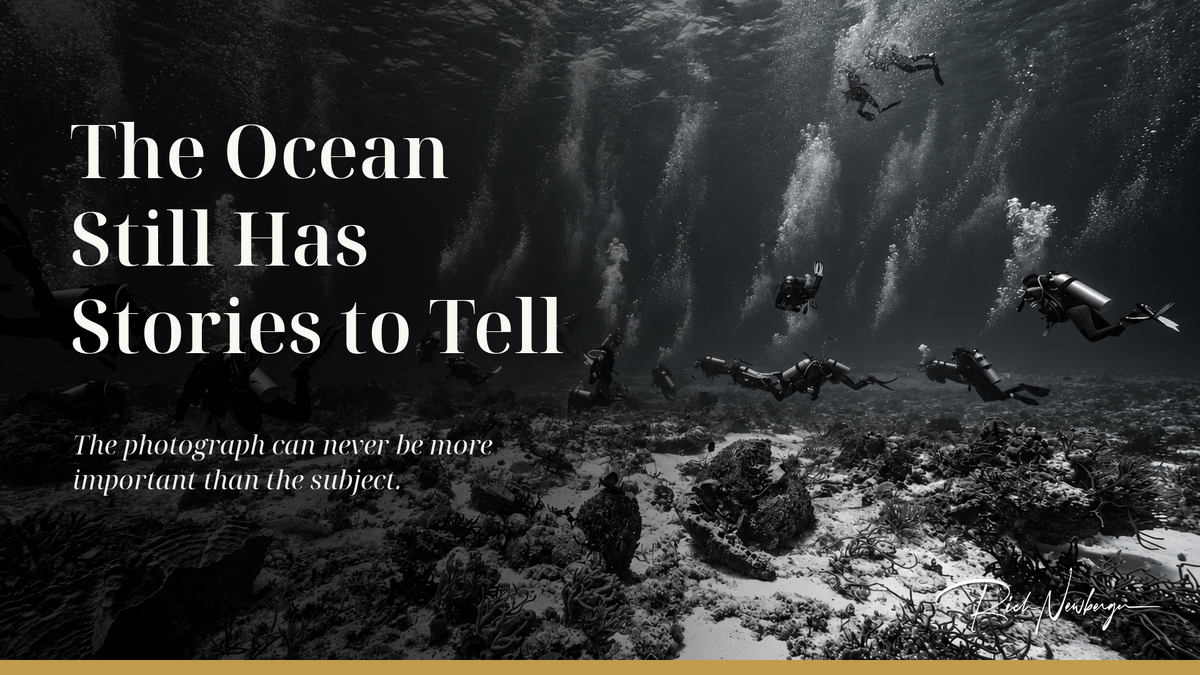
I have spent a lot of years looking through a viewfinder, both above and below the surface. Photography has always been about capturing something that would otherwise pass — a person, a place, a fraction of a second that would be gone if we did not make the effort to preserve it. Sometimes the result is artistic, sometimes documentary, sometimes neither, and sometimes a little of both. But some of the moments that have stayed with me the most are the ones when I’ve stopped thinking about the photograph. On one dive, I saw a huge loggerhead turtle in the distance. My first instinct was to move closer. You see the subject, you imagine the photograph, and your mind immediately starts working through distance, angle, light, and composition. Then I stopped. There were already so many divers around it or heading toward it — multiple dive groups, people trying to get closer, some waiting their turn and others not. The turtle had enough going on without me adding myself to the crowd. Watching so many people converge on its space was unsettling to me. So I stayed back and took a photograph of the scene as it was. It wasn’t a photograph I had planned to make, and I certainly wasn’t thinking about composition or creating something for a portfolio. It was really just a snapshot for reference — a record of what I was seeing. Divers seemed to fill the water in every direction, spread across the reef and throughout the water column, with streams of bubbles rising toward the surface. And somewhere beyond all of that activity was the reason everyone had gathered there: the turtle. The turtle isn’t even in the photograph. I had started toward it hoping to make a photograph of a loggerhead. Instead, I photographed what was happening around it. The photograph I came away with was not really about the turtle at all. It was about us. It became a reminder of how easily our excitement can become pressure on the very animals we came to see. I wrote about that moment afterward and summed it up with a simple thought: No shot is worth stressing or damaging anything. That still reflects how I feel. There are times when we can approach carefully, make an image and move on. There are other times when the right decision is simply to watch. Knowing the difference is part of being an underwater photographer, just as much as knowing how to set a strobe or choose a lens. The moment we descend beneath the surface, we become visitors. Being a good visitor means leaving as little evidence of our presence as possible. The photograph can never be more important than the subject. That responsibility does not limit creativity. If anything, it asks more of us. We should create through the way we see, frame, light and interpret a scene — not by disturbing an animal or changing the environment to manufacture a better picture. The turtle encounter became meaningful because I stepped back and noticed something beyond the image I had first imagined. Underwater imaging, like photography above the surface, is an art form. We make choices about light, composition, perspective, movement, color and mood. Two people can photograph the same subject on the same dive and come back with completely different images because each person sees the scene differently. Sometimes the goal is to show exactly what was there. Other times it is to communicate what it felt like to be there. The camera is only the tool. The image comes from the person using it. Those tools can look very different: a large housed camera with strobes, a compact, an action camera, or a smartphone in a housing. What connects us is the desire to bring something back and show someone what we saw. A photograph of a tiny nudibranch can introduce someone to an animal they never knew existed. A healthy reef can show what is still worth protecting. Bleaching coral, discarded fishing gear, or a landscape changed by human activity can tell a very different story. Our cameras document beauty, but they also document change. That is one of the things that has always fascinated me about underwater photography. Divers get to see things much of the world never will. We notice when a reef looks different from the last time we visited — storm damage, fewer fish or plastic tangled around coral. We also see recovery, new growth and marine life returning to places that have been given a chance to heal. Dive after dive, year after year, underwater image makers are building a visual record, often without ever setting out to become historians. Some of those images may never win a contest or receive much attention. Many will sit quietly on hard drives or phones for years. Yet an ordinary photograph can preserve something important: a reef, a wreck, a species or an ecosystem at a particular moment in time. As the ocean changes, an image that seems unremarkable today may become valuable for what it allows us to remember. Underwater photography may increasingly become part of the ocean’s memory as well as our own. That connection between observation, creativity, and responsibility is why I believe conservation belongs naturally alongside underwater imaging. A photograph can make something distant feel personal. Someone who has never worn a mask or taken a breath from a regulator can still look into the eye of a shark, see the complexity of a coral reef, or recognize the vulnerability of an animal surrounded by divers. Sometimes that connection is enough to make someone care, and caring is often where conservation begins. It is also part of why WaterPixels matters to me. WaterPixels was built not only to restore or continue a community, but around the idea that underwater photographers and image makers should have a place to share photographs, knowledge, experiences, mistakes, and discoveries. The same impulse that makes us bring a camera on a dive, makes us want to talk about what happened afterward. What did we see? How did we make the image? What would we do differently next time? When I think about the turtle encounter, that last question matters especially. Sharing the photograph also meant sharing the decision behind it: why I stayed back and what I noticed when I did. Those are the kinds of conversations I want us to have alongside discussions about technique. An image can give us something to learn from even when the lesson has little to do with camera settings. Photography has changed enormously over the years, from film to digital and through advances in autofocus, lighting and editing. Action cameras opened underwater imaging to a much wider group of people, and smartphones are now doing the same. A phone in a housing can document a reef, an encounter or an environmental change just as meaningfully as a large dedicated camera system. That wider participation is good for a community built on sharing. Someone asks about a lens and another photographer explains what worked for them. Someone shares a lighting technique they struggled for years to understand. A diver posts about an encounter from halfway around the world. A photographer with decades of experience helps someone preparing for their first trip with a housing. Eventually, that new photographer becomes the person answering someone else’s question. That is how a community stays alive. Of course, underwater photographers can spend endless hours talking about equipment. We are exceptionally talented at debating domes, wet lenses, strobes, ports, sensor sizes, autofocus settings, corner sharpness and probably several hundred other subjects that most people would never understand nor care about. Those discussions are part of the fun for some, and good advice can save someone a great deal of frustration. But the value of an image (or video for that matter) has never depended entirely on the equipment used to make it. A technically perfect photograph with razor-sharp corners can be beautiful. So can a grainy, imperfect image made at exactly the right moment. Underwater imaging can be scientific, documentary, journalistic, artistic, or deeply personal. Sometimes, it is several of those things at once. What matters is what the image says. Underwater photography exists because the underwater world exists. Without healthy oceans, the cameras do not matter very much. Conservation should not feel like a separate subject we occasionally add to a photography community. It is already present in the choices we make every time we enter the water. After enough years behind a camera, it would be easy to think everything has already been photographed. It hasn’t. A familiar reef changes with the light. An animal behaves in a way we have never seen before. A new photographer notices something an experienced photographer may have passed a hundred times without seeing. There is still room to be surprised, and more people than ever have the ability to record those discoveries and share them. The world does not necessarily need more photographs simply for the sake of having more photographs. What it needs are more people willing to look carefully, learn, create, and share what they discover — and to protect the places that make those discoveries possible. Sometimes looking carefully means recognizing that the photograph we came for is not the most important thing happening in front of us. That is what I hope WaterPixels continues to be: a place where great underwater images are celebrated, curiosity matters, creativity is encouraged and knowledge is freely shared. A place where wildlife is respected and the health of the ocean matters as much as the photograph. A place where someone with the most expensive & latest system and someone with a smartphone can both contribute something meaningful. Long after today’s cameras are obsolete and the technology we currently obsess over has been replaced, the reason we carried those cameras underwater will remain. There will still be another reef to explore, another animal to encounter, another photographer discovering this world for the first time, and another moment worth remembering. What we choose to notice, preserve, and share will still matter. And somewhere beneath the surface, the ocean still has stories to tell...





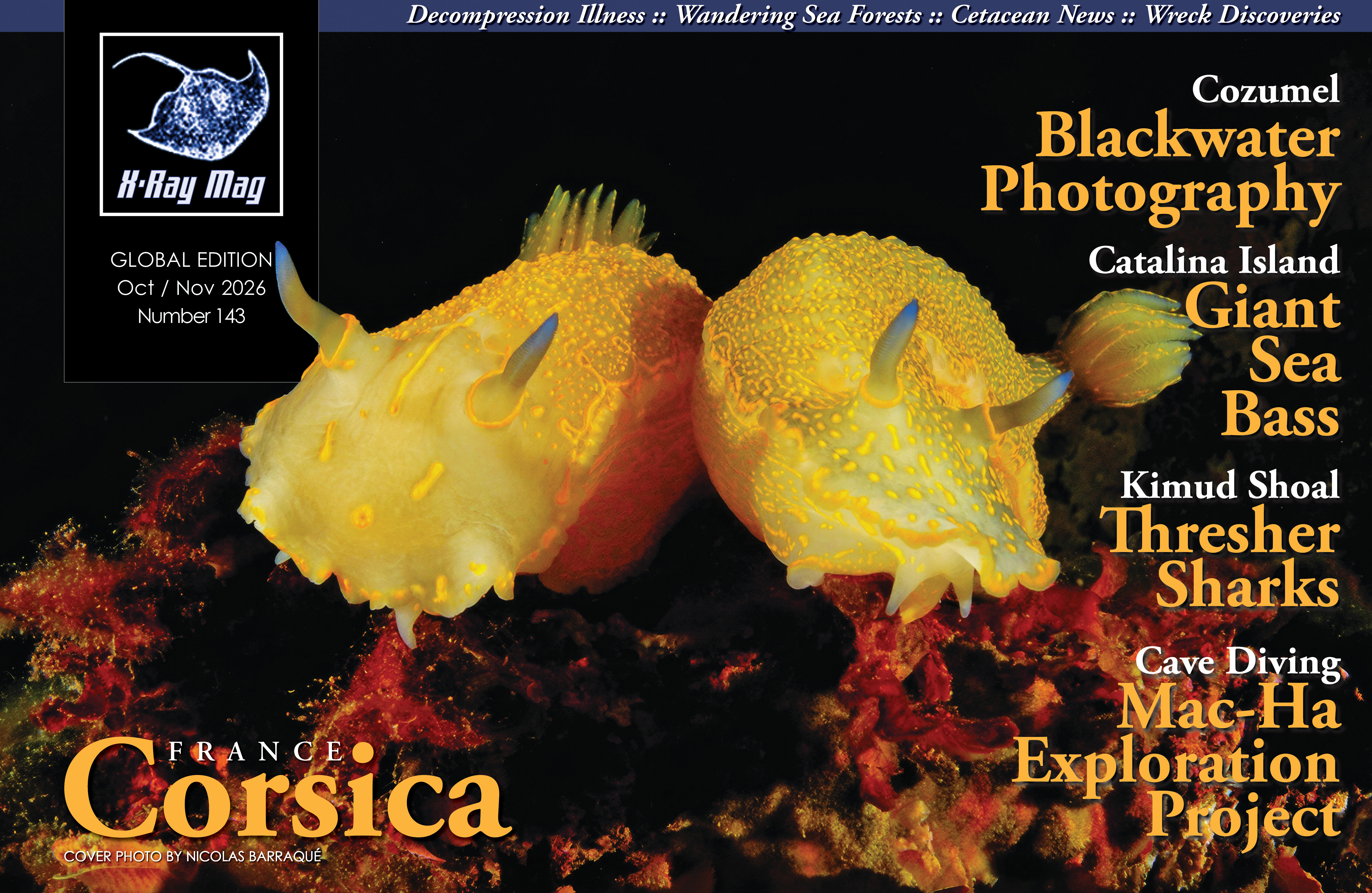 https://xray-mag.com/magazines/143 https://xray-mag.com/magazines/143
 I have spent a lot of years looking through a viewfinder, both above and below the surface. Photography has always been about capturing something that would otherwise pass — a person, a place, a fraction of a second that would be gone if we did not make the effort to preserve it. Sometimes the result is artistic, sometimes documentary, sometimes neither, and sometimes a little of both. But some of the moments that have stayed with me the most are the ones when I’ve stopped thinking about the photograph. On one dive, I saw a huge loggerhead turtle in the distance. My first instinct was to move closer. You see the subject, you imagine the photograph, and your mind immediately starts working through distance, angle, light, and composition. Then I stopped. There were already so many divers around it or heading toward it — multiple dive groups, people trying to get closer, some waiting their turn and others not. The turtle had enough going on without me adding myself to the crowd. Watching so many people converge on its space was unsettling to me. So I stayed back and took a photograph of the scene as it was. It wasn’t a photograph I had planned to make, and I certainly wasn’t thinking about composition or creating something for a portfolio. It was really just a snapshot for reference — a record of what I was seeing. Divers seemed to fill the water in every direction, spread across the reef and throughout the water column, with streams of bubbles rising toward the surface. And somewhere beyond all of that activity was the reason everyone had gathered there: the turtle. The turtle isn’t even in the photograph. I had started toward it hoping to make a photograph of a loggerhead. Instead, I photographed what was happening around it. The photograph I came away with was not really about the turtle at all. It was about us. It became a reminder of how easily our excitement can become pressure on the very animals we came to see. I wrote about that moment afterward and summed it up with a simple thought: No shot is worth stressing or damaging anything. That still reflects how I feel. There are times when we can approach carefully, make an image and move on. There are other times when the right decision is simply to watch. Knowing the difference is part of being an underwater photographer, just as much as knowing how to set a strobe or choose a lens. The moment we descend beneath the surface, we become visitors. Being a good visitor means leaving as little evidence of our presence as possible. The photograph can never be more important than the subject. That responsibility does not limit creativity. If anything, it asks more of us. We should create through the way we see, frame, light and interpret a scene — not by disturbing an animal or changing the environment to manufacture a better picture. The turtle encounter became meaningful because I stepped back and noticed something beyond the image I had first imagined. Underwater imaging, like photography above the surface, is an art form. We make choices about light, composition, perspective, movement, color and mood. Two people can photograph the same subject on the same dive and come back with completely different images because each person sees the scene differently. Sometimes the goal is to show exactly what was there. Other times it is to communicate what it felt like to be there. The camera is only the tool. The image comes from the person using it. Those tools can look very different: a large housed camera with strobes, a compact, an action camera, or a smartphone in a housing. What connects us is the desire to bring something back and show someone what we saw. A photograph of a tiny nudibranch can introduce someone to an animal they never knew existed. A healthy reef can show what is still worth protecting. Bleaching coral, discarded fishing gear, or a landscape changed by human activity can tell a very different story. Our cameras document beauty, but they also document change. That is one of the things that has always fascinated me about underwater photography. Divers get to see things much of the world never will. We notice when a reef looks different from the last time we visited — storm damage, fewer fish or plastic tangled around coral. We also see recovery, new growth and marine life returning to places that have been given a chance to heal. Dive after dive, year after year, underwater image makers are building a visual record, often without ever setting out to become historians. Some of those images may never win a contest or receive much attention. Many will sit quietly on hard drives or phones for years. Yet an ordinary photograph can preserve something important: a reef, a wreck, a species or an ecosystem at a particular moment in time. As the ocean changes, an image that seems unremarkable today may become valuable for what it allows us to remember. Underwater photography may increasingly become part of the ocean’s memory as well as our own. That connection between observation, creativity, and responsibility is why I believe conservation belongs naturally alongside underwater imaging. A photograph can make something distant feel personal. Someone who has never worn a mask or taken a breath from a regulator can still look into the eye of a shark, see the complexity of a coral reef, or recognize the vulnerability of an animal surrounded by divers. Sometimes that connection is enough to make someone care, and caring is often where conservation begins. It is also part of why WaterPixels matters to me. WaterPixels was built not only to restore or continue a community, but around the idea that underwater photographers and image makers should have a place to share photographs, knowledge, experiences, mistakes, and discoveries. The same impulse that makes us bring a camera on a dive, makes us want to talk about what happened afterward. What did we see? How did we make the image? What would we do differently next time? When I think about the turtle encounter, that last question matters especially. Sharing the photograph also meant sharing the decision behind it: why I stayed back and what I noticed when I did. Those are the kinds of conversations I want us to have alongside discussions about technique. An image can give us something to learn from even when the lesson has little to do with camera settings. Photography has changed enormously over the years, from film to digital and through advances in autofocus, lighting and editing. Action cameras opened underwater imaging to a much wider group of people, and smartphones are now doing the same. A phone in a housing can document a reef, an encounter or an environmental change just as meaningfully as a large dedicated camera system. That wider participation is good for a community built on sharing. Someone asks about a lens and another photographer explains what worked for them. Someone shares a lighting technique they struggled for years to understand. A diver posts about an encounter from halfway around the world. A photographer with decades of experience helps someone preparing for their first trip with a housing. Eventually, that new photographer becomes the person answering someone else’s question. That is how a community stays alive. Of course, underwater photographers can spend endless hours talking about equipment. We are exceptionally talented at debating domes, wet lenses, strobes, ports, sensor sizes, autofocus settings, corner sharpness and probably several hundred other subjects that most people would never understand nor care about. Those discussions are part of the fun for some, and good advice can save someone a great deal of frustration. But the value of an image (or video for that matter) has never depended entirely on the equipment used to make it. A technically perfect photograph with razor-sharp corners can be beautiful. So can a grainy, imperfect image made at exactly the right moment. Underwater imaging can be scientific, documentary, journalistic, artistic, or deeply personal. Sometimes, it is several of those things at once. What matters is what the image says. Underwater photography exists because the underwater world exists. Without healthy oceans, the cameras do not matter very much. Conservation should not feel like a separate subject we occasionally add to a photography community. It is already present in the choices we make every time we enter the water. After enough years behind a camera, it would be easy to think everything has already been photographed. It hasn’t. A familiar reef changes with the light. An animal behaves in a way we have never seen before. A new photographer notices something an experienced photographer may have passed a hundred times without seeing. There is still room to be surprised, and more people than ever have the ability to record those discoveries and share them. The world does not necessarily need more photographs simply for the sake of having more photographs. What it needs are more people willing to look carefully, learn, create, and share what they discover — and to protect the places that make those discoveries possible. Sometimes looking carefully means recognizing that the photograph we came for is not the most important thing happening in front of us. That is what I hope WaterPixels continues to be: a place where great underwater images are celebrated, curiosity matters, creativity is encouraged and knowledge is freely shared. A place where wildlife is respected and the health of the ocean matters as much as the photograph. A place where someone with the most expensive & latest system and someone with a smartphone can both contribute something meaningful. Long after today’s cameras are obsolete and the technology we currently obsess over has been replaced, the reason we carried those cameras underwater will remain. There will still be another reef to explore, another animal to encounter, another photographer discovering this world for the first time, and another moment worth remembering. What we choose to notice, preserve, and share will still matter. And somewhere beneath the surface, the ocean still has stories to tell...