



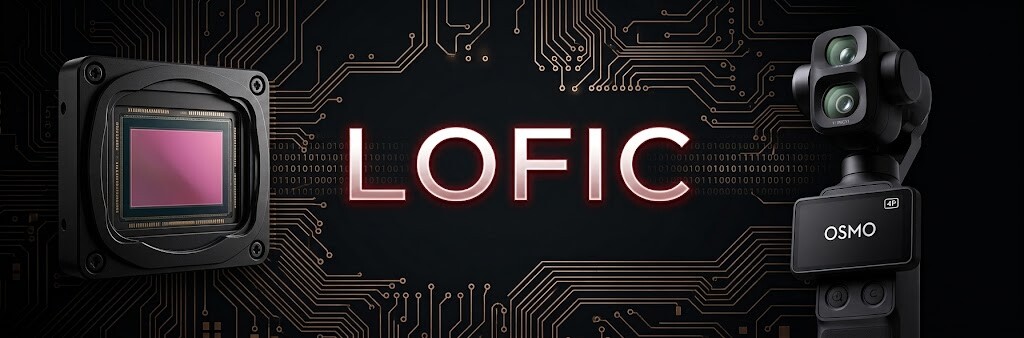

There has been discussion recently about the new DJI Osmo Pocket 4P. DJI claims up to 17 stops of dynamic range on its new 1-inch sensor, and comparisons with cinema cameras like the ARRI Alexa quickly surfaced online. Looking at the numbers, it might seem plausible, but visually the situation is different.

Spoiler: no, it is not a micro Alexa.
PetaPixel confirmed after testing it that LOFIC improves both highlight retention and shadow cleanliness, though they noted their empirical tests did not reach the full 17 claimed stops. Even if the Pocket handles backlighting very well for its size, it does not output the same image. First, 1-inch pixels physically generate more noise in deep shadows compared to the massive photosites of a Super35 or 35mm sensor. Second, it lacks the smooth highlight roll-off of Arri; on the compact sensor, the clipping to pure white is inevitably harsher. Furthermore, the DJI data ends up in a 10-bit MP4 using D-Log 2, going through a processing pipeline far different from the RAW workflows of the Alexa family. It remains a notable achievement to have this exposure latitude on a pocket camera, which is due to the LOFIC hardware.
What exactly is LOFIC technology?
To understand this solution, we need to look into how a sensor is built. Simply put, each image pixel corresponds to a photodiode, which is the physical silicon element that receives light, photons, and converts it into electrical charge, electrons.

Imagine this photodiode as a small bucket collecting light. This bucket has a maximum physical volume, which in technical terms is called Full-Well Capacity.
In standard sensors, if we adjust the exposure to properly read details in the shadows, the buckets located in the very bright areas of the frame, such as backlit water surfaces, fill up in a fraction of a second. Once full, any continuing light overflows and is lost. The sensor converter then registers a total saturation signal, leaving us with an unrecoverable white area in post-production.
This is where LOFIC, Lateral Overflow Integration Capacitor, comes into play. For every single pixel, alongside the photodiode and standard circuitry, engineers added an expansion tank of sorts: a dedicated capacitor.
The primary photodiode is kept sensitive to capture a clean signal in shadows and midtones. However, when the light is strong enough to saturate this first stage, the excess electrical charge is managed and stored in the lateral capacitor, which has a larger storage capacity.
When generating the image, the sensor architecture can simultaneously use the signal from the photodiode and the charge stored in the LOFIC capacitor. Merging this information results in a frame with higher dynamic range, physically generated at the exact same moment, single-exposure HDR, and without the flaws of software HDR.
Why it makes a difference for video
This technology changes little for photography. If there is too much contrast, we use bracketing or recover the shadows from a solid RAW file. In video, however, classic HDR, which merges frames with different exposures offset in time, has always been problematic. If we film fish, waves, or anything moving quickly, the merging of frames inevitably creates trails and ghosting artifacts. LOFIC solves this issue by capturing the entire dynamic range at the exact same physical instant. You can shoot at 50 or 60 fps and keep the action perfectly sharp.
The current obstacle for larger formats involves architectural complexity and power optimization. Bringing this system to larger surfaces requires circuitry capable of handling a vastly superior amount of data and bandwidth, all while limiting power consumption and the resulting thermal dissipation.
Current availability and future developments for M43 and smartphones
It is not surprising that this technological advancement comes from the smartphone market: the global smartphone market in 2025 totaled 1.25 billion units sold, while the entire photography sector, including compacts and mirrorless cameras, did not even reach 10 million.
Some manufacturers have already taken action. Xiaomi adopted a LOFIC architecture, utilizing the OmniVision OV50X or Light Fusion 1050L sensor, on the main 1-inch camera of its Xiaomi 17 Ultra. OmniVision itself is among the most active companies on this front, integrating TheiaCel technology, based on LOFIC, to provide a concrete response to the needs of the automotive sector, where autonomous driving sensors require flawless reading of shadows and highlights in all conditions, leaving no margin for error.
Outside the smartphone world, the Osmo Pocket 4P is effectively the first video camera to adopt it. Towards the end of the year, we will see it on an increasing number of high-end phones thanks to the new Sony Lytia L910 sensor, which has already entered production: roughly 50 effective megapixels on a 1/1.28 type chip, 100 dB of single-exposure dynamic range, about 16.6 stops, and 4K60 HDR video. A module that Sony officially presents by emphasizing the low-power optimization of its circuitry.
Final Thoughts
The transition that concerns us most directly, however, is the arrival on mirrorless cameras. Currently, the physical limit achieved and marketed with LOFIC architecture is the 1-inch format. However, industry roadmaps and component suppliers indicate that smartphone manufacturers aim to cross this barrier to reach the Micro Four Thirds format in the coming years. That format will be the natural bridge to our dedicated cameras as soon as the systems to manage the large volume of data and thermal dissipation on the camera bodies are finalized.
-
 2
2
-
 3
3



Recommended Comments