



Everything posted by Tom Kline
-
Nikon has done it!!! We now have fish AF as a selectable subject in the new Z 5II C. See this informative vid: https://www.youtube.com/watch?v=8pIkIlUEnrM
-
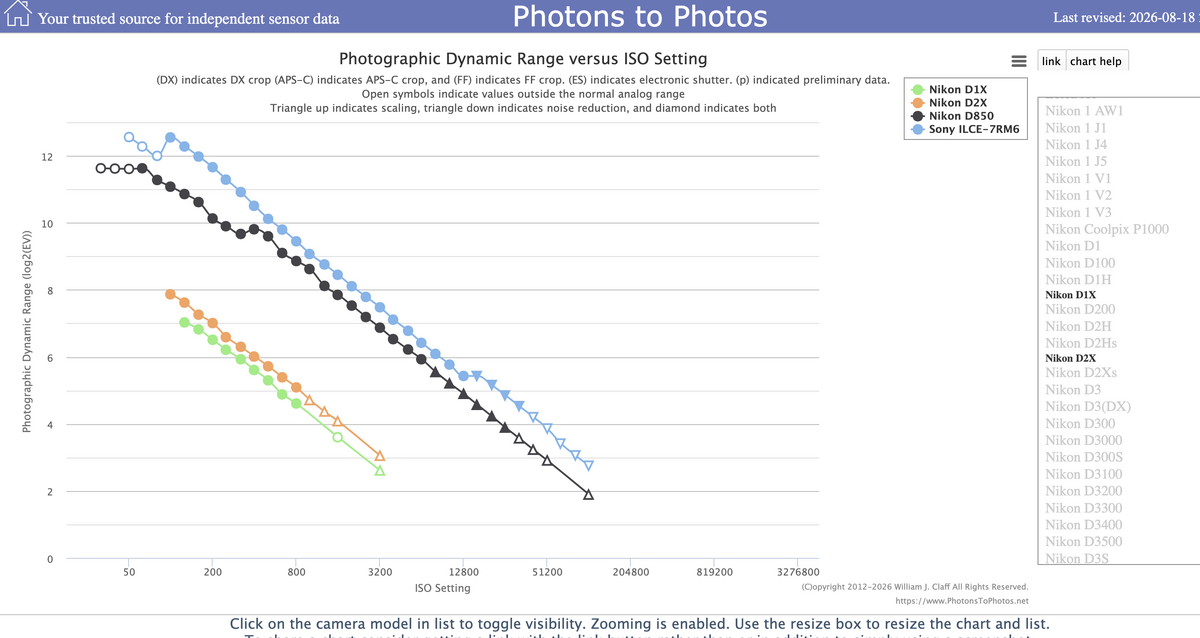
I specialize in shooting salmon under water in Alaska where I live now having done it digitally for over 20 years. My very first digital underwater shoot was with a Nikon D1X that yielded the cover shot for a book published by the American Fisheries Society. (I am a fish scientist: an aquatic ecologist specializing in using stable isotope analysis) The technology has come a long way since. I used the Nikon D2X as my main camera for about the first 8 years. Both The D1 and D2 cameras were APSC or DX in Nikon-speak. From participation on Wetpixel I learned the DX limitations could be overcome by the full-frame Canons such as the 1Ds2 which I got and literally used alongside the D2x. I even shot a pic showing this which I tongue-in-cheek titled Nikon vs. Canon: https://www.salmonography.com/Salmonid-Topic/Photography-techniques/i-KS7Jjpz/A I considered the D2X a 400 ISO camera and the 1Ds2 a 1600 ISO camera. Today’s cameras can do much better but there remains this 2 stop ISO advantage due to a larger sensor. The D2X was Nikon’s flagship camera when I bought it so had the best tech available to Nikon at that time. The sub-flagship cameras typically had poorer performance and this still applies today. The “flagship” model changes frequently within each brand. I would say the Sony R6 is their flagship today although they may not agree. One aspect of comparing cameras is to look at the Photons to photons website. I took the opportunity to plot a few select cameras on it. See attachment. You can see the leap from the D1X and D2X to the D850 and now to the R6 - technology advancement continues to march forward! I would not spend a lot of money on older tech. Nikon is overdue with updating theirs. I have a Z9 but only use it for topside shooting. Its secret super power is that the cameras has NO shutter so is truly silent. I gather the Z8 does not too. This is great for wildlife photography. I gather the R6 still has a shutter in it. The Z92 will likely be too late for you. I am all too familiar with the need to spend grant money within a specific time - mostly being the federal fiscal year here in the US. As for housings, if the Nauticam model is too large you might want to look at the competition as they might be smaller (at least the controls and grips may not stick out as far). As you are in France you might want to consider one made in the EU. Service for one will be much easier. I have been using Seacam as my housing brand. They have an R6 housing development as does Subal and Isotta: https://www.backscatter.com/Seacam-Sony-a7R-VI-Underwater-Housing Scroll horizontally to see the various brands. If the Viz is good you will be able to do a lot with the 100mm macro. Basically any true macro lens (various manufacturers) will blow away the lens on your compact camera. I use the Nauticam wet lenses on my Nikon 105mm and 60mm lenses with Saga ports (Saga is located in Barcelona). Instead of the MFO-3 with its 1.5m limitation I bought the new Marelux 60 add-on that fits just like a Nauticam one. To shoot larger things here in AK (0.8m is similar to the subject width of many of my salmon shots showing a female with her mate just behind her). I use mostly fisheye lenses and to a more limited extent the 16-35 zooms at 16mm (both C and N). The 16mm lenses need more working distance so get used more late in the season when the air temps get below freezing ( glaciers upstream stop bleeding in silt). Many shots with these lenses are on my website (exif data avail at the tiny dot with the i on it), As for underwater strobes I VERY STRONGLY suggest you get the Retra Maxi. I was using mine just yesterday with my Nikon D4S shooting in continuous mode at 5 frames per second!!!!! Forget about recycling times. Already a lot has been written on the strobe on this site.
-
I have ports made by Saga to use Nauticam wet lenses via a bayonet adapter on my Seacam housings. This gallery has several pix and flix showing them in use: https://www.salmonography.com/Salmonid-Topic/Family-ties The lens front element is very close to the port glass. In order to use the EMWL with the Nikon 60mm lens Saga made the port a few mm longer for me in order to accommodate the required diopter lens inside the port per Nauticam. I gather Saga makes these ports to order. Jose is a very good communicator via email (fill in the order form on the Saga web site to get started). Make sure to have them notched like the Nauticam ones. See: https://sagadive.com/en/product/frontales-conicos-delrin-saga/ Scroll down to see the various lenses and housing brands accommodated.
-
Still have some RS gear some converted by Seacam. Dolls were the department of my 3 younger sisters, seem to recall Bs but not Ks (6 decades ago).
-
Retra has a reflector that fits inside a reduction ring that I recall increases GN by one stop as the light gets concentrated. Retra UWTReflectorThe Reflector boosts the light output by +1 F-stop (in water) and narrows the angle of light for more precise light control. The light output is ideal for macro and CFWA photography in manual or TTL myup.
-
Experience. I used the Nikonos RS for a decade and had several close calls starting with the first time I used it when I did not know that silicone grease should not be used. Silicone grease was the most easy type to get in the US. For example Aquacraft sold 1 oz tubs (if I recall the amount correctly - they were about 2 " in diameter and and inch high). A tub (cost about $10; 1980s) would last for several years. Easy to handle and use - just stick ones finger into the grease after removing the lid. Aquacraft sold lots of small scuba accessories and were sold in most scuba shops. OTOH the teeny tiny Nikonos tubes were better used as a toothpaste tube prop for Barbies and Kens. I recall having one slip through the mesh of my mesh bag with various other loose parts (save a dive etc.) taken to a dive site and then get stepped on - squish!! More than once I had the tubes land between the two haves of equipment cases next to the hinge. The tubes were so small they fell out of compartments and onto the hinge area very easily. Another squish. By the time the RS came out I had long sworn off using the those Nikonos tubes. Silicone grease worked just fine on pre-RS Nikonos cameras. As well I believe the Inon strobes (I have numerous Z220 model strobes) use silicone o-rings for the battery compartment. Two + decades of experience. I have had them extrude and tear. There is a warning about them extruding on the strobe but that can be hard see (lots of dimly lit spaces, night etc.). I suspect Inon uses them because of the plastic body of the strobe. A hard o-ring might crack it. Lens ports and main o-rings are not static, they do move. The RS ones rolled in the groove as evidenced by the distribution of crude on them after a use in water with suspended sediments.
-
BTW I have assumed the reason for the light going out on a strobe is to have more power available to recycle and thus speed it up. I only use these lights when scuba diving on night dives. Use as an aiming light and to convince DMs not to give me one of their lights - I try to give the appearance of a Christmas tree! For non-scuba dive dusk and night shoots I use separate lights that are never aimed on the same axis as a strobe, often they are at or near 90°.
-
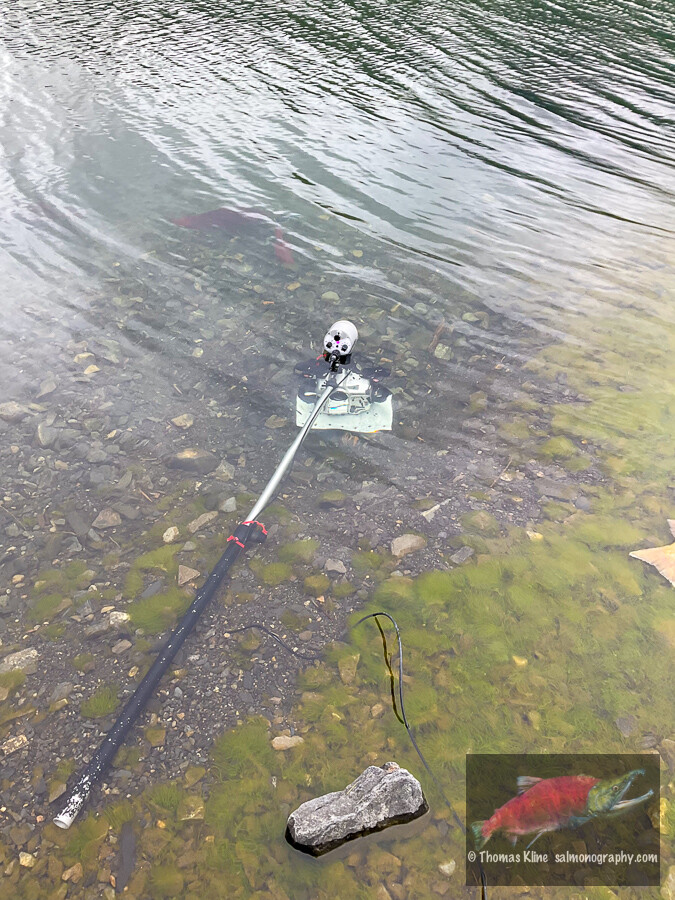
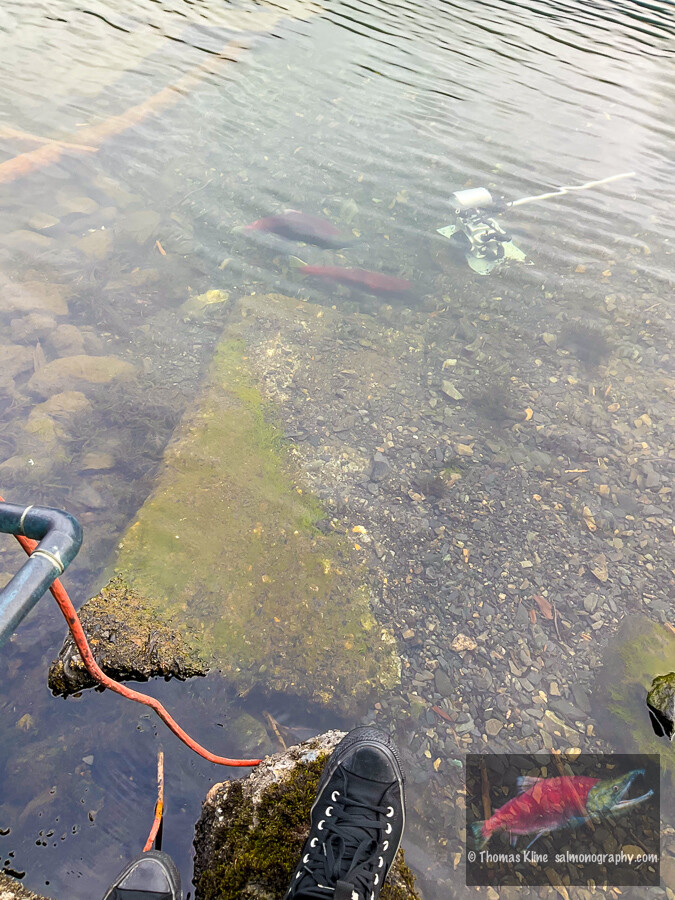
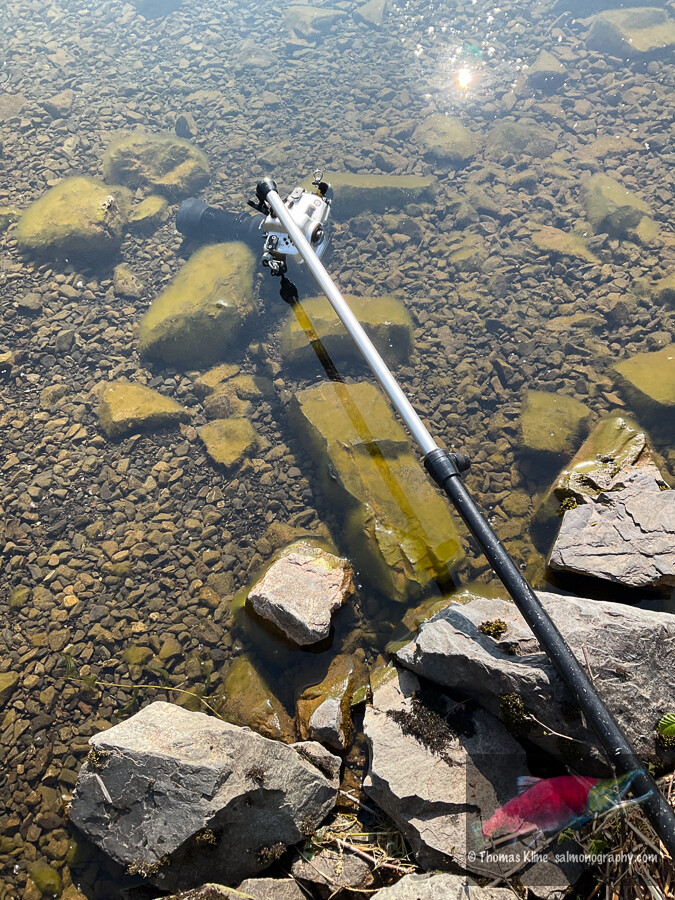
From the article: "The battery compartment is confidently sealed with two heavy-duty Buna rubber O-rings. Most other strobes on the market, such as the Backscatter HF-1, are sealed with thinner and more delicate silicone O-rings." The replacement o-rings I have received from Retra were labeled EPDM as are the Maxi ones on this page: https://www.retra-uwt.com/en-us/products/o-rings-for-retra-flash-battery-compartment They should have a less obscure place to provide this specification as well as here. Here is one of many o-ring material info pages: https://www.theoringstore.com/store/index.php?main_page=page_4 Scroll down to see the good and bad of the various types. Looks like one of the worse types is silicone. One of the fatal factors of the Nikonos RS. I have a story about this as well. I have been using my Retra fairly intensely for a couple of weeks thanks to some good weather that just turned nasty yesterday - the lake (in the pix) is already up by three feet. Getting in some post-p! I have a few setting data points. At +3 (power level) I was able to take a pic every 3 seconds (time by intervalometer) and got about 1500 shots on a full charge (stopped shooting on the blinking red signal a couple of times) . My last shoot (Saturday, two days ago) I was able to watch the ready light (see pic) which did not go out when shooting 5 frames per second at 0 (power level). I drained the battery in my D4S (Z9 gen battery - version-d) before the Retra batteries died doing 5 fps bursts (via remote cord which you can see in the pic). Is there significance to the ready light not going out during a burst? (directed at Oskar). Retra needs to provide guidance on max FPS for different power settings in the User Manual app IMHO. The red blurry things in these pix (taken with an ipad - HEICs imported into LR) are Sockeye Salmon.
-
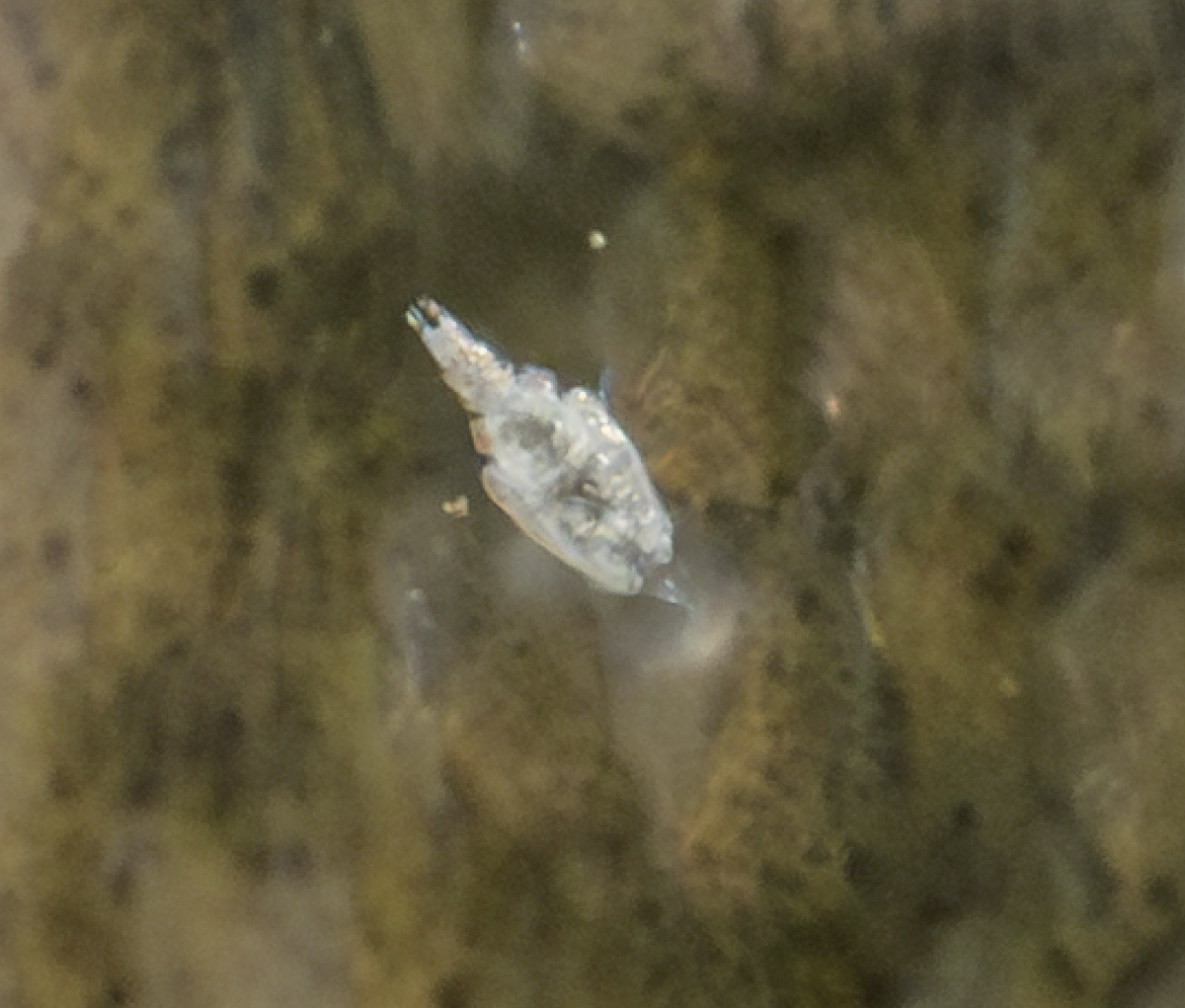
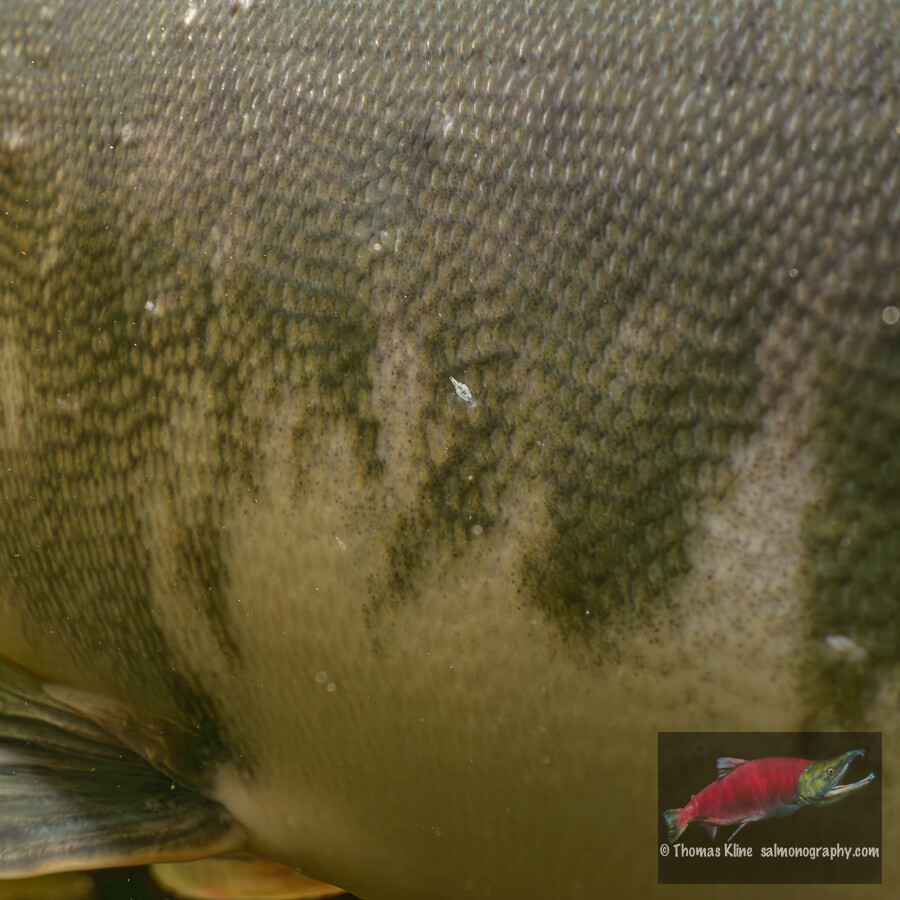
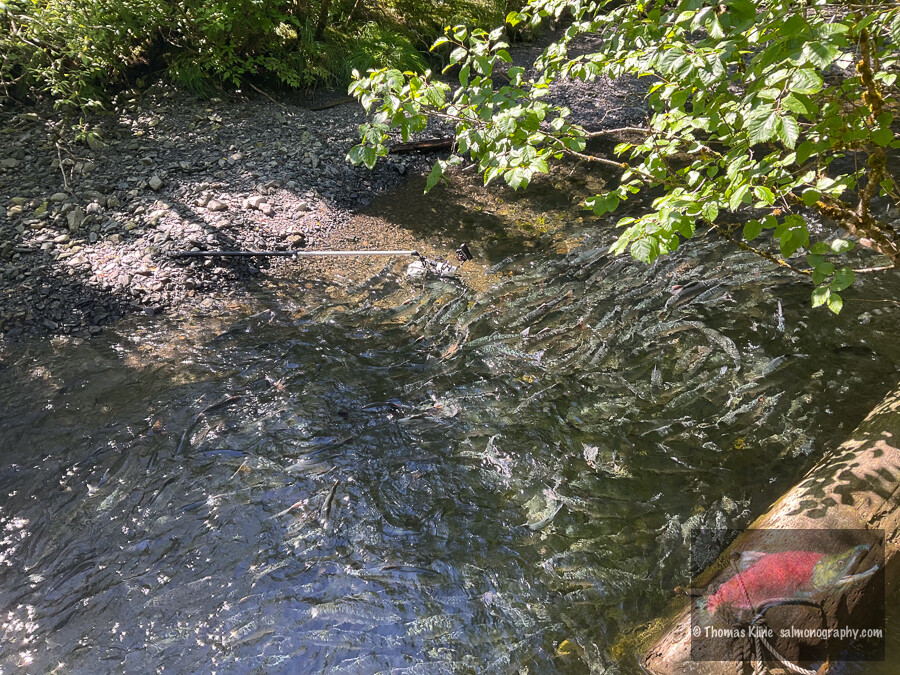
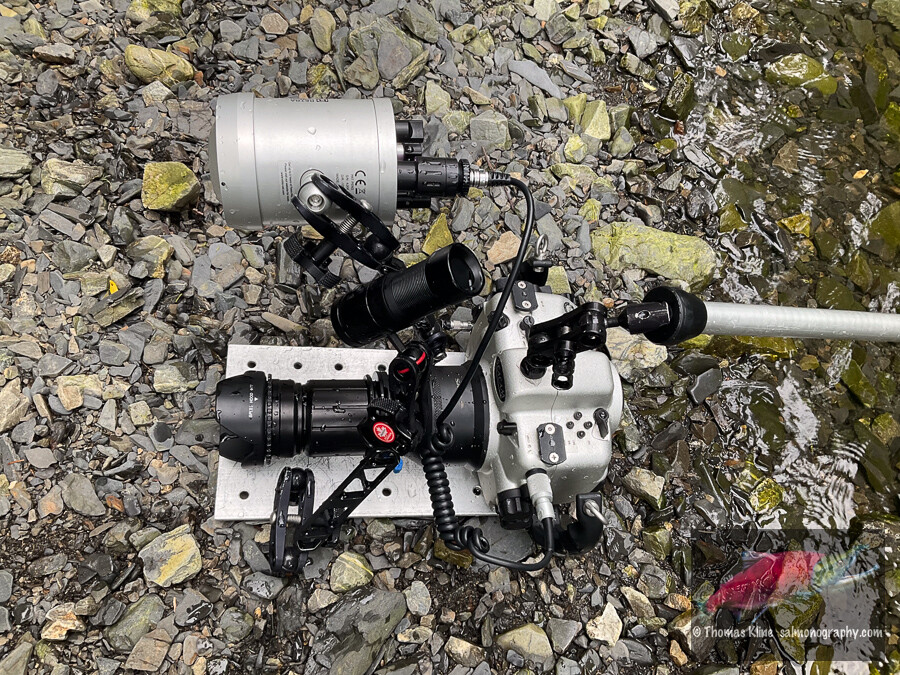
I have now had Marelux 60 lens for about a month. I bought it for the specification of focusing well beyond the ~1 meter MFO-3 limit. The MFO-3 had been on my radar since the announcement. I was about to buy the MFO-3 about the time Phil wrote his blurb on the Marelux lens here on Wetpixels. I then looked on the Marelux site and contacted them to verify this specification which they did so I ordered it right away as I have one use case here in AK and it was due about 1 month after the solstice: the arrival of Pink Salmon in an intertidal creek near where I live. For a few days sea lice stay attached and I wanted to shoot them with a normal focal length. We had a lot of rain from several storm systems during July. When it cleared up the residents along the creek told me they had been there for just a couple of days and it looked like the whole run entered at once likely triggered by all the rain. So I had my chance. This was also my first salmon shoot with the new Maxi strobe which I had pre-ordered way back when. See pix. One is square crop of a D800 image showing the flank of a Pink Salmon. Note the bug near the center. I looked at it at 300% and did a frame grab which is attached as well. This is an early stage of a sea louse. Prior to the big rain I attempted shooting it in the nearby lake on a sunny day. Although it looks calm there was enough of a swell to cause the algae I was shooting to sway so those pix had to be binned. The other pix show how I used the lens on a Seacam housing. I used a Nauticam bayonet adapter and bayonet holder on a Saga port. I bought a cheap 77mm thread petal lens shade that has a plastic thread so is semi-disposable. I would avoid using metal-metal threads in seawater. The rubber shade used on my first trial (in pic) did vignette.
-
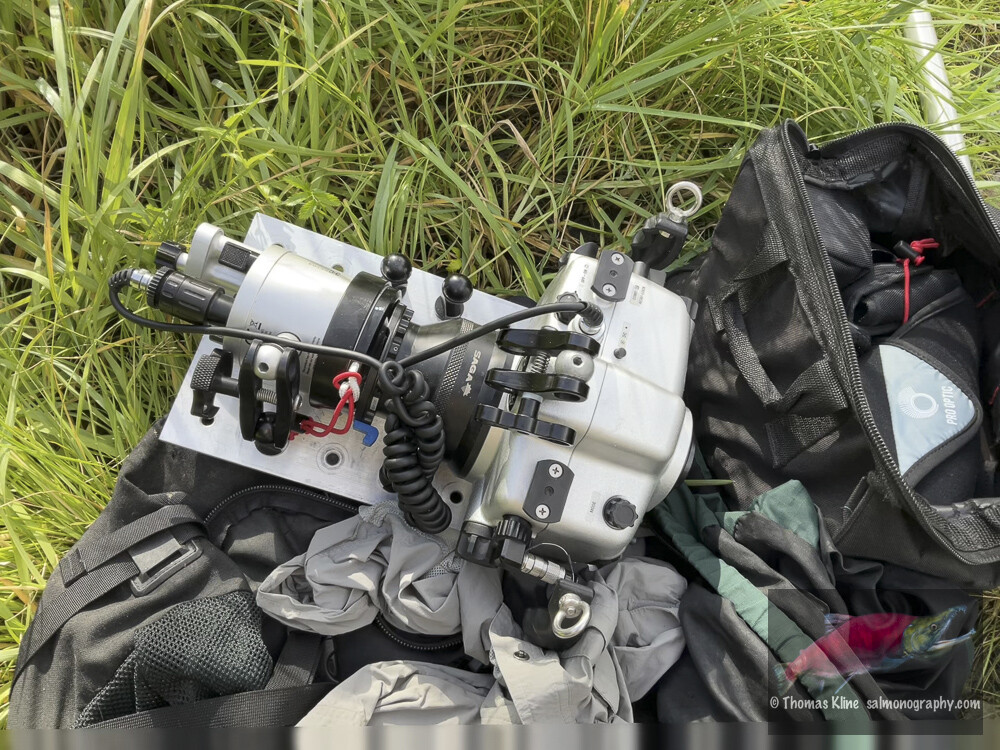
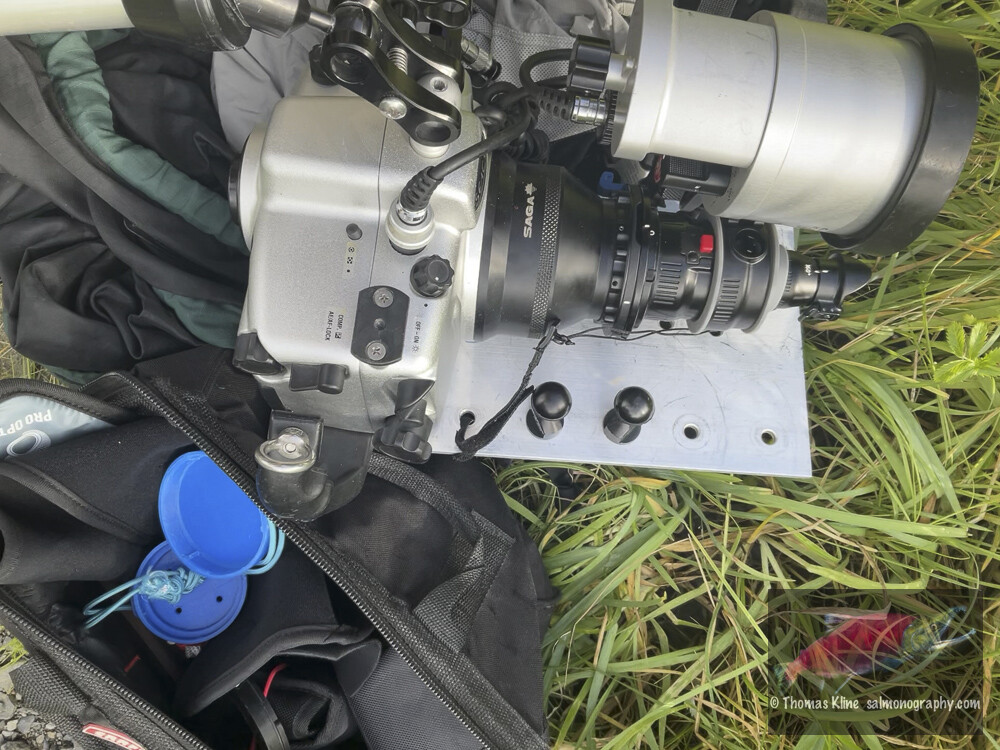
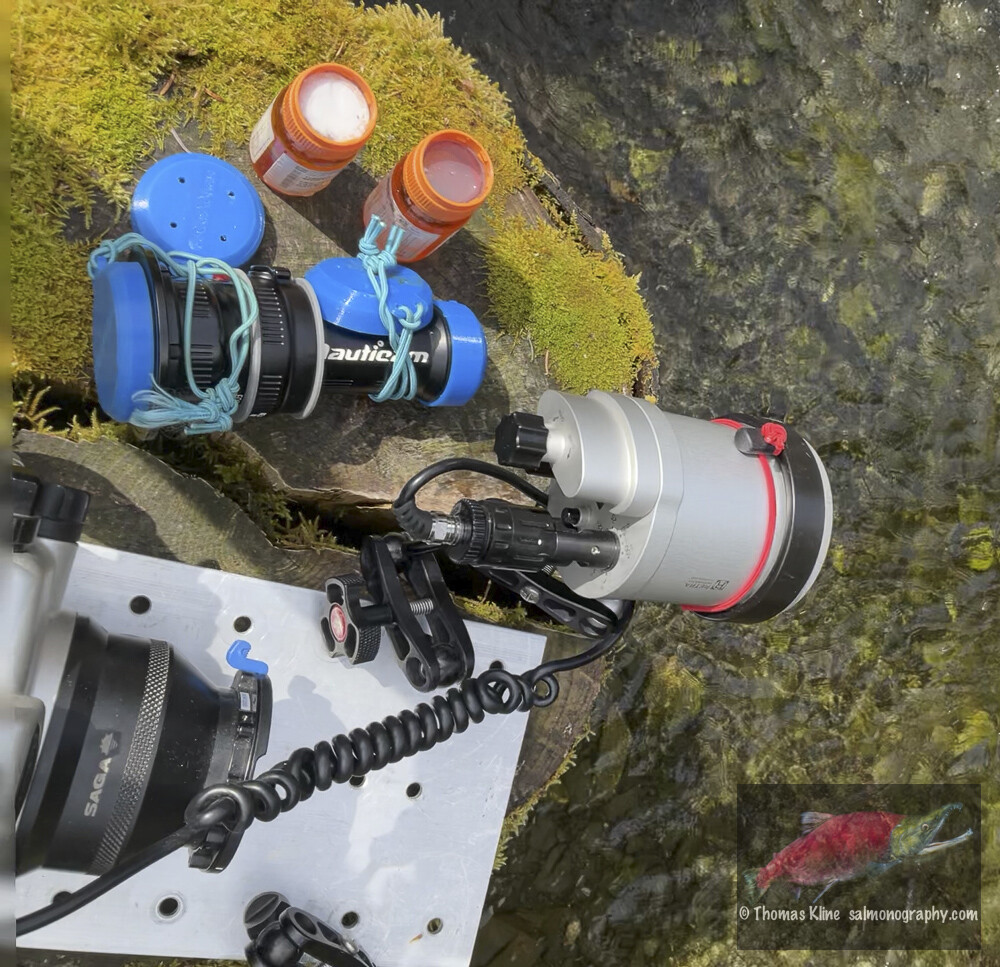
When boat diving (e.g. Hawaii) I giant stride in after having stuffed the EMWL into the pockets of these: https://fourthelement.com/product/technical-shorts/ The pockets could be larger (esp. on larger sized shorts - I have the max size) as the parts stick out a bit. With the 130° I put the objective with hood attached to it into one pocket and the focusing unit plus relay lens unit (straight version) into the other. Carrying the EMWL parts to the dive store (in the case of HI diving), I carried it with EOcean lens caps on the ends and the parts wrapped in a lens wrap. I do the same for local shooting of salmon. See pix attached. Note the bright blue color. Black parts tend to disappear in the dark which it is here for about half the year (same latitude as Oslo).
-
Thank you Jim, glad you found it useful. To your question: About a decade ago a visiting Swiss photographer used a wireless remote control by placing the device in a floating small sized Pelican case that was wired to his housing using a cable similar to what I use. You might be able to build something like this yourself. Another solution, which I have used, is to trigger an underwater camera using a built-intervalometer. None of my Canon 1D type cameras had this so it was not an option for many of my shots (I have used four different 1Ds). First use was with a Nikon D3X. Its limitation was a maximum of 999 intervals which is not many shots when it comes to salmon. I selected 3 shots per interval but this was more of a band-aid solution. More recently I have used the intervalometer in my Nikon D4S which allows 9999 intervals so is far more useful. As well the intervalometer works well in conjunction with a remote cable, for example, I used the intervalometer to take a shot every 15 seconds as a back-up in case I was away from the release stick or the release stick ceased to work (this has happened). Most shots were done with a cable. I remember this shoot because I drained the battery in the D4S with the very last shot (of over 10K) showing actual spawning. Needless to say a lot of files had to be culled. Intervalometer shooting is also useful for angles where one cannot be close enough to observe such as on the far side of a stream relative to a primary housing. Also one has available the full use of two hands to move a polecam rig while the camera keeps on shooting. This was how I managed to get multiple perspectives when shooting the underwater shots for this gallery: https://www.salmonography.com/Salmonid-Topic/Family-ties You can see in the topside shot included in the galley that I was on the ground right next to the stream and the camera pole was aimed towards my left side (can only see one of red sneakers I was wearing over my waders in the pic). As well, this particular housing has just two bulkhead holes, one for the flash synch and the outer for a “remora” (a common name for remoras is shark sucker but mine is a housing sucker!), so I was compelled to use the intervalometer.
-
I have been using 8-cell Power-X chargers for many years. My 4th copy is black whereas the 3 older are grey. I am looking at the tiny label on the bottom of the black one now - It has MH-C801D in the name but no mention of smart. Mine all came with AC adapters for US current that connect with a DIN type plug. The only issue I have had is that segments of the LCD display seem to fail after a while (years). This happened to one unit of my first two bought (close to 2 decades ago) so bought #3 and more recently #4. The now 2 units with a semi-functional LCD still charge but hard to tell with missing segments. It is a good idea to have 2 of any type of charger so one can swap them out or have two to charge more batts (16 at a time is minimal for Retras). A possible issue on boats is unreliable electricity. This was a problem on a research vessel I have been on. So all computers were plugged into UPS units. On one cruise it was reported that one UPS unit caught fire as a result of the ship's poor power (a 1960s vintage vessel) on the previous cruise. I would not be surprised if the longevity of power adapters is much less when used on boats. Possibly with portable generators as well.
-
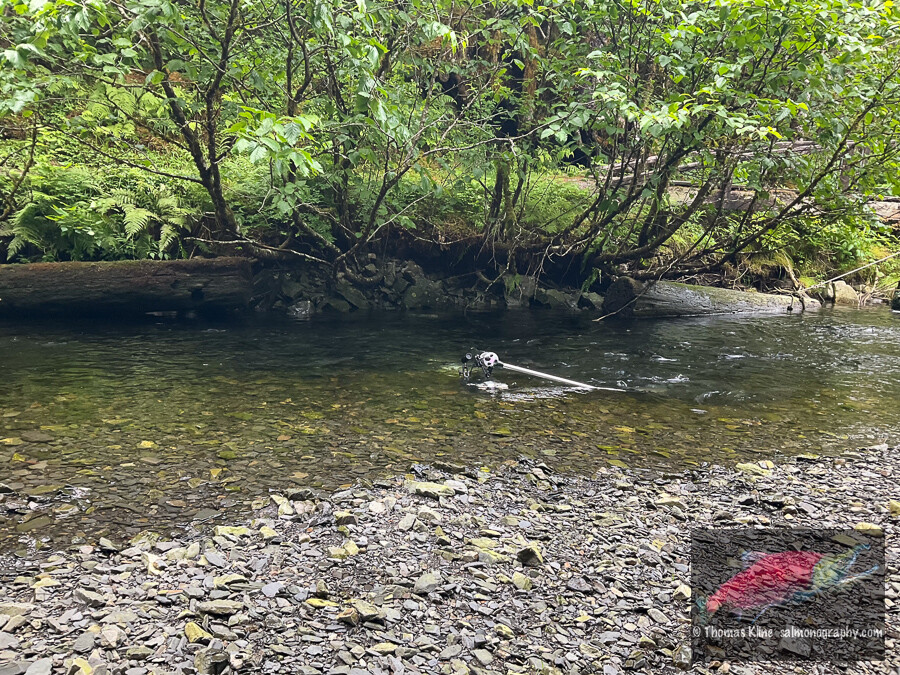
Remote control has been a core technique for my UWP of salmon for over two decades. There are many pix showing set-ups on my web site at: https://www.salmonography.com/Salmonid-Topic/Photography-techniques/n-mnzBPB They are in chronological order with newer ones first. They show Seacam housings most of which are set up to use the Seacam remote control. https://www.salmonography.com/Salmonid-Topic/Photography-techniques/n-mnzBPB/i-ChFJBmw/A shows a set-up placed on the ground. In this pic you can see the bulkhead near the bottom of the housing where the remote is plugged in as well as the remote control “stick” at the other end of a 10-meter long cable, my standard length for remote control. The button on this stick works just like the shutter release button on a camera body (at least for Canon and Nikon, the brands I have used). A light touch on the release button wakes up the camera (if the camera is asleep) and turns on the autofocus (AF). A further push triggers the camera. As the AF technology has improved over the previous two decades I have had to adjust the timing between the first touch and the triggering to allow the camera to focus. I often took a full second way back when, following advice given by Chuck Westfall, the late Canon tech rep, on the net. Here is one example: https://digitaljournalist.org/issue0506/tech-tips.html This is not the one I recall reading which may have been on DPR or Photo.net. Regardless, it is important to finesse the AF system a bit especially if one is using a more computational type of AF such as auto-area which is what I use with Canon. Nikon came out with a similar mode starting with the D4 generation. The many shots on my website suggests this works. There are other makes of remote control besides Seacam. I have used the Aquatica remote with the Nikon D1x which I installed by disconnecting one of the N5 bulkheads from the hotshoe fitting and installing a cord with a fitting for the Nikon 10-pin socket on the camera. The Aquatica remote uses Ikelite cords that connect with the N5 bulkhead as opposed to the S6 bulkhead used by Seacam. The Aquatica release does not separate the wake-up-AF-on and the trigger functions; it is just a simple switch so I connected two of the three wires on the inside of the housing (that goes to the camera) and only used AF priority. Nonetheless the first shot in a series was typically OOF when using the Aquatica release. It might be better for video but I have zero experience with that. Reef also makes a release. See: https://reefphoto.com/products/zen_remote_release_handle. It is a bit cheaper than the Seacam and uses Ikelite cords. I have not only not used it I not even seen one in person. Hopefully someone will provide you with some info on this. The Nikonos RS had a remote control as well. I modified mine to work with the D1X because I could separate AF-on from triggering. The RS release is a piece of junk compared to the Seacam one. I will leave it at that. Cheers! Tom
-
Done. The button label looks like a cartoon call-out. BTW, before seeing this I did not know you are responsible for the new vid show, thought it might be Matt's!
-
A serious blast from the past! An actual table of contents for an internet thing!!! Nota bene, a table of contents is something one typically found near the beginning of books. Claude, however, is far from perfect. See the Seacam entries at https://wetpixel.echeng.com/companies/seacam/. "Both (viewfinders) were available for all Seacam housings..." The Seacam Silver housing for the NIkon F5 was offered in versions that did not take the interchangeable finders but instead had a flat window for use with an F5 with an Action-finder attached (DA-something, I know because I have one). As well, the remote system started a few years earlier before it was shown at DEMA (2007 as reported in the Wiki) because I was able to order my D2X housing (late 2004 or early 2005) with it installed (ordered retroactively during the 9-month wait it took). I seem to recall the remote was announced alongside the Seacam housing for one of the Canon 1D cameras (either 2 or 3 series). When I saw that on Wetpixel I called Liz at SeacamUSA and asked about adding it to my housing as well as the big question for me: Would it be able to be used with longer cables than the lousy 1.5 meters of the RS remote control (which I had at the time). The answer was yes and has been at the core of my digital UWP.
-
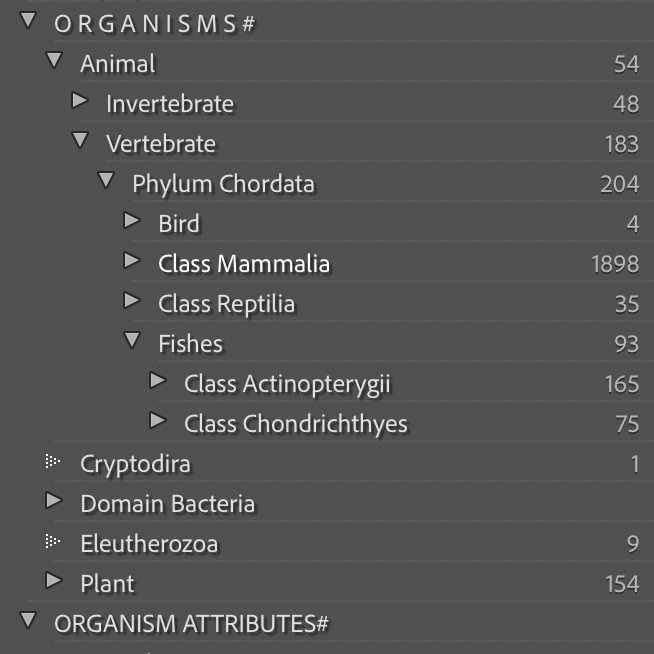
After making the above post I saw that there was a big error in my hiearchy which I have just fixed. Fishes was in the wrong place. It was an easy fix.
-
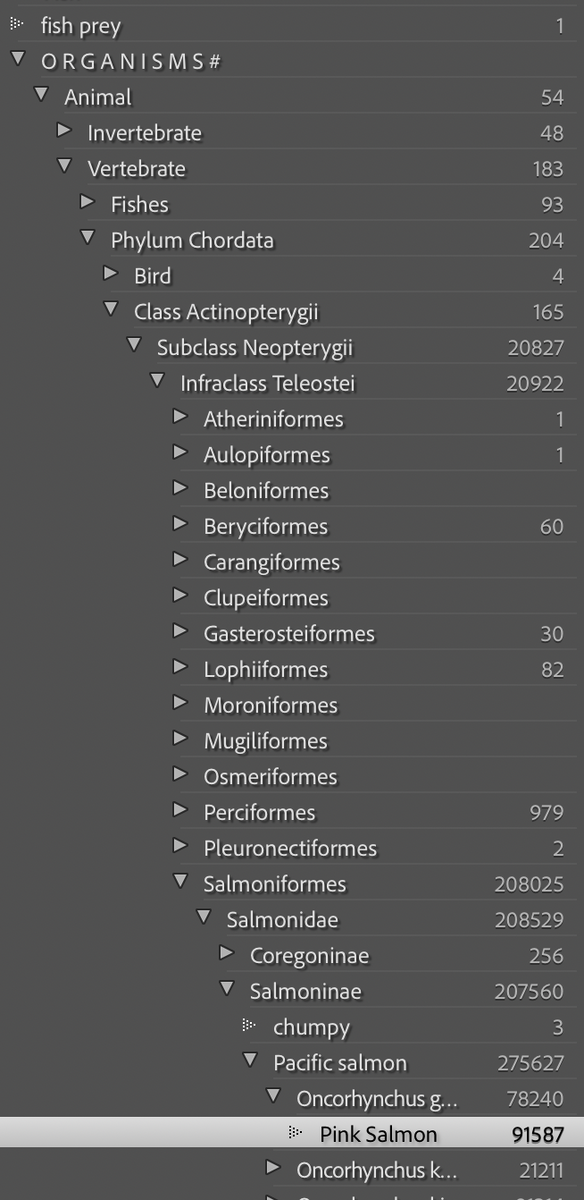
A hierarchy is useful for doing the whole taxonomic nine yards. Here is an example from my LR catalog. I only have to type in pi, the first two letters in pink, and LR often gives me pink salmon as the first choice. Select that and all the higher bits are automatically added on LR export such as when generating jpegs. Note that I have over 91K pix of just that species but the number above is smaller. It is possible to equalize the numbers but it is time consuming so I have not done it for a while. As well you will note the mixture of English and scientific names. This is so the English names for higher taxonomic groups also get included in the key-wording. The includes some rather obvious words like vertebrate. I have been using LR since version 1.0 so this is a fairly developed KW list. It is VERY easy to modify. Just drag the keyword around in the list. Put it under the KW you want in the hierarchy. I have done a LOT of modification over the years. This includes having to deal with taxonomic revision such as for the mantas a few years ago. Often have to fix spelling errors! Need to do some clean up as well - the fish prey KW needs to be moved or deleted. I use the # symbol as well as all caps to designate a division in the KW list just to keep them more organized. It can selected (via a dialog box) so that this not exported hence it is a non-keyword.
-
Looks like a potentially useful tool. Looks like I will not be able to use it as I have Intel macs (tower and laptop) and will NOT be updating my pro model anytime soon (very last Intel model). At any rate it looks like you have loaded up on beta testers. I think the way to do the test is to make a "daughter" catalog for one area. I have done this for Hawaii and loaded it onto my laptop for a trip to HI. I was thus able to use existing keywords as well as see what I already have in the way of pix for a given spp etc. as I imported new images. New pix were in a new folder in this catalog. On return home I made a daughter catalog (selecting the new folder) on my laptop which was then imported onto my mothership (tower computer).
-
I have the adapter Chris mentions. There are several versions. I have used three versions thus far. One of the first two might work for you. It is a bit of a Rube Goldberg with both fiber optics and a cable, one on each side of the adapter that dangles in the middle. I found this to be not rugged enough for my use in Alaska. The third version screws into a Retra starting with the gen 3 models so does away with having to use fiber optics. This is what I am using now. One thing you should know is these adapters are for manual use, no TTL. I suggest that you use a strobe that takes N5 cables. This is the only way you are likely to get TTL flash which was more useful with film than with digital as there is no chimping with film. There are loads on the used market for not very much. The last new model was the Nikon SB105 that was introduced to replace the recalled SB103 so are likely to be not too used. Make sure to have back up synch cords on hand as they do eventually fail.
-
Looks like it may be an Acropora. Really need a close-up shot showing the ends of an arm. As well it looks like a fairly young colony (small size - few polyps) so may not have developed much of the 3-dimenional aspects of one that is more developed.
-
Shorting out the triggering contacts should trigger the strobe. This trick can also be used on topside strobes. Some (mostly older and studio) models will generate a significant arc. Make sure to have the strobe power,on for a while to reform the capacitors - 30 minutes should work.
-
Nice report! A basic tenet of underwater photography is that one needs to minimize the water distance between the camera and the subject. Therefore the angle of view of one’s optics needs to be proportional to the subject size and therefore the focal length inversely proportional. A 200mm focal length macro lens will be great for shooting butterflies topside but mainly useful for tiny subjects under water. Aiming and focusing a 200mm will also be a bit more challenging than shorter focal lengths.
-
I think it is now more important that ever to sign one's works to "humanify" them. Hence a watermark. This can be forged as well but if there is an authorship question the author can be contacted to verify. It is only a matter of time before AI starts adding imperfections - a speck of backscatter here and there for example. Easy to ID species will be less problematic for AI compared to others. I invite people to look at dichotomous keys to see the types of minutia that may be needed for others. Some require looking inside as well as I recall a fish key I used in a class that showed up during an examination that required knowing the peritoneum color.
-
Tariffs strike again!
-
I wrote it live so to speak but I did have to scroll up and down quite a bit to see the prev mssgs super keyboard challenged



.jpg.857dbbfbdc4d79d9c6ebf7b4ba96ed1b.jpg)

