Everything posted by Tom Kline
-
Your solution looks quite a bit more elegant compared to a simple rectangular piece of aluminum which is what I have been doing recently. In my case I am seeking to reduce negativity due to the EMWL system so use float arms. https://www.salmonography.com/Salmonid-Topic/Photography-techniques/i-8NTBjs5/A
-
The numbers following the dash in the model names reflect the chronological order of when the model was introduced so has NOTHING to do with magnification. Yes it should be possible to give a magnification factor but this is probably easier to do empirically as Chris did in the MFO-1 thread. The MFO-1 is more akin to a CMC than a SMC. I had been thinking of trying to use a CMC-2 with my 105 but now can trash the idea.
-
Hi Reefy Thank you! I most likely used a single flash mounted at 12 o'clock above the housing. This technique shot is from the same year: https://www.salmonography.com/Salmonid-Topic/Photography-techniques/i-SCFhVQk/A
-
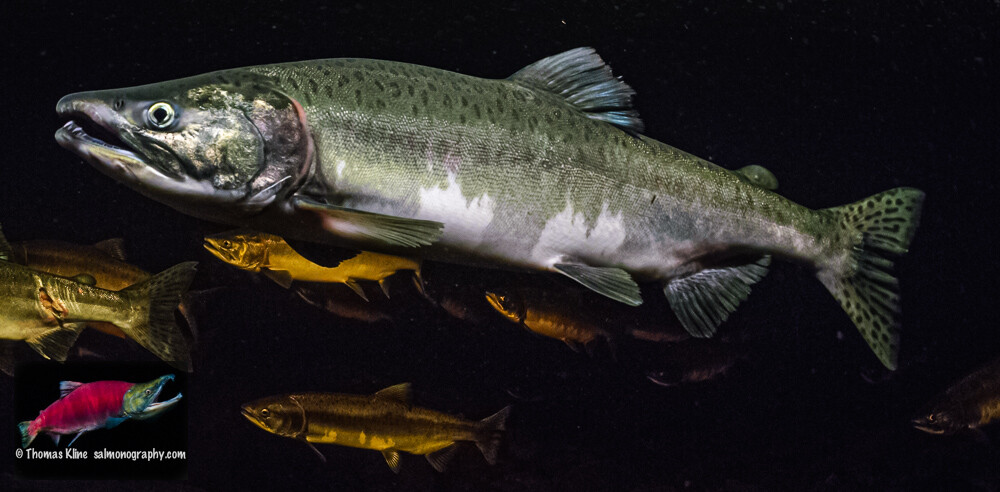
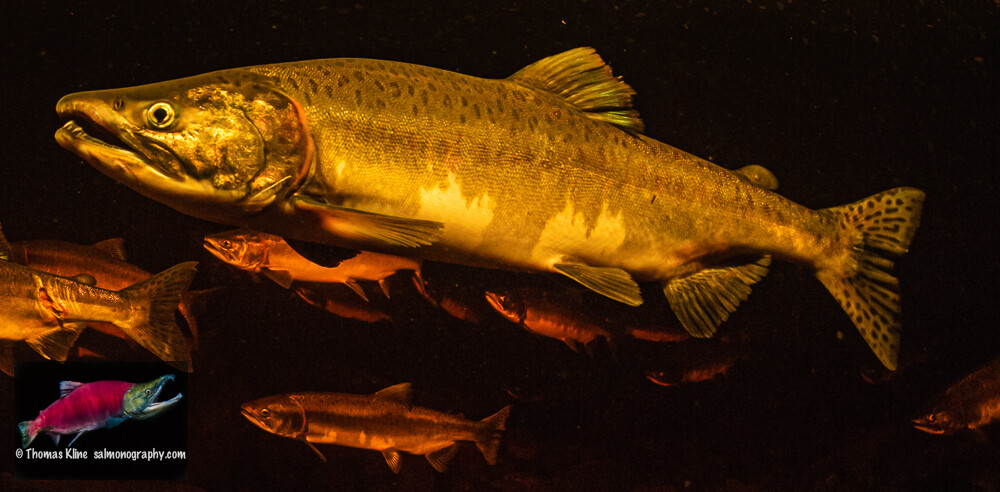
I shoot quite a bit in tannic water. It ranges from iced tea to Coca-Cola. I understand northern FLA is more like coffee (from a Skin Diver article about fossil hunting UW from many years ago). One of the more challenging streams in my area was the location for the attached shots. I made a virtual copy of the OK version in LR and reset the WB to daylight (5500 °K), nothing else, before making the second jpeg. Shot taken with a Nikon D2X and 10.5mm fisheye so fairly old. I have not been back to this stream, which is unnamed, since. It is hard to get to as well as rather stained.
-
Interesting result! I have not done anything like that although your shoot reminds me of shooting developing salmon eggs in situ. For that I tried various combos mostly with internal diopters as well as the Nikon Micro-Nikkor zoom lens with NO focusing (AF off and no focusing gear) - port length was fixed at maximum length (the lens extends) - zooming used to control image size. Main issue was very shallow depth like your setup.
-
One reason for using LR is to avoid having to do all that. As well one can make multiple virtual collections based on alternative key word types for example, location, common name, scientific name, phase of the moon, month, year..... About 20 years ago I followed the example of of an "expert" whose used date and grouped by quality with selects in one folder etc. This became a nightmare... This was before LR came out. Thankfully it saved the day but those early files are still a mess. I have been using consecutively numbered folders and file names (generated when I took the pic) with separate ones for each camera. Larger folders for years. If a certain camera is used a lot in a given year there may be A, B, C folders for that camera that year. Separate folders makes it easier to collapse the list of files when looking at them inside LR. It also makes it much easier to keep track of things when doing back ups. Missing numbers are easy to detect.
-
You are still getting a 1.33x mag if that is the goal. Distance depends on focal length, i.e. greater with 105 compared to 60. I have rather limited facilities to do testing here - see above. Working distance can vary depending on ones port setup. One trick is to have a bigger air space (longer port) to reduce water path. Cannot use that trick if configured to use the EMWL as one needs a small air space inside the port.
-
ROTFL!!! My first guess was supermacro, maybe much longer working distance than any of the SMCs. Another guess is that instead of an add-on lens it is a complete port, sort of a macro analog of the WACPs. 105 or 60mm goes inside??? Kind of late for a 60 but might work with the Z50 macro.
-
Look at what Alex is testing!!!!!

-
I believe you are incorrect. One can certainly focus UW > 1:1. Folks have been doing that for years, e.g., using 1.4 teleconverters or internal (on the lens inside the port) diopters. With domes one is focusing on a close virtual image - this is the distance the camera lens focus is set at and can be read off the focusing scale (with a transparent housing!!!). Many lenses do not focus close enough to allow them to work behind a dome such as 50mm f/1.4 lenses with a typical min. focus distance of 0.45m. This is a big problem as well with medium format cameras. I know this because I have the Hasselblad EL housing that uses 8" plastic domes. The 50 and 60mm wide angle lenses that work with the housing focus to just 0.5m so special Zeiss made diopters were sold. As it took me years to find them I used standard off the shelf diopters that also worked. With a flat port one can typically use the entire focusing range of the lens. For example with the camera lens at infinity (virtual image distance) the lens is focused close up with the amount dependent on diopter strength so further rather than closer.
-
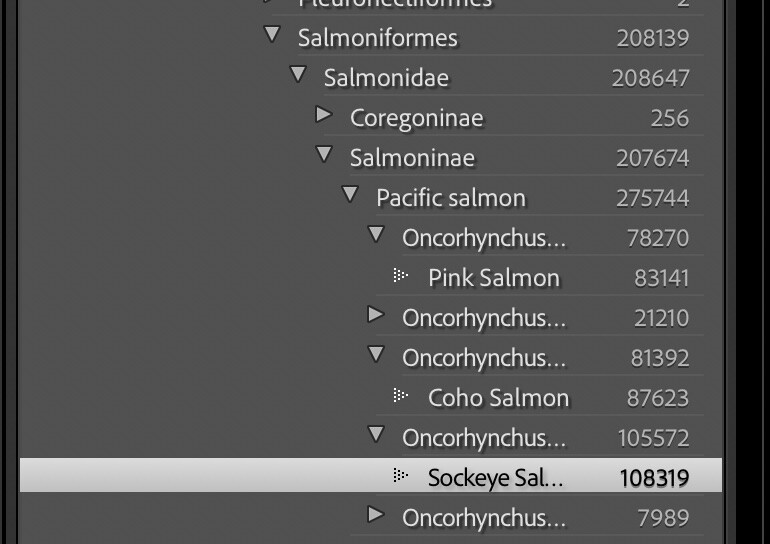
There is clearly a lot of variability in how people use LR. The lrcat file is generally rather small even in my case with 0.7 million pix. It is the previews file that takes up space and there are choices in how one does this. Some are big while others are small. One can set 1:1 previews to expire as well, which I did not do at first. One can delete the previews file which is the equivalent of starting from a backup file. I did this only once and that was years ago - when I did a version upgrade. The trouble was that I only saw grey rectangles until the previews were regenerated which can take some time - happened when clicking on the folder in library mode. The images appeared sequentially as they were generated. I had only a few 10s of thousand images back then. Just for laughs I have more images of three of the Pacific salmon species than Tim has in his entire catalog - see attachment. Note the large space to the left - those are the higher taxonomic categories further up from order (Salmoniformes). Be thankful if you are not a biology nerd!!!!!! BTW you will note that I have the common name at the bottom of the hierarchy so I only have to type in "so" for Sockeye Salmon and LR does the rest, which I do when importing into LR. If I used the scientific name I would have to correctly spell the genus name and at least one species name letter to get LR to pick the right keyword.
-
My comments in bold.
-
Consistent but do not forget the SMC mag is quite a bit higher than what the lens does alone. The real goal IMHO is the large gap in minimal working distance. For example I would not normally use the 105 without a wet lens or internal diopter at this location due to very low viz. At 1:1 there is too much distance, can only work very close. BTW because the MFO is so light and compact it is easy to bring along with an EMWL. I actually had the 130 EMWL with me along with other options I did not use (remote control cable and 45° finder).
-
PS, It just occurred to me that with the MFO the max magnification is reduced compared to using just a flat port so looked up the Nauticam port sheet. Nauticam states it is 1.1x for the 105 Nikkor AFS-VR with the MFO. But max with a flat port is 1.33x thanks to the refractive effect of water.
-
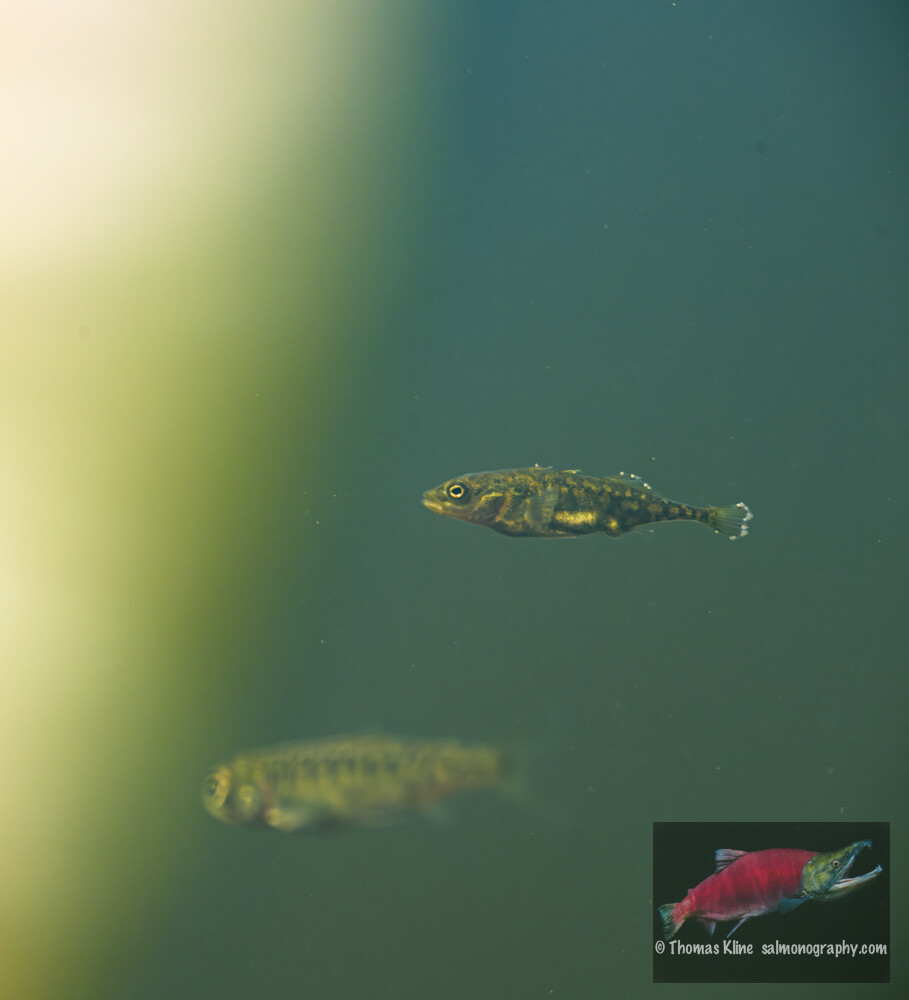
Not dry here at all. It took a week but the sun did break out for a short while (remained mostly cloudy) yesterday so was able to give the MFO a tryout - the rain commenced just after getting home! Raining hard with wind now. I also tried out my new float rig (note all the float arms). The UW shots shown here were taken at f/8 with auto-ISO. Note that I did a vertical crop of the two-fish shot. Just the stickleback is in focus. This is in a protected spot as the wind was blowing enough to cause white caps and small breakers on the shore of the main lake body. I stood (with waders on) where the camera is in the setup shot and pole-cammed the results using the camera's intervalometer. Note the brown bottom. Water is stained so that a very heavy hand was used for post-processing. For this shoot I was in the two to seven inch working distance range so right in the range for which the MFO was designed. The bare lens is about a foot minimum distance (Nikon 105VR-AFS F mount on Nikon D4S).


-
The MFO-1 is listed in the N85 datasheet from Nauticam so meant for micro4/3 as well.
-
Good discussion thus far but nothing said of the shooting conditions such as light levels and water temperatures. Both of these factors can make UWP quite challenging. I know because they dominate the conditions I typically shoot in (Alaska). Water is in single digit °C with very few exceptions such as the surface waters of a lake during the late summer. I have used mostly gripped camera bodies as a result (big batteries). Currently I am using a suite of Nauticam water contact optics from EMWL to the most recently acquired MFO-1. Also have the SMC-1 with the piggyback magnifier. These are camera brand agnostic. I do NOT do vid only stills.
-
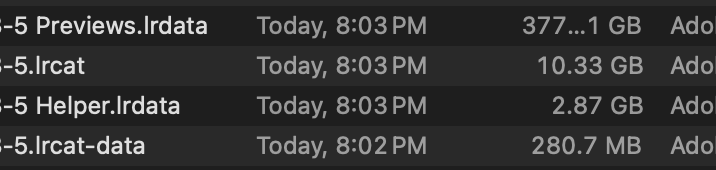
To the OP: What are your catalog sizes? I have nearly 700K images in my LR library. The image data are on spinning hard drives, two 16 TB drives. This is after 2 decades of digital photography. Files created by PS like when using BSXT go with the raw data on these drives. I use regular previews. The smart ones are quite large is my understanding so do not bother with them. One of the attachments shows my various catalog sizes. Previews size is < 400GB (hard to read since I did some squishing to minimize area I was screen-grabbing.
-
Ps., almost forgot. Just got the MFO (mighty fine optic) a few days ago as it was back-ordered (from Backscatter). In the bag ready to take it out but waiting for the rain to stop (predicted for later today)
-
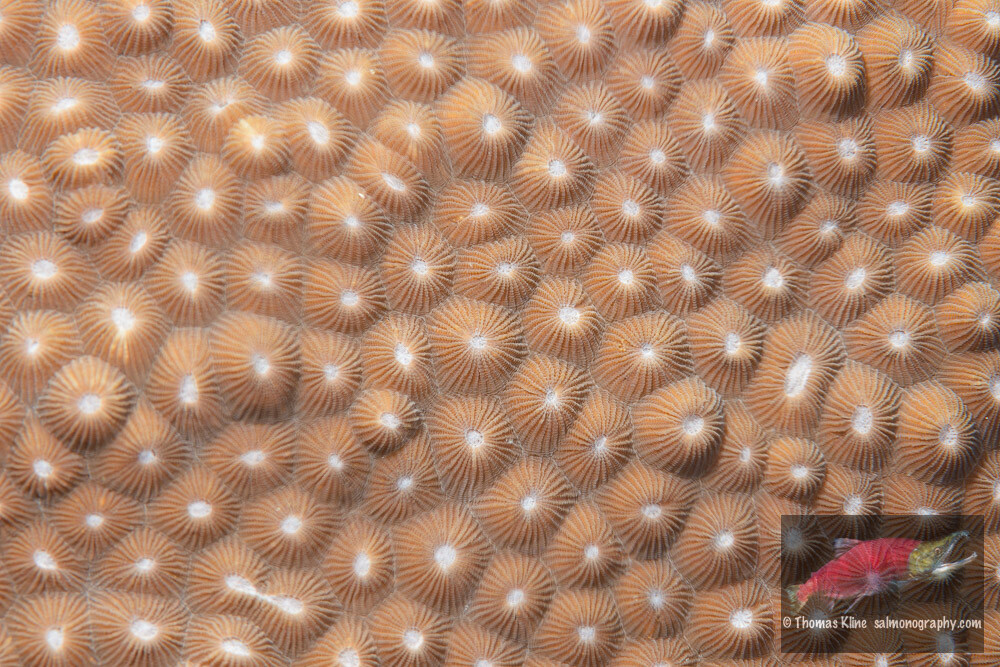
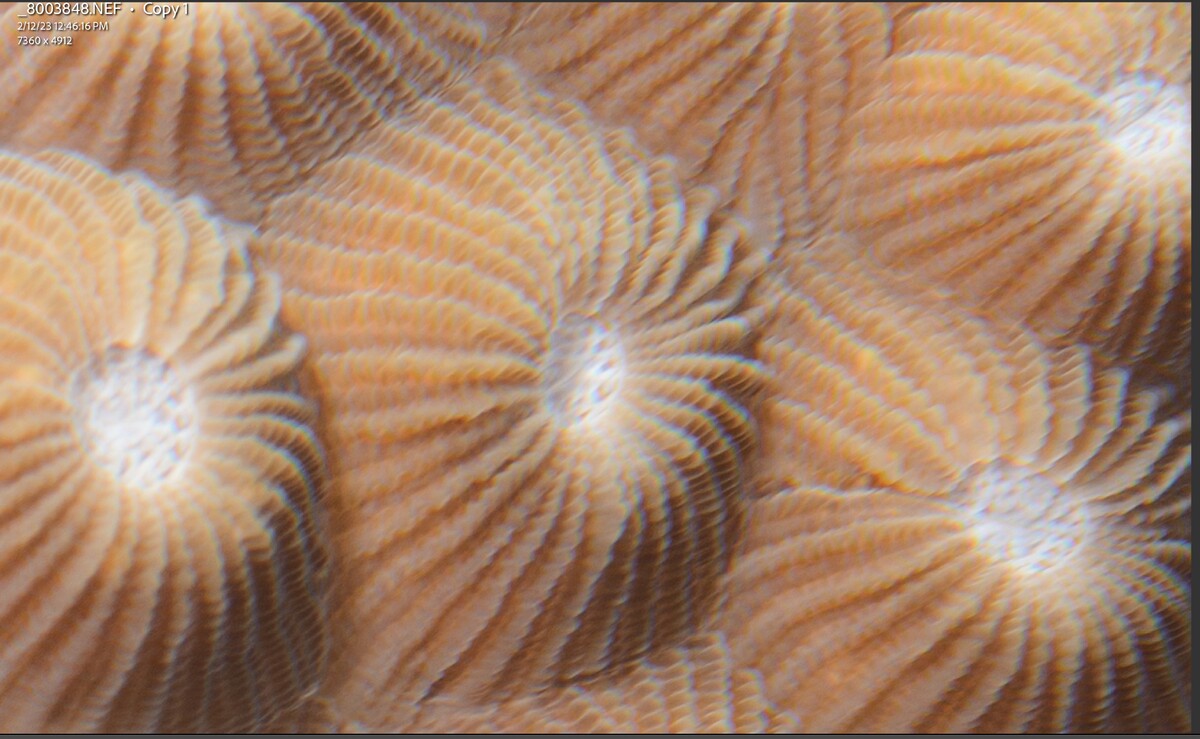
I think Robin D has the right idea. The 105VR lens is no slouch so one has to find its weaknesses especially those when used under water. For example see attachments. A 105VR shot done with a Nikon D800 so 36 Mpixels. One jpeg is of the whole frame. Looks decent at 1000 pixels for the web. Next shot is the upper right hand corner at 300%. I did a screen grab then converted to a jpeg to make the file size quite a bit smaller but still larger than the whole frame shot. The color fringing not evident in the whole frame image now is. One gets more of this (fringing) with out of focus high contrast edges. FYI, chromatic aberration correction was turned on (in Lightroom).
-
I had a related experience a few years ago from buying a secondhand housing with a threaded lens port that refused to come off. I bought a special strap wrench to try at first and used penetrating oil a few times as well. Then I tried the thermal trick by placing the housing in a chest freezer. Trouble with that was that it got covered in condensation when I removed it as I live in a rainy area (northern limit of rain forest that extends southward through BC to Washington state. Months later, during winter, we had a very cold spell, dry and cold, so the temperature was well below freezing outside. Finally that worked, after a few hours in the dry cold. Humidity was also low indoors so very little condensation.
-
You probably do not want to use the Mk I (non N) version of the Nikonos 15mm lens for the same reason why adapting many older Leica rangefinder lenses is not such a hot idea. Especially since the Sony cams reportedly have a thick cover glass over the sensor (discussed on Leica forums). This is because the lens is way too close to the sensor so that the light rays hit the sensor at an acute angle in the corners (leads to optical issues such as vignetting, color shits), i.e. the lens is NOT telecentric. Even many film (i.e. older) SLR lenses are not telecentric enough. This was discussed ad nauseum on internet forums in the early digital days (2 decades ago now!). I suspect that even the 15N lens may have issues (it is slightly retrofocus, the opposite of what was stated in post #1, but not to the same extent as SLR lenses (mirror box clearance need being greater than the TTL metering parts (metering first introduced with the N-IV, not the N-V)).
-
The hood is shown in the link that I posted up-thread. Scroll up and click. It is generic, i.e., no brand. The only text on it is 67mm.
-
The only marking on it is "67mm" like the first one in this search result: https://duckduckgo.com/?t=ffab&q=67mm+vented+lens+shade&atb=v320-1&ia=shopping&iax=shopping
-
screws in