



Posts posted by Chris Ross
-
-
10 hours ago, Adventurer said:
Thankfully Landvogt1893 send me the RAW files and we can have a look at the two uncorrected RAW files to learn how much of the image is actually black and artificially generated. I have activated Lightrooms overlay to give you a better idea of the dimensions. If you want to shoot 4x5 you still have some black corners, but much less, which you could also fill with Photoshop's content aware fill:There seems also be some lens flaring in the 2nd image provided. Here is one of the corners, Waso was so curious about:
I have also made this illustration of the corner to show you where the lens correction moves the corner to fill the frame:
So, what do we learn from this? In my view it’s quite surprising to spend more than $1,000 / €1,000 on the Nauticam WWL-C for dismal results like these - especially when strong in-camera corrections and additional processing make the output look somewhat “artificial”. Especially if you could also have gone for the much cheaper INON UWL-95S (roughly half the price) and achieved similar ( or maybe even better ) results, with a more compact setup - assuming you’re pairing it with the Canon RF 24–50mm STM. 🫣
At the same time, in some parts of the world the WWL-1B and the WWL-C cost the same - or the WWL-1B is even available for less. Considering that the WWL-1B (optimized for 28mm) also has a reputation for higher image quality than the WWL-C (optimized for 24mm), I don’t really understand why Nauticam doesn’t recommend zooming slightly to 28mm and choosing the WWL-1B instead of the WWL-C.
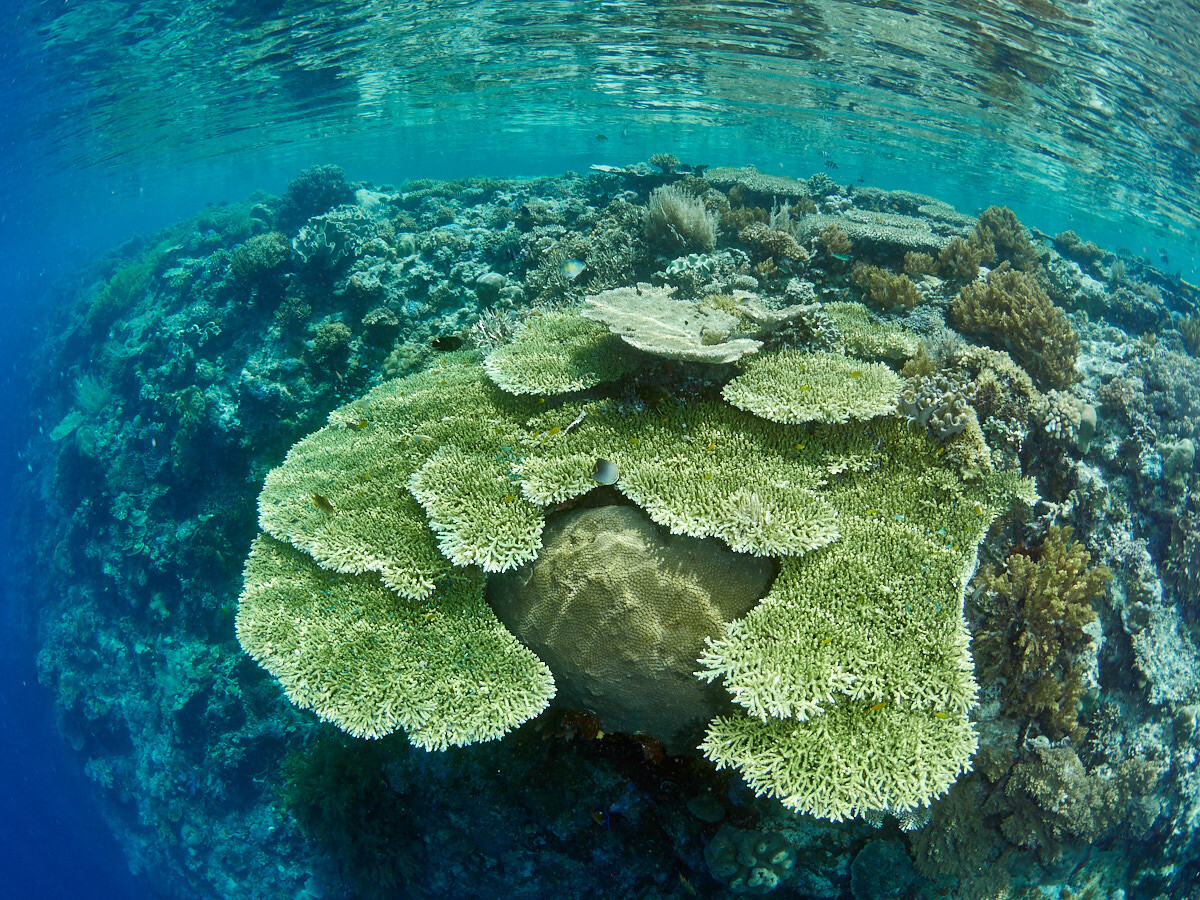
The lens correction is removing barrel distortion and you can demonstrate this on a fisheye image with the lens correction tools in your IP program. Here is an example image taken with a Panasonic 8mm fisheye:
If you use the lens correction tool it removes the barrel distortion at the cost of a reduced field of view:
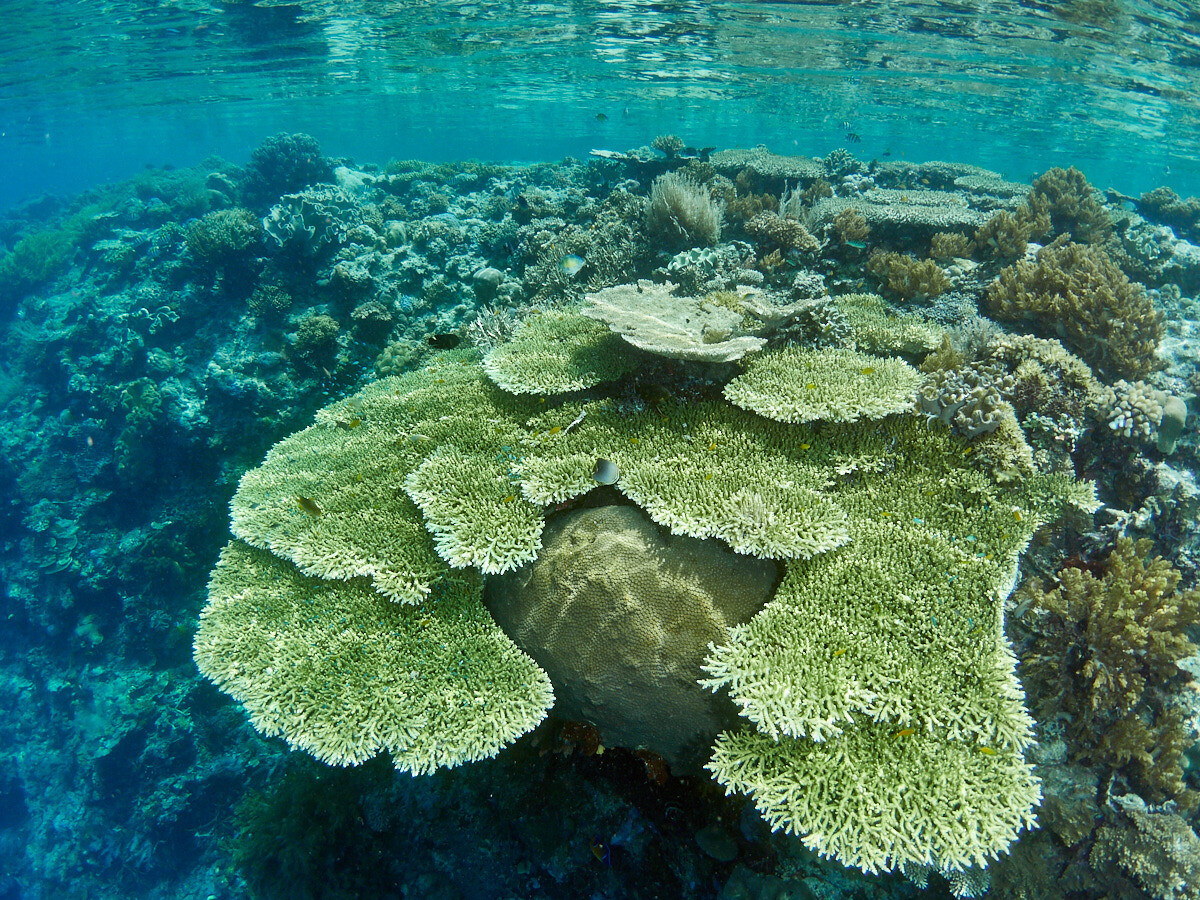
You can see that the image has lost the edges and it hasn't even been fully de-fished yet, so it doesn't actually stretch the image into the corners, but crops them out. I expect the lens correction on the 24-50 does something similar and I expect what Canon has done is that the 24-50 is actually wider than the a standard 24mm lens, knowing full well it will lose the corners when the barrel distortion correction is done. Unless you are doing raw conversions in Canons software the correction will be done using Lightroom's standard lens correction tool. It would be an interesting exercise to compare an image cropped out of the raw file with one that is automatically corrected and also to determine if the 24-50 has the same maximum field as a regular 24mm lens.
-
9 hours ago, Architeuthis said: I had a look at the video, linked above by Tino. In the video Alex states that FCP/28-60mm(?) has lower IQ compared to the WACP;WWL/28-60mm combinations. This makes me doubt that FCP/28-60mm provides superior IQ compared to the Canon 8-15mm/2x Sony TC combination. It seems to me that FCP cannot justify the high cost, size and weigth ...
I fully agree on EMWL, but low tide in my burse at the moment (the new Sony 100mm macro arrived just few minutes ago at my entrance door...🤗)
Also it seems the optics reduce the depth of field, noticeable in CFWA work, there was a thread on it a while back in the initial flurry after it was introduced.
-
9 hours ago, tailwind_marseille said: Regarding what to shoot, I want it all ! :) Really, as a newbie it's hard to say. It's early to want to specialise in anything. The options we have here in Marseille are enormous, there's big fish (merou, barracuda, tuna, etc), large schools of many species, nudibranch everywhere, corals, and many wrecks. I've done night dives in wrecks that I wish I could repeat the conditions with a camera in hand.
I do seem to be attracted to wide angle and large apertures in my topside photos. I'm thinking it will be the same underwater.
What focal distance would you be thinking about when wanting to shot mid sized fish ?
Well, I would suggest that you base your selection on the availability of lenses and ability to easily add more lenses as time goes by without requiring a camera system change and the consequent new housing.
UW is quite different to land based photography. using wide angle lenses up close to reduce water between you and the subject. I tried for the first year or two to apply some land based techniques and found they didn't work so well. Placing a lens in a dome port doesn't make it just like on land , it's necessary to stop down to deal with the aberrations caused by dome port optics, most people shoot around f11-13 for wide angle behind a dome port, even fisheyes are generally stopped down. Some of the wetoptics can be opened up a bit more.
Typically a flexible solution involves a zoom lens, you can swim right up to a coral reef, but if you try doing the same thing to a shark or a tuna it will swim away. SO being able to zoom from a static subject to something with some more reach is very handy. By more reach it's something in the range of a 30mm equivalent lens on full frame. It's still significantly more reach than a fisheye.
Wide apertures are used in macro work, where you can actually create some good bokeh, in wide angle work it can create some rather ugly out of focus things in the corners. Here is an example of photo taken 17mm and f8 in a small dome, note the lower left corner:
https://uwaterphoto.com/?p=839
For fish portraits a longer zoom or a short macro lens tend to be good options.
Again I'd suggest rather than gravitating to a camera body go ahead and see what you would need for macro, mid range and wide in a couple of different systems, then see how much it will cost you and the weight and size. I don't know if you plan to travel for diving but a compact system makes traveling a lot easier.
-
3 hours ago, Landvogt1893 said: The lens needs to be corrected; otherwise, there is noticeable vignetting at 24 mm. That’s why I was surprised by your statement that you find it ironic, especially regarding corner sharpness.
Overall, this lens in this combination is a good compromise, but it’s not for pixel peepers.Booth are taken with 24mm.
I believe what is happening is the lens has a lot of uncorrected barrel distortion and relies on software correction. Barrel distortion stretches the corners out and the corrected image needs to be cropped after correction. So Canon designed it a bit wider than 24mm to accomodate the cropping and the end result is black corners in the uncorrected image.
There may be some benefit in in shooting uncorrected and zooming in till the vignetting stops as you really mostly don't need the corrections UW, it's no different to shooting a fisheye. If you don't do the software correction to remove the barrel distortion the overall image quality can improve. Whether it's worth the trouble I don't know, you would have to manually pick the widest zoom setting you can live with on the uncorrected lens and it would be fiddly.
I agree the lens is a compromise, it seems like there might be sample variation as well, some land reviews give it a poor rating and others say it is quite good including sites that do performance testing.
-
 1
1
-
-
2 hours ago, tailwind_marseille said: A pity that opinions on Salted Line / Seafrogs seem mostly on the negative side... they have (low) cost on their side. Mostly what concerns me is how the ports will affect the light. No point in getting a fancy lens and then put it behind glass (acrylic...) that will ruin the show.
I have a good deal on a A6400, might go down that route. In the meanwhile, also ordered Alex Mustard's book and will do my best to make myself more enlightened ! And then get decent strobes :) @Lewis88 thanks for the tip on the YS-D3. A pity there here in France they retail for 650-850 euros .... (the YS-D3 Duo). I had impression that many people had issues with reliability with Sea and Sea lights (https://waterpixels.net/forums/topic/3224-sea-sea-ys-01-ttl-inconsistency-led-behaviour-known-fault-repairable/) ? And Inon being a more solid choice ?
Cheers everyone!
Don't get me wrong, people will happily use the Sea frogs housings and they'll keep your camera dry and take decent photos, but they are somewhat limiting.
Regarding strobes there are a great many on the market at the moment. The INON strobe, the S220 is a solid little strobe, but a little lacking in power, it will certainly work well getting a compact underwater and is I think fine for a m43 rig. There are a great many strobes available on the market today to pick from.
On the Sony A6400, again I would encourage you to to look at the whole picture before jumping onto a camera body. With Sony APS-c and to a lesser extent other APS-C systems, the big manufacturers only make 90 or 100mm macro lenses. Canon and Nikon used to have 60 mm lenses, but are discontinued (at least the Canon is) . The long lenses on APS_C due to the crop factor are IMO too long for UW and force you to back up too far if shooting medium sized macro subjects. This means too much water between you and subject, strobes will struggle as strobe range UW is very limited and much greater chance of backscatter from the strobes. Sony has Zeiss 50mm macro, but the AF is quite slow except on certain bodies and can hunt a bit. On Sony you would be adapting a full frame fisheye for wide angle work if that's the way you wanted to go, though the 16-50 kit lens and WWL seems a good option if that is the way you wanted to go.
I would suggest pricing out some options and working out which lenses you would use with which body before jumping on a camera body. Go into the exercise with your eyes wide open rather than discovering issues once you have invested into a system.
On macro lenses again here is a pic of an Olympus 60mm macro side by side with a Canon EF100mm macro - massive difference in size and the ports have to cover this so also a difference in weight and size an $$.
I would also suggest considering second hand rigs. Housings really don't hold their value and some bargains can be picked up if you consider using an older model.
-
2
-
-
First thing I would try is a multimeter to see if voltage is applied to the buzzer when it activates. It could either be the buzzer itself or the relay/transistor inside the electronics box that is not switching voltage to the buzzer. I assume the vacuum system is working, I expect the buzzer could be replaced if you had enough electronics experience to work out what type it is a select an appropriate replacment.
Something like this would likely work, but you would need to check the voltage applied, I expect it would likely apply direct battery voltage.
https://www.jaycar.com.au/mini-pcb-mount-buzzer-9-14vdc/p/AB3459
as you can see it's a $5 retail part.
-
2
-
-
-
Take a look at the big picture, first think about what you want to shoot, is it macro, reefscenes, big animals, fish portraits? A little bit of everything?? Then look at what lenses you need to achieve that . Only then think about which body you can match up with the lenses.
Regarding full frame, yes it's great, lower noise, more MP and all that. However the cost to take thing underwater scales with sensor size at least in aluminium housings, the housings cost significantly more, you need bigger ports, the lenses are a lot bigger. and with an expensive full frame camera it doesn't make sense to me get a cheap housing and a system where the ports and extensions needed are not optimised and so the you throw away part of the resolution you paid $$ for. The other consideration with full frame is traveling with it - it bigger, heavier and incrementally harder to take with you when flying to a destination. some of the resolution is also taken up due to the optics of the air water interface and the water between you and the subject blurring things.
Next think hard about what you will do with your images. If they are just for you and 99% of the time you look at the image on a laptop or even a reasonable size monitor screen I think you will be challenged to see the difference in the overall image.
Underwater things are different, the ultimate resolution is less and you need to get your camera down there, things like reach are different - you use wide angle lenses not to capture a big scene, it is to get closer to your subject. Wide angle optics presnt a particular challenge underwater. Fisheye lenses are extremely useful and the distorted perspective is nit really noticed on most shot, they get you closer to your subject and the optical characteristics are a much better match for the optics of dome ports. Ergonomics is important as well to get the most out of your limited time UW.
So having said all of that, IMO m43 has the best selection of lenses suited to UW photography. There are 5 different macro lenses between 30 and 90mm focal length, some really nice wide angle options, two different fisheyes and several options to use with wet wide lens type optics, like the WWL. You can also adapt the excellent Canon 8-15 to give full zoom through from a 180° diagonal fisheye to a 28mm equivalent rectilinear wide in terms of reach and focuses right up to the dome port for CFWA.
This entire gallery was shot with the adapted 8-15 and the OM-1:
https://www.aus-natural.com/Underwater/Walindi%20Resort%20PNG/index.html
-
4
-
-
2 hours ago, CaolIla said: I made some shots during last trip... but to be honest I don't know wich with and witch without the MFO-3
I can try to find some but without waranty.
But if you have time, I'll have some after 10 days diving in Lembeh next month.Look at the subject distance in the EXIF, it will be in the range of 0.6m plus unless you are pushing right in next to the lens, It shows up in properties under details tab, scroll down to camera in Windows explorer.
-
Looking at the rig I'm thinking one large buoyancy behind the monitor arm between the the two arm clamps, either using triple clamps or a system like this one:
If you add enough foam to the back of the monitor to make it neutral on it's own you can place it where you want it without worrying about trim too much and you could raise it a little to make room for a big arm there.
Then place about the same amount of buoyancy underneath between the two rails, maybe overall go for slightly positive on the housing/sled.
Next attach floats to your light to get them independently neutral and connect them up with plain arms. you could try to find a hollow ring type arrangement or I think even a "T" at the end of the arm with a float above and the light below , it could then be set so the clamp is not too tight and it will always have the float wanting to sit directly above the light. set the fore-aft position of the light attachment point so that it sits level and doesn't want to twist.
I did something similar with an astronomical telescope on a fork mount years back. A guide scope above and the same weight below the body of the scope plus a trim weight going back and forth. Fiddling with positions I could get it to sit anywhere it was pointed with minimal friction on the axes. In principle you are trying to achive the same thing with your rig, but using floats rather than weights for balancing and trim weights to adjust for aft trim. The scope only had two axes to worry about, you will have three, but the side to side is handled through symmetry.
-
1
-
-
strange it went to a red X it wasn't that way after I posted, try again:
also include the text version of link:
bcgforums.com/threads/nikon-z8-focus-shift-and-flash-issue.34347/
it went straight to the red X just now for some reason.
Hopefully the new trigger will solve the issue.
-
7 hours ago, Christopher Drye said: Thanks. I’m using a new to me Olympus TG-6 in a PT-059 housing. I have a Backscatter M52 Air Lens on the housing

I bought the kit as a used complete set from eBay. I was told it had done about 100 dives (not sure where or over what time frame). I checked it upon receipt and I missed the fact that whilst the strobe was firing it was not registering the TTL
I just removed the knob and screw from it and have now discovered another major issue - cracked mount (was being held in place by the other side mount). Basically it’s scrap. I have no comeback via eBay or PayPal because it has been more than 30 days since delivery.

I’ll enjoy my training and this next trip and then when home will sell the working twin YS-01s (one of which still under warranty) and then look out for / save up for the INON S-220s. The best price I’ve seen here in the uk is eBay from Italy at about £375 each once all taxes and duties are paid.
I’m shocked by the cost of these things and their apparent fragility! I’m glad my ScubaPro regs don’t have the same reliability risk. I’ve heard INON are very very long lasting (I am meticulous about caring for and maintaining my equipment as I expect it to very rarely let me down and last many holidays !)
Yes, it's unfortunate that some of these things are not well made. Bear in mind you'll also need a 1"ball mount Z adapter to add to the strobe, with INON they are purchased separately. The mounting system for the INON strobes is quite sturdy. I had my INON Z240s for 10 years and they are still in good shape.
Don't be afraid to use a single strobe while on this trip, the the TG-7 doesn't require particularly strong flash as it's f2.8 at the wide end and the single YS-01 will provide OK coverage there. For macro, you are closer and using one strobe for macro is quite straight forward for most situations.
Also be aware that f8-f18 is achieved through a ND filter on the TG-7, the only time you would want to use it is if you are trying for a black background, it doesn't provide additional depth of field.
-
1
-
-
3 hours ago, bvanant said: What engineer thought that 5 button pushes in 3 seconds was a "good" implementation? Insane. We make medical devices and I can only imagine what patients would say if we made them use a series of button pushes to get at some feature of the device.
Bill
Incredibly annoying, but the problem is people buy them without research only to discover this and then complain about on internet forums as the manufacturers are behind a firewall and hard to contact and even if you do, it falls into a black hole. The only way to force change is to stop buying crappy solutions like this.
That is why I have an INON focus light, it turns on by rotating a knob to low power, rotate it further and get high power, seems like it's a magnetic switch with two positions. Simple and robust, uses AA batteries, not incredibly bright - but enough for focusing, no auto off on strobe - it is not needed as the light is dim. On lights with higher output and more power levels they add another dial.
-
If you refer to the port charts you will see that the A7 port chart consistently requires 5mm more extension on the same lens/dome combination compared to what is listed on the port chart for later bodies. It appears they re-designed the housings placing the camera flange 5mm further back in the housing, perhaps to accommodate new lenses better, or even to allow for the grip on newer bodies?? Whatever the reason, the port charts changed due to change of housing design and this required a different Nikonos adapter.
if your refer to the below webpage and scroll down to section 8 you will see the A7II has a deeper grip so this seems the likely reason for the re-design of the housing and new port charts:

Mirrorless Comparison
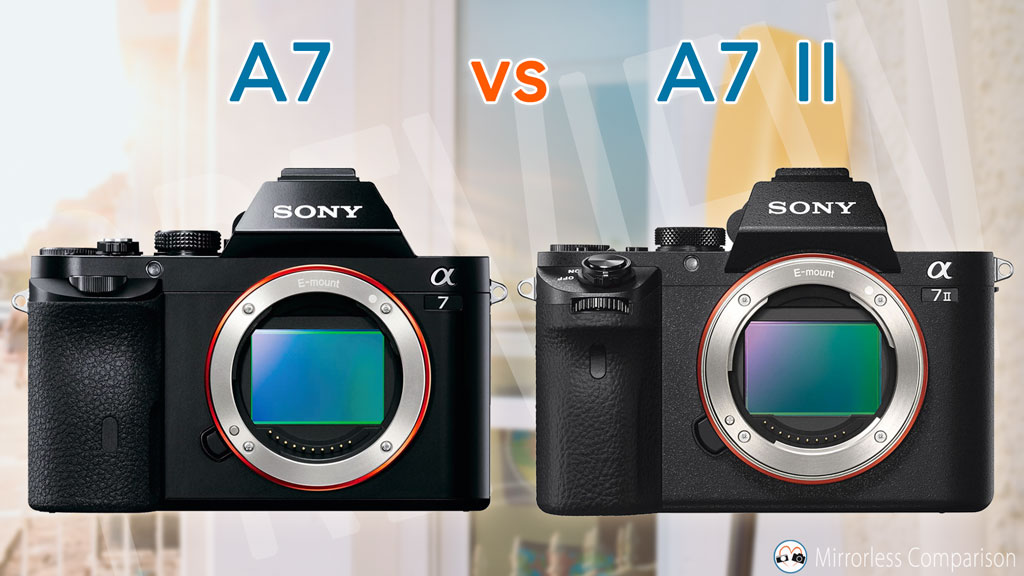
Sony A7 vs A7 II - The 10 main differences - Mirrorless C...
The A7 was Sony’s first ever full frame mirrorless camera. It was released at the end of 2013 alongside the A7R. One year later, the Japanese company caught everybody by surprise with the launch of thIf you look at the 37202 adapter, it has those two bolt-on pieces which act as the adapter flange to prevent the water pressure pressing the adapter into the housing. They are removable to allow space for the control knobs to rotate into position. This is consistent with having to place the lens 5mm further into the housing.
The modification of the camera tray was discussed on another thread is un-related I believe, they are talking about very small adjustments because the location mechanism for the tray is not precise enough to get the accuracy required to achieve infinity focus. The different adapters are purely to accommodate the change in the housing design.
-
1
-
 1
1
-
-
One thing with non matching strobes is it's not as straight forward to keep the lights balanced, also a video light is nowhere near as powerful as a strobe.
The other thing to consider is trying to use manual - it's not as hard as it seems. You don't say what setup you have, but if you are doing macro having the strobe at the same distance means the strobe exposure is constant. It's also easier to use a single strobe for macro. IF you end up buying one strobe I'd suggest the little INON S220, it also uses AA batteries and is an excellent little strobe.
If you want to balance the two strobes together one way you can try is have one strobe in TTL connected to your camera and the second strobe also in TTL can trigger off the flash from the first strobe. I expect it would trigger without a cable, but if you do use a cable run it off the first strobe. If I recall correctly the YS-01 have a port on front of the strobe for a trigger cable. The cable runs from the front of the strobe to the fibre port on the second strobe.
INON uses a screw on connection at the strobe end end but the camera end is the same as the YS-01.
-
I have heard of many S&S strobes failing similar to this - the TTL circuit dies and can't quench the flash when required. It is possible it may spread to only full power on manual control.
I'd think that with 26 days to go, you would be pushing to get it repaired in the available time, unless there is a repair shop in country, but even then it will take to to assess and possibly get parts. Also given repair costs a new strobe might be the best solution. I would suggest researching what is available to buy now, if they have to get stock in, again time might be tight. Might be another Solis - or perhaps a pair on INON S220 - a nice little strobe and INON seem to have a better reliability reputation.
-
7 hours ago, Adrian Gresores said: Given that, do you feel the reduced minimum focus distance alone is enough to justify keeping and using the MFO-1, considering the added weight and bulk it adds to the setup? Do you personally use it in a similar configuration?
Alternatively, would it be just as good—or even preferable—to shoot with the bare 60mm and rely on a CMC-2 on a flip adapter for the (probably rare) situations where I need more magnification?
Based upon the reviews and the fact it only gets to 1.1x, I don't have an MFO-1 and don't plan to buy one. Seeing as how you already have the CMC-2, mounting it on a flip seems the best way to go. I agree I'd take the MFO-1 along, you might as well try it out, it's not like it takes up much space.
-
1
-
-
57 minutes ago, Adrian Gresores said: Thank you for such a comprehensive answer. I thought this was a simple question, but it seems the answer may be far from that.
If I understood you correctly, the CMC-2, like all diopters, may not be a great choice for my m43 setup. The focus distance would be too close and thus difficult. I suppose I should have done more research first.
Now, I wonder if I should keep the MFO-1, and ditch the CMC-2. 🥴
That being said, if diopters do not work well with m43, what option would you suggest for super macro, only the 90mm lens?
No not exactly - the suggestion is to work out if you regularly find critters that require that amount of magnification. My experience with the 60mm macro is it's very rare for me to find something small enough that I feel like I need a diopter. From a week in Lembeh with over a hundred critters found only one or two were small enough that a diopter might have been useful. Your experience might be different, I think it depends on where you dive, how good you are at finding small stuff etc.
The CMC-2 will be challenging to use at max magnification for sure, I'm not suggesting don't use it, rather I don't see it as an either/or situation with the MFO-1 as they have different magnification ranges and I would choose based upon how much magnification I need. If you find you are getting down to 1:1 all the time currently and wishing for more and are OK with lighting subjects right on 1:1, then a CMC-2 is possibly the next logical step.
The 90mm macro I think would be a lot easier to use at high magnification, it has about 65mm working distance at 2x compared to 22mm with the CMC-1 also at 2x, but it's an expensive lens, needs a new port etc. I'd want to be sure I would make use of it and could live with the extra working distance. At 1x it's only maybe 10-15mm more working distance than the 60mm, at 0.5x (35mm wide frame) you are at 170mm then 330mm at 0.25x. So for 60mm long subjects you are getting quite distant. I have the 90mm macro and use it a lot on land, but have not been tempted to take it UW.
-
2
-
-
On 1/9/2026 at 2:15 AM, Aliens From The Deep said: Hi everyone,
just wanted to post a quick update and close the loop on this thread.I’ve now been in direct contact with Retra support and sent them detailed test shots and settings. They tested the Maxi strobe under exactly the same conditions I described (3 fps, low power) and confirmed that:
➡️ The strobes themselves are not the cause of the black frames.
➡️ In their tests there were no dark frames and no relevant drop in output across the burst.This strongly points to a sync / trigger issue, not a strobe performance issue.
That fits very well with what Dave Hicks already suspected earlier in this thread — especially regarding the Nauticam LED trigger. Dave had similar problems in the past with other strobes and mentioned firmware-related trigger behavior causing missed sync in burst shooting.
Retra’s recommendation now is to test with a standard manual trigger from TRT-Electronics, which should eliminate any pre-flash / timing issues and give reliable sync for burst mode.
My only small dilemma:
I’ve just bought the Nauticam housing with the LED trigger brand new, so replacing it means both additional cost and removing a factory-installed trigger — not something I was initially planning. Before doing that, I’ll reach out to Nauticam to see if they are aware of this issue and whether a firmware update or alternative solution exists on their side.Bottom line so far:
✅ Retra strobes (including Maxi) are fully capable of burst shooting.
⚠️ In my case, the limiting factor appears to be the trigger system, not the strobes.Huge thanks to everyone here for the input — especially Chris, Dave, Tim and others who helped point in the right direction. I’ll report back once I’ve tested with a different trigger or heard back from Nauticam.
Best,
Marco
@aliensfromthedeepThanks for the update. I suspect it is something similar to what i see with e-shutter on my OM-1 . In focus stacking I do on land with an Olympus flash - the flash fires very rapidly on low power. I trialed doing a short stack UW, using the mini flash on manual at 1/64 power for triggering. The little strobe can fire rapidly at such low power but it was like it was waiting to confirm the flash was ready again before firing.
The standard way of getting around this is to make use of the X-sync on the camera, which it basically a mechanical contact built into the shutter - the camera doesn't recognise there is a flash attached and fires every time the contact has closed as long as it has charge.
Did a little searching to find this, seems the problem is by design from Nikon:
-
1
-
-
The MFO-1 should be thought of as a high quality low power diopter. In the case of the 60mm macro it only improves magnification to 1.1x while the CMC-2 achieves 1.7x but it will only focus between 33 and 122mm. Based on the focus distances there might be a little overlap with the CMC-2. It seems there are some benefits on image quality on full frame sensors and also prevents hunting with some macro lenses which readily switch to the background. However it seems that for m43 lenses there is no reported improvement.
It seems to me that whether to keep it or not comes down purely to whether you can find subjects in the magnification range covered by the diopters. There is less case for diopters with m43 lenses, first the working distance is small and diopters work by reducing working distance, second the field covered at 1:1 with these lenses is 17mm across, half that covered on a full frame sensor. The CMC-2 covers a field 10mm across at a working distance of 33mm which means it is difficult to aim and to light the subject.
Because diopters like the CMC-2 limit the focus range to a a limited working distance, they are in general more difficult to use compared to a bare macro lens, the MFO-1 limits the range but the maximum working distance is over 1m so you can use it just like a regular macro lens, you can find the subject from a distance and close in while looking through the viewfinder, not so easy to do if the subject isn't in focus until you close right in on it.
-
1
-
-
1 hour ago, bvbellomo said: Cable issue confirmed! I borrowed a working cable, and it worked. How I had 2 cables fail at the same time, I don't know. A friend on the same trip believes 1 cable is visibly broken and fixable, so we will try fixing it, but the other looks brand new.
If you can fix it. but only have one cable, try running the other strobe with a bare port it will likely trigger off the other strobe. If you need to cut the cable to repair it - DO NOT use scissors, a sharp box cutter or razor blade is what is needed, it needs to be cut at right angle to cable.
-
2
-
-
1 hour ago, bvbellomo said: With the dial set to 0, I am able to see a bright red light by looking into the end of the cable when I take a picture. With 1, the light is not as bright.
The hotel remote reliably fires the strobe directly, but not through the optical cable.
I have 2 strobes and cables that worked together in the past. I know this isn't just the wrong type of cable, and it is unlikely the cable is damaged.
Unfortunately the evidence is that the cables are not putting enough light through, the INON strobes are usually easily triggered. The strobes should trigger through the cable with an IR remote. try the test with the strobe in manual - first thing to try is to get it working in manual - a strobe in manual is better than no strobe.
It's not 100% clear from what you have said, you mention more light coming out of the cable at position 0 compared to position 1, however some questions to clarify:
Have you tried to trigger strobes in both positions 1 and zero with the trigger?
Have you tested both cables?
Are you testing with the cables plugged into the housing? If so have you confirmed the LEDs are well seated in the fibre ports, i.e. pushed all the way in? The instructions mention this and I recall a few times this was the problem people had with triggering.
Is there someone else there who has a cable being used with a LED trigger that you could borrow briefly for testing purposes.
What were you triggering the strobes with before this trip? A different trigger? an onboard flash?
It's important to check all of these things and report back if we are to have a chance to successfully troubleshoot.
-
1 hour ago, bvbellomo said: How are you supposed to turn the rotary dial? At home, I used a jewelers screwdriver, but didn't bring it on the trip.
Don't know where you are, perhaps the dive shop could loan a screwdriver or are there any hardware stores around? The little dials don't require much force to turn so perhaps a small nail file might work? Probably some other household or kitchen items might be put to use.
-
14 minutes ago, Davide DB said: Yes of course, but I was told that several dome/ports are treated/coated on the inside.
It would depend on the type of coating, but I expect it would require strong mineral acid to have any impact, magnesium fluoride is often used as a glass coating and it's reported to be quite resistant to acids. Searching showed that magnesium metal is treated with HF to provide a MgF coating which resists corrosion by acids, much more so than the bare metal.
-
1
-

Putting together a rig ...
in Photography Gear and Technique
In fact fisheyes play better with domes, the Canon 8-15 is an amazingly sharp lens and the Tokina 10-17 works better UW than it does on land. This is because of dome port optics where the lens is focusing on a virtual image located around 3 dome radii from the dome surface. The Rectilinear wides are designed to focus on a flat plane. so struggle more and more towards the corners. The focal plane of a fisheye lens is curved around the lens so it matches the shape of the virtual image.
I dive temperate waters around Sydney and shoot mostly macro with some use of the 12-40 lens (24-80 equivalent) on offshore dives and also using my 8-15 fisheye there on occasions. I have a 7-14 lens (14-28 equivalent) and it uses the same dome as the 12-40, but I rarely use it. I'm not sure the 10-18 would be a great lens for CFWA. To be really effective this requires the lens to focus on the glass of a small dome. Fisheyes do this, but rectilnears have poor corner performance in small domes.
Fisheyes have barrel distortion which enlarges the centre of the field relative to the edges and this has the effect of bring the subject forward with the background seemingly receding and this gives the images more impact. The Tokina 10-17 zooms from 180° diagonal fisheye all the way through to about 23-24mm focal length range, so effectively combines the fisheye with the range of of a lens like the 10-18, it just doesn't quite have the reach, but it's close. The 22-24mm focal length range refers to the width of the frame of a wide angle (rectilinear) lens zoomed to about 24mm or so.