Skip to content

Lights, Strobes, and Lighting Technique / Archived topic

RETRA Strobe Thread

Started by guyharrisonphoto ·

  • 698Posts
  • 698Replies

Read-only discussion

RETRA Strobe Thread

698 posts
  1.  

    ..... does the new strobes will support the latest Nauticam TTL converter ?

    I can help answer this question, if Oskar permits me.

    Nauticam #26308 TTL-Converter will support Retra strobe TTL, when this strobe appears on the market. Retra strobe TTL-profile is planned to be in Converter firmware, set to position "9" onboard rotary switch.


    c8459e4a8791.jpg

    Edited by Pavel Kolpakov
  2. I can help answer this question, if Oskar permits me.

    Nauticam #26308 TTL-Converter will support Retra strobe TTL, when this strobe appears on the market. Retra strobe TTL-profile is planned to be in Converter firmware, set to position "9" onboard rotary switch.


    Hi Pavel !

    Thank you for your input :)

    My TTL converter is the SKU#26308 and only has two switches on the board (no rotary switch).

    26307_1024x1024.jpg?v=1507150129

    I bought it this year with my NAD850 and Nauticam website does not list the Retra strobe as compatible :


    Compatible Strobes:

    Ikelite DS-160, DS-161

    Inon Z-240, Z-330

    Sea&Sea YS-250, YS-D1, YS-D2, YS-D2J

    If Oskar has had a chance to test the new strobes with it, I'll have my answer :)

    If not, I'll ask Nauticam about how the switches should be positionned if compatible.


    Cheers

  3. The TTL output with existing profiles (Inon, Sea&Sea, etc.) will be much more consistent with the new firmware on the original and new Retra Flash. Of course a profile made for a specific strobe is the best solution but our new firmware for TTL (or more precisely slave TTL) will be generally more consistent in every situation.


    Thank you Pavel!

  4. Hi Pavel !

    Thank you for your input :)

    My TTL converter is the SKU#26308 and only has two switches on the board (no rotary switch).

    No problem, this is just another version of that board, it has another switch type. This board is also fresh version, firmware can be updated.

    Currently it supports the following strobes: Z-330, Z-240, YS-D1, YS-D2, YS-250, DS-161, DS-160.

    Retra Pro strobe ttl-profile will be available and will be added to firmware of all TTL-Converters, when this strobe is available. We will ask Oskar to lend a pair of samples, for ttl-profile tests.

    If you want to update your board firmware by any new profiles (i mean future strobes on the market, like Retra Pro), you can contact Nauticam, send the board to manufacturer for update, for some fee.

    The same way is available for UWTechnics TTL boards update. It is available for some fee. Contact manufacturer.

    If there will be any questions, contact me, i can help too.

    Edited by Pavel Kolpakov
  5. Once the firmware update for the current Retra Flash is available (expected at the end of the year) TTL converters will likely work with existing settings for currently supported strobes.

    Until then we do not recommend making any changes.


    Hello Oskar,


    Any updates on the firmware update?


    Thanks!

  6. As soon as the update will be ready we will publish details in the news section on our website: https://www.retra-uwt.com/

  7. Any new status on the firmware update? The new season is starting...

  8. We have recently made a light output comparison with different flashguns: https://www.retra-uwt.com/blogs/news


    I have read your news article with great interest. I believe it would be more useful to conduct some in water tests (you don't need a light meter there are other tools that can be used in post processing) because the dome shaped strobes like the Inon Z330 are likely to loose light in a similar way they do on land whilst the other strobes with a flat surface will probably deteriorate 1 stop across all angles making the gap much less. I would recommend you remove strobes with dome interface from your comparisons as in water it won't be like for like. I would be happy to demonstrate that to you if you wish however I am pretty sure you understand it yourself

  9. Hi Stefan


    We are currently testing additional firmware features, that were designed for the new Retra Flash, on the original Retra Flash. We want to give the latest possible update because the update is quite difficult to make and requires sending the flashes to us. It’s going to be a longer wait but taking into account the lifetime of the flashgun it makes sense to take a few more months before starting the program.

  10. Hi Stefan


    We are currently testing additional firmware features, that were designed for the new Retra Flash, on the original Retra Flash. We want to give the latest possible update because the update is quite difficult to make and requires sending the flashes to us. It’s going to be a longer wait but taking into account the lifetime of the flashgun it makes sense to take a few more months before starting the program.


    https://www.retra-uwt.com/pages/retra-flash


    On this page you say see link for time output however the graph do not actually provide any information on the light intensity they just roughly say that the beam is around 120 degrees in air


    What is the measured guide number in the centre?

  11. Light output is not about power in the center of the beam: “All you need to remember about Guide Number is not to use it as a guide for buying a strobe. The Guide Number is determined both by the light output and the spread of the beam. A focused beam produces a much higher Guide Number than a widely spread beam, yet the latter is more desirable underwater.” Alex Mustard in Underwater Photography Masterclass (2016)


    Although we have measured maximum power output of all flashguns it is not relevant for this test. I can say though that the power output in the center does not vary as much as power output on the edges.


    We are aware that a curved surface will change the light spread once in contact with water. The truth is that all tested flashguns have a curved front port and therefore we can not rule out any of them. We are also curious about the comparison in water and plan to reproduce the test in a pool.

  12. Light output is not about power in the center of the beam: “All you need to remember about Guide Number is not to use it as a guide for buying a strobe. The Guide Number is determined both by the light output and the spread of the beam. A focused beam produces a much higher Guide Number than a widely spread beam, yet the latter is more desirable underwater.” Alex Mustard in Underwater Photography Masterclass (2016)


    Although we have measured maximum power output of all flashguns it is not relevant for this test. I can say though that the power output in the center does not vary as much as power output on the edges.


    We are aware that a curved surface will change the light spread once in contact with water. The truth is that all tested flashguns have a curved front port and therefore we can not rule out any of them. We are also curious about the comparison in water and plan to reproduce the test in a pool.

    What Alex is trying to say in the book is that you should not take only the guide number to judge which strobe to get but also the angle of coverage and how the light falls


    What your test shows is that circular tubes give a wider beam which we knew from before


    Instead of plotting fstops why dont you plot your graph also in absolute intensity?


    You dont provide any information on the power nor the number if cycles and that is awkward


    Sent from my iPhone using Tapatalk

  13. Regarding the reason we don't plot the graph in absolute intensity: "The absolute power is also not so important because with most good flashguns we don’t use them on full power much. However, the quality of light, determined by pattern of the beam, always affects our photos on all powers. All good underwater flashguns give a wide coverage, but still differ in how much of their light they get out to the wider parts of the beam. A wide, even beam gives a better quality of light, without unsightly hotspots and produces a more even illumination on the subject in wide angle photography. These flashguns are also easier to use, being more forgiving of slight errors in how you position them.” Alex Mustard


    Some specifications are yet to be confirmed and will be published in due course.

  14. Firstly i dont know why I would shoot at half power? But if that was true I would definitely want to have a power rating otherwise what is that am halving?


    Sorry but your line of reasoning seems a bit weak. You are not actually providing any useful information especially as all is based on single strobes while in reality at wide angle where beam matters you have two so no matter how smooth your beams are the middle of the frame where the two strobes meet will always be brighter than the edges even if the strobe had a completely flat profile


    Anyway enough now as it seems you dont want to provide the information


    Sent from my iPhone using Tapatalk

  15. Regarding the reason we don't plot the graph in absolute intensity: "The absolute power is also not so important because with most good flashguns we don’t use them on full power much.

    Cave divers will use strobes on full power. We’re trying to light big rooms with no natural light.

  16. Firstly i dont know why I would shoot at half power? But if that was true I would definitely want to have a power rating otherwise what is that am halving?


    Sorry but your line of reasoning seems a bit weak. You are not actually providing any useful information especially as all is based on single strobes while in reality at wide angle where beam matters you have two so no matter how smooth your beams are the middle of the frame where the two strobes meet will always be brighter than the edges even if the strobe had a completely flat profile


    Anyway enough now as it seems you dont want to provide the information


    Sent from my iPhone using Tapatalk


    I avoid shooting at full power for three reasons: 1. recycling is quicker, 2. more flashes are possible with a set of batteries, 3. flash duration is shorter. At full power a strobe may need >1 second to recharge its capacitors (recycle). Furthermore the flash duration at full power is most likely several milliseconds for most portable strobes. To stop action one may want to use 1/4 or less power. Few of any of the strobe manufacturers provide flash duration data for their strobes. For some applications these three points may not apply such as Alison's above. Shooting hundreds of pix of fish behavior (i.e., fast moving subject) over many hours of being powered up has different demands, my case.


    I am also an exception to paragraph two, above. I have shot tens of thousands of fisheye lens pix using just one strobe.

  17.  

    I avoid shooting at full power for three reasons: 1. recycling is quicker, 2. more flashes are possible with a set of batteries, 3. flash duration is shorter. At full power a strobe may need >1 second to recharge its capacitors (recycle). Furthermore the flash duration at full power is most likely several milliseconds for most portable strobes. To stop action one may want to use 1/4 or less power. Few of any of the strobe manufacturers provide flash duration data for their strobes. For some applications these three points may not apply such as Alison's above. Shooting hundreds of pix of fish behavior (i.e., fast moving subject) over many hours of being powered up has different demands, my case.


    I am also an exception to paragraph two, above. I have shot tens of thousands of fisheye lens pix using just one strobe.

    Tom


    I have shot over 200 images at full power in single dive and I don’t have an issue waiting five seconds for the next shot in wide angle situations

    In those situations I am typically shooting at 1/125 so strobes are mostly to bring colour back


    Either way as I said before if you plan to shoot at half power is even more important to know what is the number we have halving

    I rather know that instead of being presented with unknown then once I know I have plenty of power I can decide myself how much I need to use and for what


    Now let me ask you a question if you knew that the Retra 100W version had GN 16 and you had to shoot half power which is GN 11 in air in water f/8 at ISO 100 would you buy it?


    Sent from my iPhone using Tapatalk

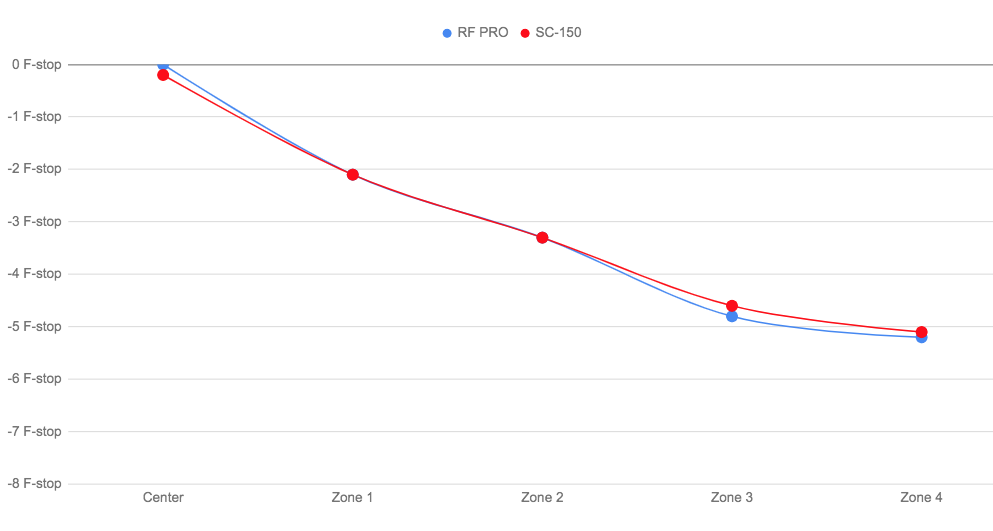
  18. The below graph compares two flashguns with similar specifications when set to full power. Their maximum power in the center and light fall off is similar.


    post-58193-0-69834000-1555142829_thumb.png

  19. The below graph compares two flashguns with similar specifications when set to full power. Their maximum power in the center and light fall off is similar.


    attachicon.gifComparing SC-150 and RF PRO.png

    I think your test is really mixing the issue of strobe beam angle with the drop of light intensity at distance


    A light source for the purpose of testing needs to be approximated to a point in order to do that the size of the tube needs to be much smaller than the travel distance. 60 cm is too small for that purpose I would think you need at least one meter

    Second point is that you use a flat screen to perform the measurements this creates further problems because the distance of travel is different in the various point.

    In your zone 1 the distance is Sqrt(2) * the centre for the inverse square law light will already be half the centre without taking into account the tube geometry.

    In zone 2 is 1/3 in zone 3 is 1/5 and in zone 4 1/6 this is something that is known and does not need proof

    So what you should be really doing is to measure the light intensity at difference incident angle to the front of the strobe once you net out the drop of light your graph will show that your strobe and the seacam at 45 degrees angle have 1 stop loss and at 55 degrees two stops whilst linear strobes have over two stops loss at 45 degree already


    What your graph confirms though and this is really interesting is that past 110 degrees any strobes is really ineffective


    The reality however is that for wide angle where strobe beam is important you always have two strobes and when you combine two there is a compensation effect even if they have less beam angle once you work out the correct distance. Clearly you can illuminate a wider area with a combination of two wider strobes however considering real subject are tridimensional and not flat you can achieve decent results also with narrower beam. As at the edges the values are 3-6% is unlikely you will see any beneficial effect from both colour and exposure point of view especially because wide angle is balanced light not just strobe light


    I think some subjects like large seafans schools of fish will definitely benefit from a wider more smooth beam others with a single subject in the centre like close focus wide angle will bear little to no benefit from larger strobes. For macro and anything with a lens with 20-30 degree coverage the wider beam will make no difference whatsoever


    With regards to your product it will need to issue at least GN 14 in water in the centre like the seacams to be useful. A pretty sure you 150W will do that I am unsure the 100W unit will be any good as it may just not have enough steam for big scenes


    img_1701.jpg?w=948


    This image is a false colour diagram of two 95 degrees video lights on a pool wall with a WWL-1 lens 130 degrees diagonal. Despite the non wide beam you can see that the drop of intensity of the combined lights is 50% off centre and it drops to dark only in the edges

    Considering that in a real life situation the edges are not that important this shows that you can cover most of the frame anyway because even a fisheye lens is not more than 95 degrees on the vertical axis


    Lab test in air on a wall with a single light do not really represent real life usage of products because with a single light beam angle is not important


    Edited by Interceptor121

Account

Navigation

Search

Search

Configure browser push notifications

Chrome (Android)
  1. Tap the lock icon next to the address bar.
  2. Tap Permissions → Notifications.
  3. Adjust your preference.
Chrome (Desktop)
  1. Click the padlock icon in the address bar.
  2. Select Site settings.
  3. Find Notifications and adjust your preference.