bghazzal
Members
-
Joined
-
Last visited
-
Currently
Viewing Topic: Advice on a Carry-On Camera Backpack -
Country
Japan
Everything posted by bghazzal
-
Thanks for confirming, it's what I feared - I saw the stickiness and AF speed settings which are great, but not being able to manually lock AF tracking point for underwater video is an issue. I shoot video in MF, which is fine for wide angle or standard macro, but becomes a problem for blackwater / bonfire type macro video. The main issue is that the subjects are quite small, which means magnification and a small depth of field. This isn't a problem for standard, ground based macro, but in blackwater the subjects are also moving fast, and the shots handheld. They move in and out all the time, which is why most blackwater video you'll see are super slow-motion extensions of tiny in-focus clips. Based on my tests, I think is something else to explore, a combination of operator following ("manual tracking") and a fast AF tracking, which would allow for longer in-focus sequences. I've managed to get shots in MF (at 30fps) by following as much as possible (using focus peaking, which on the a6700 is also available in AF, great), but since I'm shooting handheld in the water column at high magnification, there is no way to refocus manually in time using backbutton focus or a focus knob -action is just too fast and induces camera shake or loss of the animal. This is why and where I would need a fast AF, to work with me to track the subject along a shallow focal plane - I would lock the AF on the subject, and physically follow as much as possible to keep in focus - the AF would complement this by making small adjustements to keep the subject in focus. All this is certainly possible with this camera - however, I would definitely need to be able to lock focus on the suject to be tracked. Bonfire type scenarios are chaotic, with lots of moving subjects - think of a lightbulb with swarming insects on a summer night - I don't think the AF will be able to stay locked onto one subject in such conditions. With AF tracking lock, however it would work - unfortunately, as you have just confirmed, tracking lock is done through the touch screen only in video mode (stills has half-shutter or touch screen for AF tracking lock). All this means there is no way for me to lock AF onto a subject to be tracked underwater in video mode, which was the plan... It's a shame because this possible on Lumix cameras which have a much weaker AF and, I believe on Canon cameras as well. Unfortunately, touch screen based functionalities are a curse for underwater applications...
-
as a side note to your setting questions (which I am also interested in as I might be buying an a6700 in the future - but too much life to deal with at the moment), I've been looking into the a6700's AF video settings. I recently spent a bit of time playing with one here in a store in Japan and it seems that it's not possible to lock AF tracking on a subject in video mode - or more precisely, the only way to do this is through the touch screen, which kills the option for underwater use. In the a6700's stills mode you can lock tracking with a half-shutter press or with the touch screen, but for video it's touch screen only. This is a big letdown for me as I was planning to use focus tracking for shooting fast moving macro (black water / bonfire type stuff, basically locking onto a subject so the camera can work with me to keep it in focus), but apparently it's a no-go. I was planning on assigning AF tracking lock to the backbutton focus button (C2? if I'm not mistaken), but nope - even more frustrating is that in default setting the video AF tracking works as long as you press the button, but unlocks on release... Of course the standard AF is very good, but difficult to know how it will react in a busy setting like the ones we get on bonfire dives. I've played with tracking on the LX10, and it's certainly possible to lock onto a subject (on Lumix, the main issue is that the lens AF doesn't keep up, too slow to maintain focus - it tracks efficiently, but doesn't maintain focus). Basically in the a67000's video mode it's either manual or AF-C, and video AF tracking lock is possible through the touch screen. For AF questions, I would recommend watching this video as well: Now this is a rather specific issue for a rather specific use, but still a letdown for manual control-freaks like myself 😁 If you ever look into it, do let me know if it's confirmed! cheers ben
-
Marelux plans to develop an A6700 housing next year, but final release date not set yet.
-
IIRC Ecuador also doubled their Galápagos National Park Entrance fee on in August 2024 ($100 to $200 USD) might have been an inspiration.... But on a daily levy like the Revillagigedo NP's, this really stings...
-
Very valuable feedback, which I hope will one day make its way back to Japanese operators aiming to expand to what they call the "inbound" market (translation = foreign visitors). For diving, the ministry of tourism mostly has eyes on the North-American market because of the number of divers in the US (but in this, they do not really take into consideration factors such as access to international travel and ease to do so, length and availability of holiday, general travel practices, diving culture etc), the rest of the project being mostly introductory diving experiences aimed at the greater Asian market. People stuck in their ways (which can be for multiple reasons) is definitely an issue here, and can also cause issues for local foreign operators willing to offer more customised, high-end services in line with what commonly offered in this big world of ours. The Chiba shark-scramble you mention (which is also quite something from an ecological point of view...), is a good example, as here the time-limit cannot really be justified by safety protocols as it is the case in Mikomoto. From what I understood it is mostly linked to the frequency of the chumming dives... To give another example, on Okinawa main island where I am now, especially in the north, it's very difficult to organise boat diving, because the rule/tradition is to go through local boat operators which are all fishermen / ex-fishermen. They boat operators set the rules, and 45 minute dives is all they have the patience for... Luckily there is good shore diving where operators do not face these constraints. Yes, it is definitely not the most flexible country ( let's keep in mind Japanese administration still uses faxes in some cases... 😅) and customer-service generally oscillates between great /over-the-top to... dreadful. And then there's the rest, the very same operator portrayed in the doc also offers / was recently offering this kind of aquarium diving experience with captive dolphins for instance, which I leave you to ponder: It's not exclusively Japan of course - land-based diving in Palau, for instance, is also somewhat old-school, favouring large groups as opposed to smaller ones (this is changing slowly with smaller operators like PDA), and actually not the most eco-conscious I've encountered despite the country's official positioning and the Palau Pledge, and there's of course much to be said about the practices of some operators in places like Egypt, Thailand or Mexico, just to name a few. But a major difference is that the Japanese economy is not as reliant on tourism and even less so on dive tourism (being built around a strong domestic customer base), and many Japanese divers stay on the "Japanese circuit" abroad, and are thus not really exposed to international diving practices (which are often seen as sub-par, something which transpires a little in this doc). And all of this tends to deepen the gap... This is a little sad because the diving here in Japan is actually excellent, but a little difficult to access because of cultural codes and something of a lack of communication (interest?) with the rest of the world up to now. Autarcy might be the key word here. Hopefully this will evolve with the new generation, but until now I can't help noticing we don't have many Japanese participants here on open discussion spaces like this forum, for instance, and I'm not convinced this is purely a language issue... But Japan is changing fast, for better or for worse, time will tell.
-
2 lights will always be better than 1 light for multiple reasons (flexibility, backscatter control, more even coverage of the area), so the clear answer would be two lights BUT if the main focus is macro, then a single light goes a long way. Two 4000 lumen lights will not be useful for anything more than closeups / nightdives, but for macro it's perfect - especially if you get a well designed product like the Backscatter MW4300 - this is a really functionnal piece of kit, with a flood and spot mode (most of which can be used for macro or mid-range), really nice button setup and accepts the MS-10 optical snoot and filters if you're into that - it does however have one major flaw in my opinion which is a low CRI (70 range), which you can feel when pairing with higher CRI lights... But I would still recommend this for macro video - to give some examples of mine, these macro clips are shot with a single MW4300 example one, two and three, as is this mid-range clip (worked, but 2 lights would have been even better) However, if you're going for wide-angle video, then there's no way around it - get a pair of lights, and the most powerful you can afford (ideally constant output, so not Big Blue lights which are not constant output) - a single light will be really complicated to use for anything else than closeups (for which 2 lights would be better anyway). I'd say a bare minimum for wide-angle would be 2x 8000 lumen lights, but most people will use a pair of 10K, 12K or 15K - there's no way around it because you need to cover a wide area, hence the need for two lights. And for this, don't fall for the retailer marketing hype, you actually want a tighter beam (say 90°) rather than a wider one (120°), because it will mean more light falling where it should be (on your subject). Or you can work in ambient light for wide (manual white balance with a filter), and a pair of weaker lights for mid-range, closeups and macro, which is a good compromise. You can mix the two approaches (ambient and artificial light) for wide angle by using ambient light filters on the lights and a filter on the camera to match both light sources (see Dreifish's the thread on the subject here), but filters halve your light output, hence the need for powerful lights to get results. cheers ben
-
I can't comment on the X-Adventurer brand - not sure if it's produced by the same factories as Weefine and Kraken and related in anyway, but design is similar (as is often the case for these products 😅) - and Kraken lights are nice. Really good light quality, constant output (you get the lumens stated during the whole dive, not something which dims constantly), good built BUT button ergonomics are really not great for UW video use (long press, short press, double press etc) - some lights have the option to use a remote, which is a game changer but less so for a single light kit. Weefine range is now different from that of Kraken, but they shared the same factory in the past and design/charateristic are still similar, as is the price range. Both are constant output for lights over 2500 lumen. These are not the cheapest however, in the upper mid-range - look into Hydras for instance. cheers
-
In Japan, Sony cameras intended for the Japanese market will be cheaper but with menus Japanese only (and sometimes cultural oddities like non-mutable shutter sounds), and no option to change language. The hacks/firmware tricks to add other language support to Japanese modes are iffy, risk issues with software compatibility for subsequent firmware updates and will void warranty. And importantly, most don't work for recent Sony models. It also means cameras will be difficult to resell outside the Japanese market because of this - individual buyers are taking a risk in buying a hacked camera, warranty is void and pro retailers will consider the camera to be in Japanese, which makes it lose value (50%+) However, you can also buy international models (海外仕様) in Japan at flagship stores or major outlets like Yodobashi or Bic Camera and, I think Kitamura, but they are a little more expensive. Most if not all second-hand models in Japan, like the ones sold at Maps, with be Japanese models only. You can then get a tax discount on new models and second-hand in stores offering tax free-shopping - just make sure not to use the auto-gates at the airport so that you get an entry stamp in your passport. You can then get a QR code for tax free shopping from visit japan web or bring your passport (Japan being Japan, bring your original passport anyway). Online tax-free shopping is allowed but inexistent, most retailers won't do tax free online, even if you have the QR code. There are limits, I think it's one camera and lens set per person. So it's a tricky decision, and one which I am currently facing for a Sony camera (I read Japanese, so a Japanese menu isn't an really an issue, but it won't be future-proof for resale, and I will need to know the Japanese menu equivalent for any English language info found online, which is a little tiresome). Panasonic and Canon no longer have this issue like they did in the past, not sure for Nikon. Lenses, however, are cheaper and readily available second-hand without language issues, with a solid second-hamd market I don't see massive discounts on Nauticam products in Japan, I find that they're usually in the same range as elsewhere. There is basically one major Nauticam dealer here. Where did you see good prices? It might be because the yen is low at the moment, which helps. Or maybe i'm out of touch with European prices. Second-hand underwater imaging gear market is limited (Mercari, Yahoo Auctions, Jimoti...) Dive gear is generally much more expensive than Europe.
-
Thanks for all this - unfortunately, there doesn't seem to be a good solution at the moment for macro video. My first choice was the Zeiss Touit 50 macro, but AF support, more than price, is an issue here. Zeiss isn't being particularly helpful, support considers macro videography (where high framerates are quite commonplace, think insect videography) to be "special applications" Zeiss Touit 50mm documentation states: "To achieve maximum compatibility on APS-C cameras of the Sony Alpha series with E-Mount (AF in video mode) we highly recommend using the latest Sony firmware" . This seems to indicate the Zeiss lenses can handle video AF to a certain point, but it is difficult to know if the lens is capable of handling the Sony Alpha series latest AF - the a6700 has Sony latest tracking autofocus, which is more recent than the lens - and also, importantly, if it can support video AF at 120fps. To which Zeiss replied: Unfortunately we cannot guarantee that the lens will be able to support 120fps Video AF. The AF speed of Touit lenses is limited due to their design. We therefore recommend Touit lenses primarily for photo shoots and cannot make any statements about the speed for such special video applications. With the monster adapter + 60mm solution now no longer an option, it seems like the only macro lens capable of handling video AF correctly is the Sony 90mm (which is a G M series lens), and maybe the Sony 30mm (optimized for video up to 120fps, but which has working distance issues, especially with necessary diopters).
-
Any 3D printing leads for the following Nauticam zoom/focus gears for Sony lenses? SE1650-PZ Zoom Gear SE30-F focus Gear cheers ben
-
Good idea, but wouldn't this kill off lens AF?
-
Thanks for that Craig, that' s a really good plan. I'll get the kit lens anyway to work with the camera on land, and the good thing is that new lens' AF is supposed to have optimised for video. Regarding the ports, it's really good news that the Macro Port 45 works for both (I was focused on the Macro Port 40 with with Focus/Zoom Knob, hadn't noticed the 45 worked for the kit as well. So this means you would get the Nauticam Macro Port 45 with Focus/Zoom Knob + SE1650-PZ Zoom Gear for the kit lens, and just need to add the 30mm extension for the Zeiss. And looking at the charts, the Macro Port 45 with Focus/Zoom Knob can also be used for the 30mm (with SE30-F focus gear), so that's basically 3 lenses covered with the 45 with knob, phew 😄
-
Very sad news from Egypt, and this time with human casualties... It's a lot in a short time for an area - a couple of years ago unplanned drydocks or inactivity during pandemic lockdowns could be seen as a contributing factor, but in 2024... 😅 Wow - reminds me of Richelieu Rock (Andaman Sea, Thailand) when i was working there - I counted 14 liveaboards around the rock once, all 25 guests, all doing 3 to 4 dives there meaning only 20/30 minutes of schedule to play with to try to space out drops... Fantastic site, but the small horshoe shaped pinnacle was easily overcrowded - My whole guiding there was focused on avoiding other groups (watching streams of bubbles in the distance and using depth, areas where pushing little into the current to pass a corner would get you to an empty area, etc...). Not something I would like to do again...
-
Thanks for the reality check - yes, you're right - the main issue issue is that macro + fast video AF is a very uncommon combination (other than for insect, especially flying insect fanatics) - for standard macro MF or backbutton focus AF works perfectly fine. The adapter was a bad idea from the start, and it's been confirmed it doesn't work for video. Thanks - the Sony 30mm macro actually one of the remaining contenders for this, video AF should work well according to the description, despite its age - the issue is working distance, especially with diopters - on average i was shooting at 80mm FF equivalent, so this is quite a gap, but I don't think diopter use will be an option with it. the Zeiss Touit 50mm I would need to test - it is by far the best choice overall, and video AF is supported on paper, but I've also ready users describing it as working in steps which is problematic for video. I need to check on land first. It's been confirmed that the adapter doesn't support video, so at least this is clear! Yes, this an issue as I would need to use diopters with it. With the Nikon 60mm adapter solution gone (as well as the Sony FE50mm macro, which has dismal AF for stills and video, I can see the following options for shooting macro on Sony, with relatively fast video AF Non macro lens + diopters - new Sony 16-50 kit lens (E PZ 16-50mm F3.5-5.6 OSS II ) advantages: OSS, AF optimised for video, cheap, flexible for non-macro shooting, Nauticam port solution given (SE1650-PZ + N85 Macro Port 40 with Knob), light so easy rig won't be nose heavy disadvantages: not a macro lens, I would need to use diopters (which I have) to make working distance acceptable, but it will not achieve 1:1 magnification - image quality (debatable for video) Macro lenses - Sony macro 30 (E 30mm F3.5 Macro ) advantages, macro lens, optimised for video according to Sony, cheap, light so easy rig won't be nose heavy disadvantages: working distance issues (very tight, making diopter use very difficult, maybe impossible), no OSS - Zeiss Touit 50 (ZEISS Touit 2.8/50M ) advantages best focal length, macro lens, Nautical port solution given (N85 Extension Ring 30 + N85 Macro Port 45 ) disadvantages: video AF performance unknown - documentation does mention video AF support, but does it work well? no OSS, price (but still acceptable) by far the most solid option, IF video AF works well enough... - Sony 90 (FE 90 mm F2.8 Macro G OSS ) advantages: macro lens, video optimised G series which should work very well with Sony's latest AF, OSS disadvantages: focal length (135mm equivalent on APS-C!) makes it near unuseable for this application, long MFD, high price tag, long/heavy lens which will need a lot of work to compensate for a balanced, non-nose heavy kit
-
Hello all, I'm thinking about upgrading to a Sony a6700 rig specifically for the advanced AF functions and high-framerate it offers, which could come in very useful for shooting videos of planktonic critters, especially in blackwater / bonfire type settings. So small, erratic and fast, high contrast 😄 A situation where pretty much anything will be better than what I currently use, which is manual focus at 30fps... This is where the Sony a6700 comes in, being something of a hotrod with a lot (too much?) under the hood for video. But alas - lens options are very limited, especially for macro, and even more so for fast AF macro lenses, the ultimate info/spec killer being fast AF macro lenses supporting high-framerate (120fps) video with good AF performance... Phew... The Sony G 90mm sounds good (the G series has AF optimised for video according to Sony propaganda) and is even stabilised, but it's a 135mm equivalent on an APS-C sensor, with a long MFD, so too tight and tricky to use for my purposes, a 50mm or 60mm macro lens being ideal. The native Sony FE macro 50mm, however is definitely not an option, dead in the water for macro video due to poor AF performance (see here) This leaves us with the unstabilised Zeiss Touit 50mm, which is a nice lens, but offers very little info / feedack on how well autofocus (the lens does have a linear motor) actually performs for video with a6700. Enter the Nikon 60mm macro ? Looking into blackwater data here and elsewhere, it seems some photographers are succesfully using the famous Nikon 60mm macro (AF-S Micro NIKKOR 60mm f/2.8G ED, to be polite) with an adaptor on Sony cameras - the most common adaptor cited being the MonsterAdapter Nikon F to Sony E mount adaptor (I think 2 versions are out now) However, it is very unclear if this adaptor does support AF in video mode, and if it actually does, how fast it is for handling tracking AF used for video... It is also unclear whether said adaptor would work for a scenario like Sony aF6700 > monsteradapter > Nikon 60mm (in a Nauticam N100 macro port?), and even less so for shooting video. Today, I contacted a Japanese MonsterAdapter dealer who told me the Nikon F to Sony E mount adapter supported still images only, and is not compatible with video recording. I do not know if this is true in practice, where things can be a little different than on paper. I'm waiting on an answer from MonsterAdapter themselves. But it would be really nice to have some experienced-based user-feedback on the subject, from people who have used/are using monster adapters, so I'll try to centralise monsteradapter data for video use. *** Has anyone on the forum ever shot video with monster (or similar) adapters? Did AF work, and if so, to what extent? thanks in advance for your input! cheers ben
-
done. Video cleaning tools are mostly noise reducing plugins like Neat Video or Topaz AI, but there is no backscatter focused application (which would be fantastic, if technically feasible!)
-
This is Quest slate with holder btw - I just gave mine away to a neighbour 2 days ago 😉 The GoPro mount, 3 flex arm mounts (and compass!) are bolted to the plastic slate holder/protective cover
-
Any video plugin version in the making? (asking for a friend 😁)
-
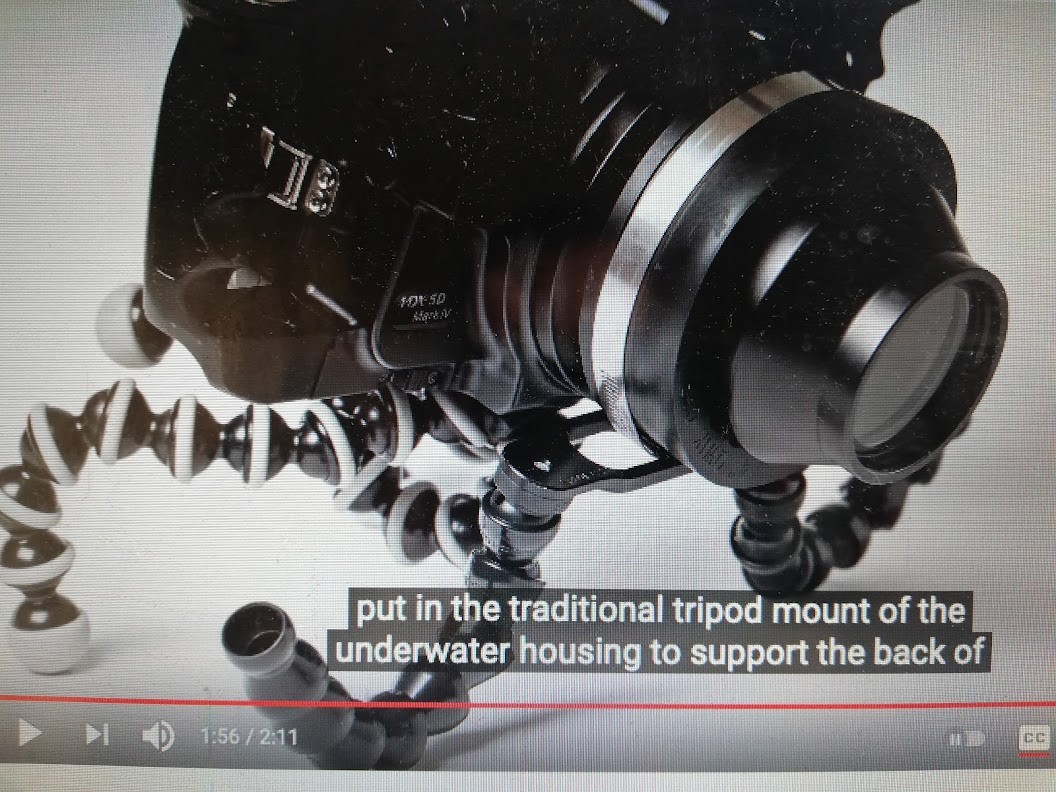
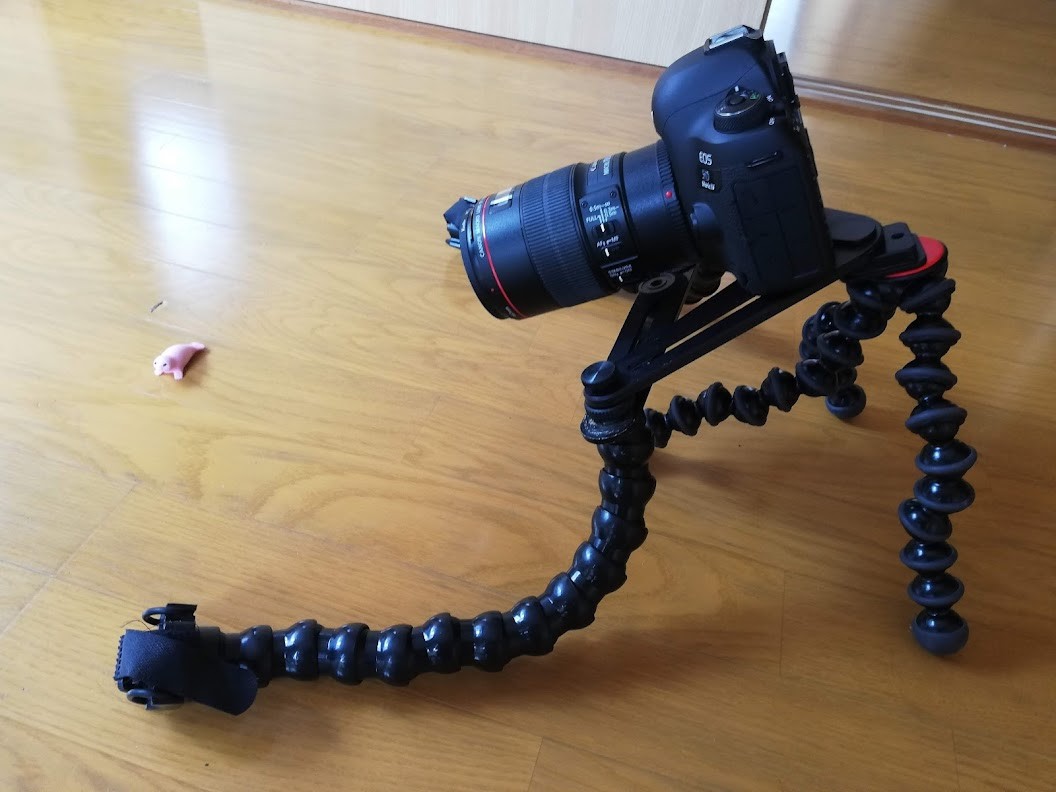
Here are ideas using some locline arms and/joby style legs. This is something I tested with a borrowed camera, before finally going for the quadripod solution, as it was much more convenient. As you can see, I combined my Joby Gorillapod on a central mount, combined with locline flexarms: Here's a similar example I found online: but for a lightweight actioncam setup this is probably overkill. cheers b
-
Great, thank you Wags, this a very nice example of what the camera is capable of doing with a little CC, impressive and more balanced than previous clips I'd seen, though there is a green hue. Is the water green in your locale? (it would seem so based on the surface shot) I'm not sure this would make a difference since you're D-log, so already flat - but are there other WB options than the kelvin scale in camera? cheers ben
-
Couldn't agree more. Wonders how others feel about this, did it put them off a little or actually challenge them to be part of the "elite" divers capable of braving Mikomoto currents? On the "DIY" aspect, I think most of Europe is like this - France certainly is, so is the UK, and most if not all of the historical CMAS-BSAC-club diving base of dive operations. This actually extends to (W)RSTC affiliated operations in the area as well, either because most if not all dive operations are both, because of local regulations and also, more importantly, simply because the diving context requires it - there is less manpower because it's more expensive, and also conditions in general (diving from RIBs/dinghies, cold water, etc...). Beyond historical concerns, I think the situation is similar in North-America (Canada and US as well) - so Japan is not really an exception, but more in line with typical dive operations found in the Global North, especially in local dive ops as opposed to resorts / liveaboard cruises welcoming visiting tourists. Shameless plug, but I'd actually wrote a little about this here https://bluejapan.org/diving/organisation/ and here https://bluejapan.org/diving/practicalities/ The resort (I've heard the term "cocktail diving" as well) and liveaboard scene is mostly found in Global South countries - which also happen to concentrate the largest dive-tourism industries - Egypt and Mexico where it all started, South-East Asia (Indonesia, Philippines, Thailand), Maldives, Central America, Micronesia and the South-Pacific... I may be wrong, but I'd imagine places like Australia would offer a mixed experience, with local diving being autonomous, whereas tourism oriented resorts and liveaboards would also offer the hand-off, turnkey experience, as would other places around catering mostly to fly-in divers. Anyway, I have no real problem with this and actually think it's better for divers in general to be in charge of their equipment (and I also hate people touching my stuff, even in a recreational context), and yet have somewhat mixed feelings about the message being sent here. I do feel what might be something of a superiority complex or ill-placed elistism, which sits a little oddly with what is likely a real passion for this complex and fascinating environment, as well as very understandable safety concerns (surfacing in a shipping lane in rough seas 😅...). I definitely agree with safety-first, clear operating procedures and rules instaured to make the experience safer, but the doc does bring up concerns/questions about the way this all seems to be implemented. Yet not having dived there myself, I can only go with what I read, see and feel, which is worth what it is... Personally, as much as I'd love to see schooling hammerheads and actually do love current diving, be it drifting or more stationary / hooked (like the Filipino guide featured in the doc, I've worked in currenty places like Palau, Maldives, and Komodo for instance - the latter having - by far - the most complex and potentially dangerous current I encountered), I'm not sure I would be able to enjoy diving in such conditions. Here's some additional food for thought: a Mikomoto Hammer 2023 dive briefing clip (fasten your seatbelts 😉) and - while I'm not really a fan of the format - an local incident discussion by Discovery Divers Tokyo: https://youtu.be/roOSko4DKrA
-
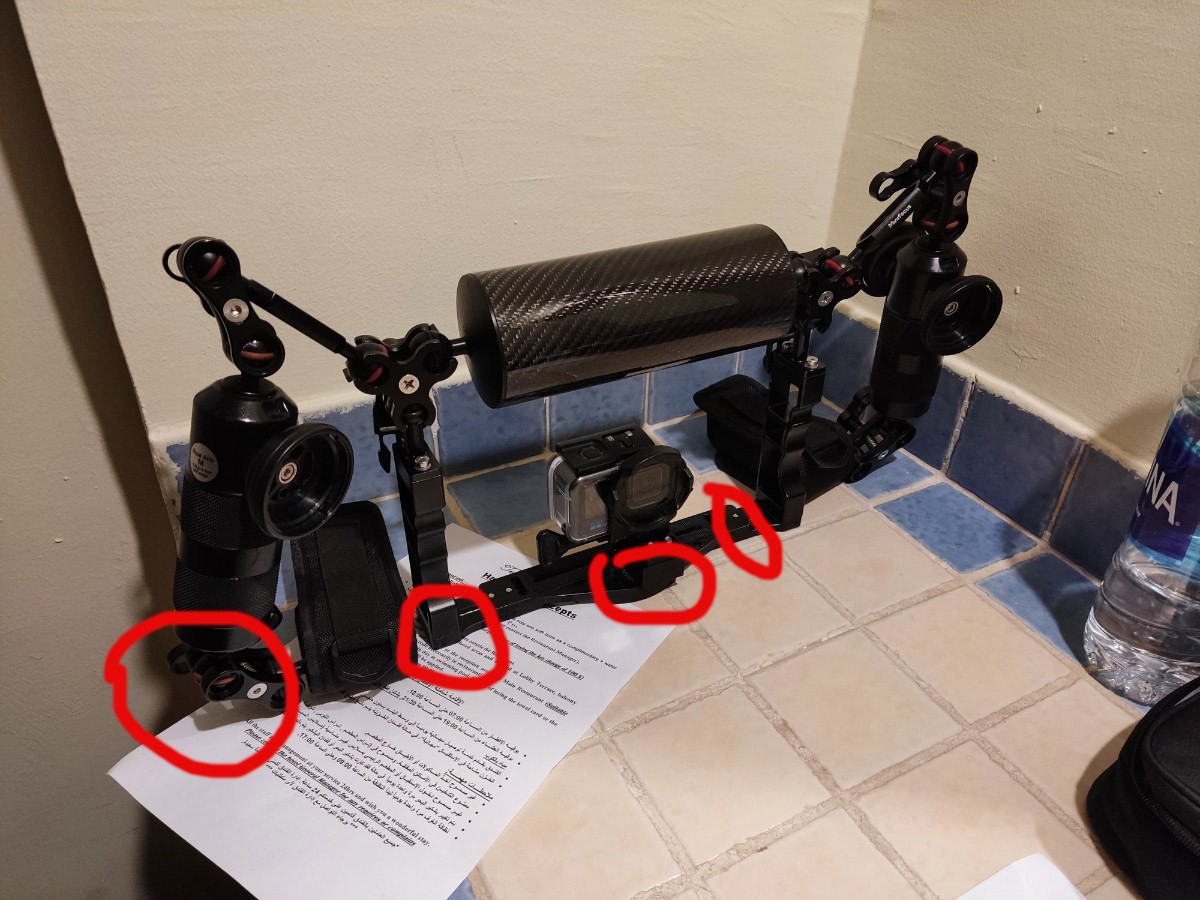
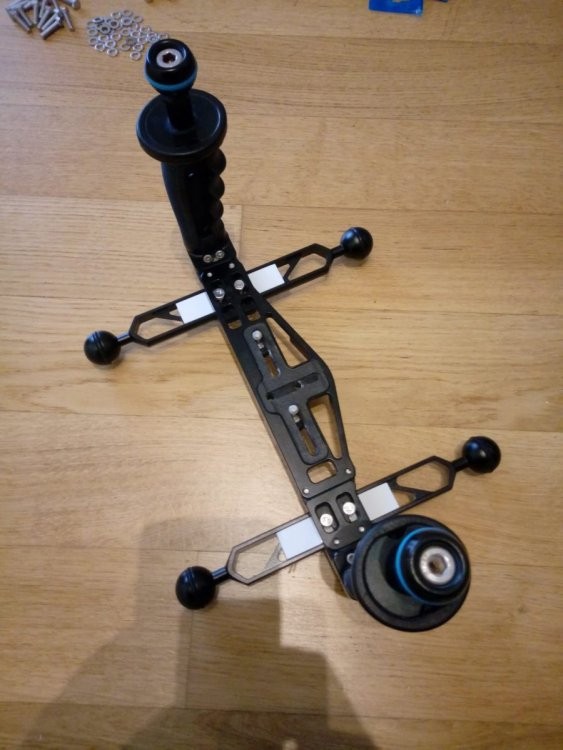
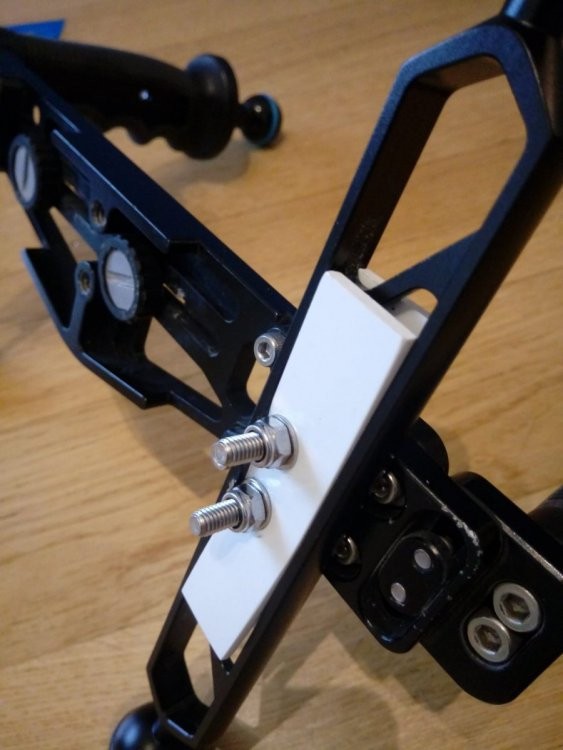
As mentioned, if you go with flex arms (locline) you can connect them to your tray with ball mounts and clamps, but also with an M6 thread mount, a 1/4" thread mount or coldshoe mount for instance. This would allow you to connect 2 or 3 flex arms to your tray in multiple ways Have a look at the options here https://www.flex-arm.com/en/components/34-flexible-arms-components Looking at the picture of your rig, you could add triple clamps (especially open ones) to the ball end you have at the end of the tray, add something to where the handles are, add a perpendicular 5" ball arm and also work with the main central mounting point for example
-
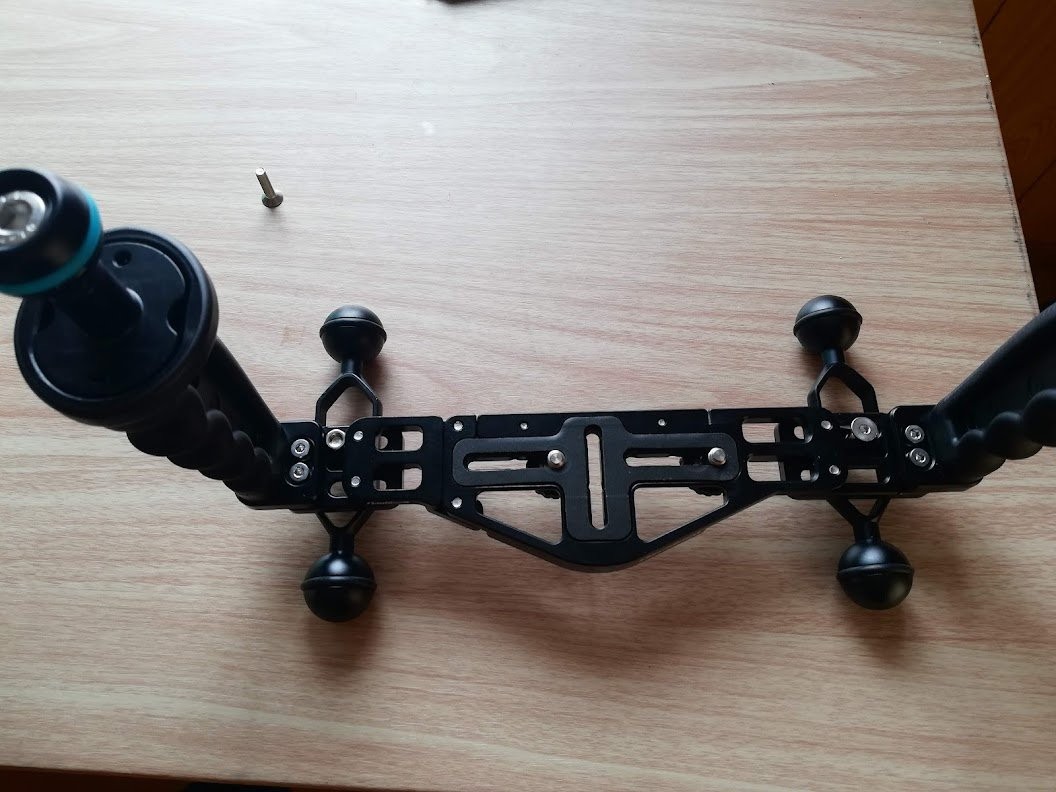
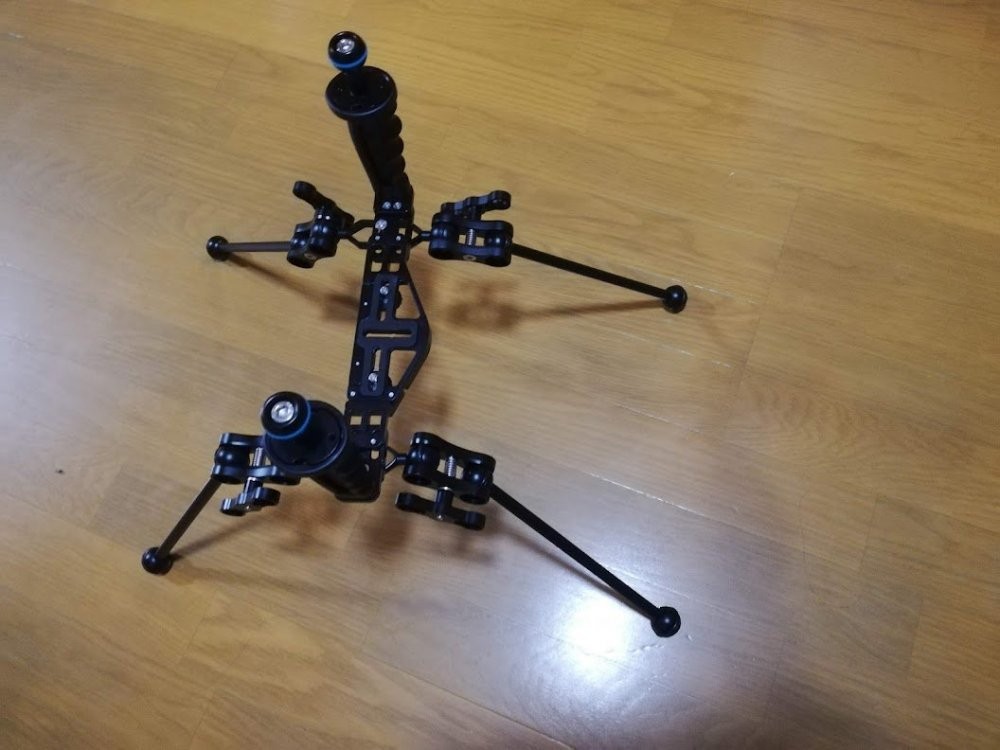
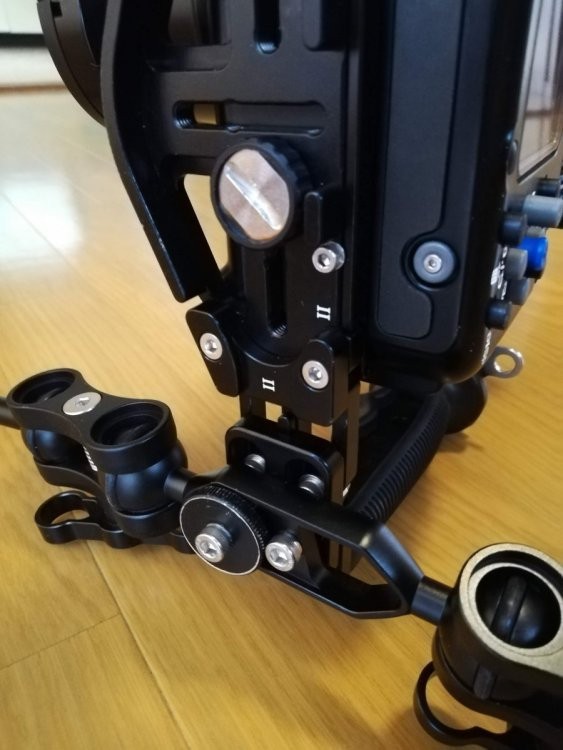
how about two 5" ball arms perpendicular to your tray? Some images from a legacy WeP thread, where I was asking about attachine a tripod to a pesky Nauticam flexitray and got great help for others: My screwed-on solution ended up being more simple, but here's a YouTube tutorial for a slightly more elaborate one: Here's a similar approach (copyright Davide) Otherwise in the prêt-à-shooter readymade section, you have these kinds of solutions (but where's the fun in that 😁) https://www.bgningoem.com
-
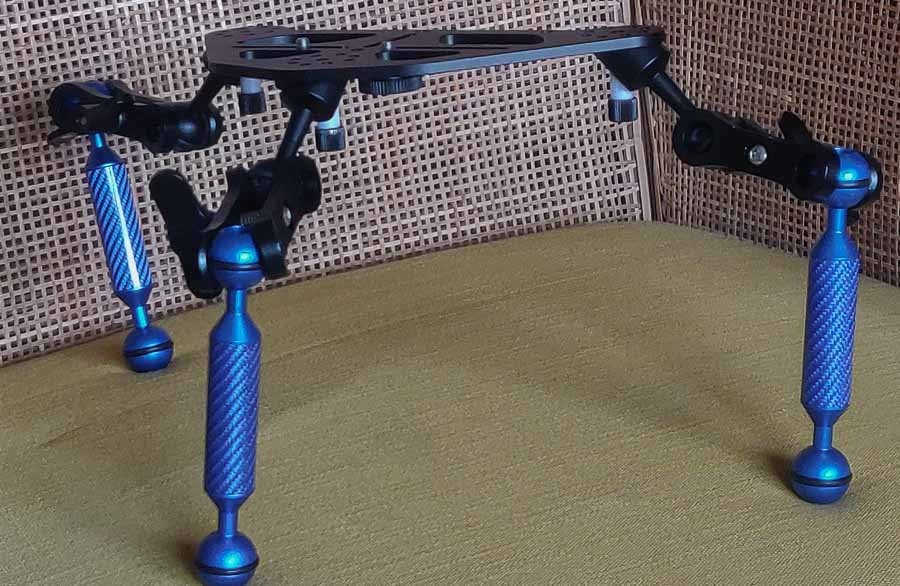
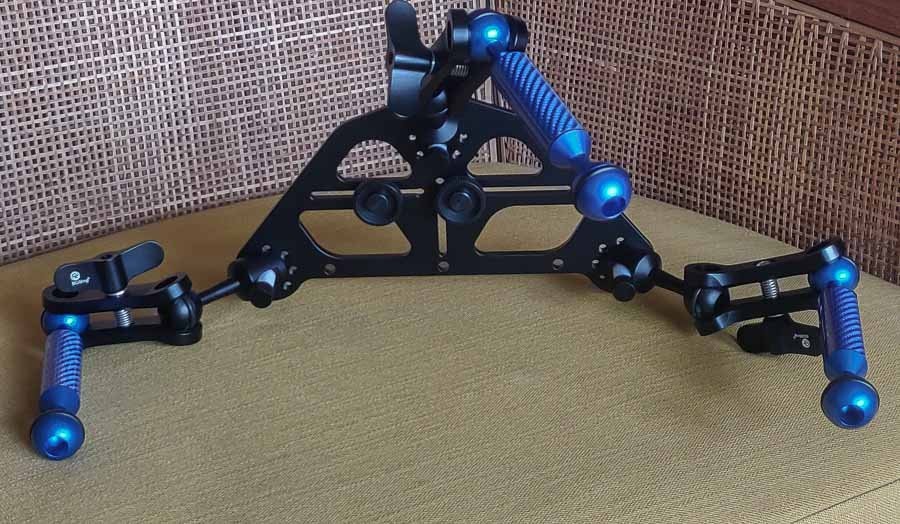
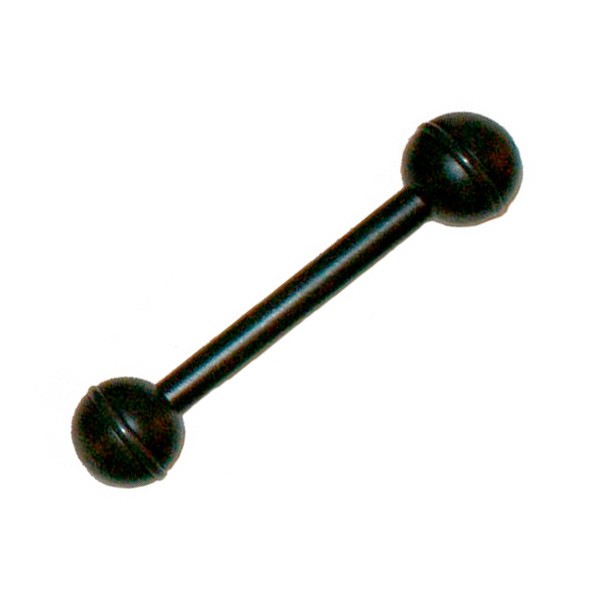
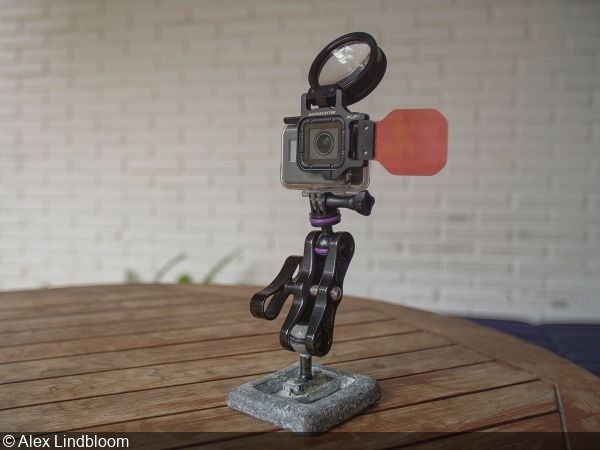
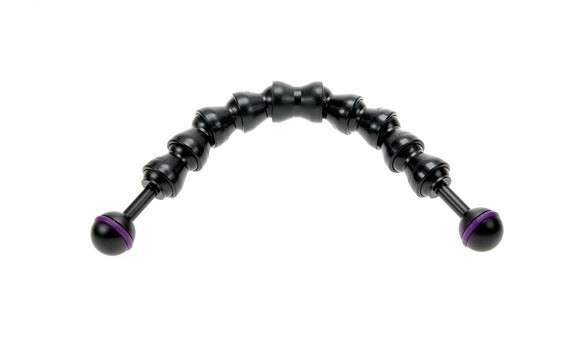
As a side note - if you want to make do with less weight, keep in mind that a 4 leg setup (quadripod) will be more stable than a tripod, allowing for lighter setup. I use aluminium ball arms for my quadripod, which have the added advantage of having quite a bit of weight themselves, which helps, be it in a tripod or quadripod setup - these guys here: Otherwise a quick-and-dirty weighted monopod option for action cams would be as follows: Source So for your rig this would translate to adding a ball mount beneath it, then keeping the extra weight in a pocket for instance, easy to handle, but not the most flexible. Lastly, when I was playing with GoPro and closeup lenses, I fitted a Joby Gorillapod tripod - they come in different weight options and are quite handy, with lots of options, including for 3kg, 1kg rigs on land... I think I had a 1kg one, but the 500g Actioncam Gorillapod is fine for underwater use, this here: https://joby.com/global/gorillapod-500-action-jb01516-bww/ Keep in mind that these are not specifically designed for UW use / saltwater, so make sure to rinse well - they will wear down, but do work for a whie Another more option along the same lines, as suggested above, would be to design your own with flexarm / locline type arms, which would be more durable - a locline based quadripod (or tripod) with ball-ends could be flexible, light to carry and yet stable enough to hold an action-cam rig, and also offer plenty of options to attach to your rig:
-
Here's a review of the series: https://www.theguardian.com/tv-and-radio/2024/nov/20/our-oceans-review-barack-obama-nature-show-netflix Here's a little snippet on wildlife documentary narration by former POTUS 😁 For the most part, Obama acquits himself well in his new role. His voice, which has always been steady and soothing, was made for this. (Can you imagine any other high-level US politician pulling it off? Would narration sustain George W Bush’s attention? Would Joe Biden’s narration sustain ours? Does Trump know what a fish is?) This doesn’t mean that Obama is the new David Attenborough, of course. Attenborough is a career naturalist who almost single-handedly created the genre of wildlife television. Barack Obama is here to emote about dolphins. He isn’t helped by the script, which sometimes seems to underestimate the intelligence of its audience. It’s too folksy, describing the clownfish as “the world’s most famous fish”, presumably because there is a film franchise that stars the species. During a sequence about cuttlefish, Obama growls: “Don’t make him angry; you wouldn’t like him when he’s angry.” At one point, he namechecks Murder on the Dancefloor. At another, he uses the word “fishnado”. Attenborough would never.