



yes, I have the new Nauticam 0.8:1 viewfinder and it is outstanding with the EVF set to high.
Thank you this is what am planning to buy myself
Sent from my iPhone using Tapatalk
Read-only discussion
yes, I have the new Nauticam 0.8:1 viewfinder and it is outstanding with the EVF set to high.
@Interceptor121
Having shot the A7IV, the A7RIV, and the A7RV, all with the 90mm lens on the same subjects (small detritus on a beach) it is clear that:
For AF (above water, with Sun fairly low on the horizon) with this lens - the A7RIV is slower than the A7IV, which is slower than the new A7RV.
In this one scenario, the AF (faster to lock on a small subject) of the A7RIV subjectively about 2x slower than the A7IV on the same subject. The A7RV feels about 25% faster yet again.
When the Nauticam housing arrives will be able test this better in the pool, and then in the real world in the spring.
As @Phil Rudin mentions the A1 is both at a significantly different price point and different class of camera. I would expect the AF to be faster than the A7RV, but by less than it is over the A7IV (as they share some of the AF intelligence, but not the sensor architecture).
I also think that a blackwater dive might be the best test of this difference. It will be interesting to see what folks like @Mike Bartick are seeing throughout this season and next for any Sony gear used for BW dives (which is one reason why I will keep shooting with my D850 and D500) - not yet ready to move to a mirrorless system.
Regarding Blackwater diving Mike Barwick and I both did articles about BW for UWPMAG.com in the same back issue #121. Mike was shooting in Mexico and mine are from the Palm Beach, Florida. Mike's images are all with the D850 and 60mm macro while mine are with the A-1 and 90mm macro. I can assure you that the Sony A-1 is quite capable of excellent BW images and can keep with super fast animals like the 8cm (3 inch) Tuna attached below.
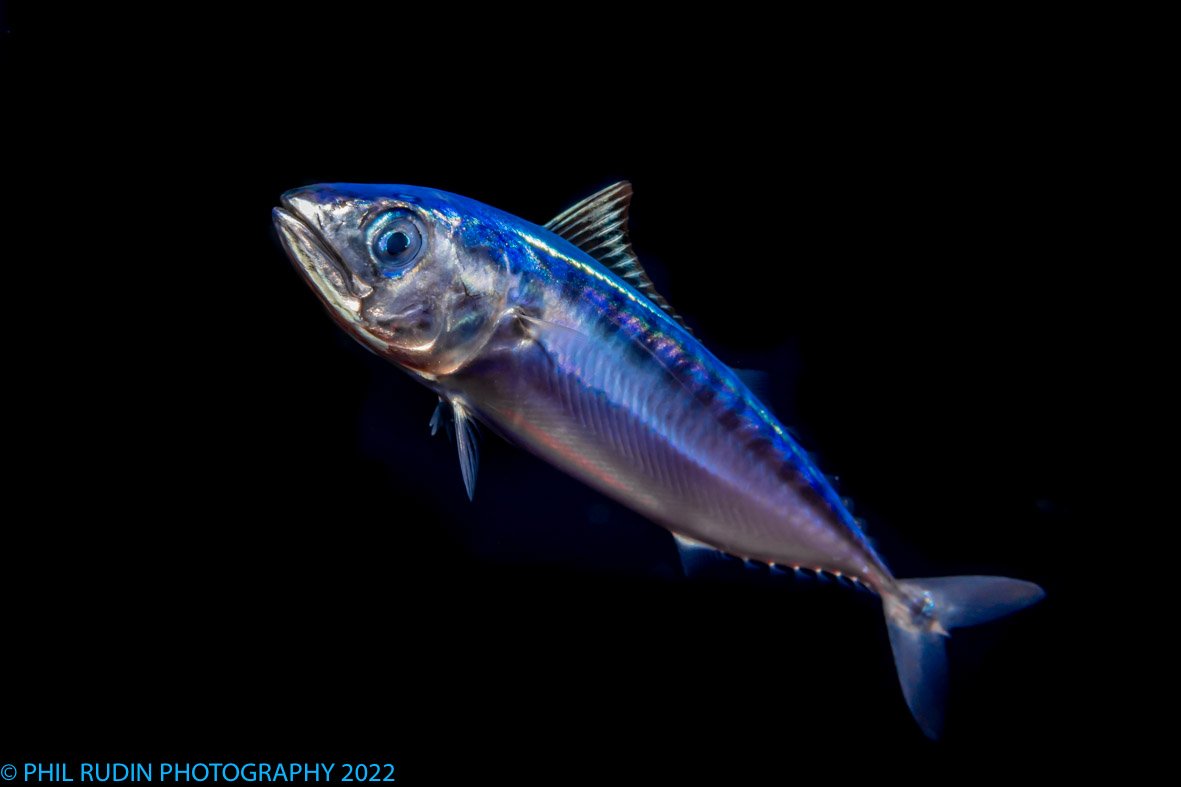
@Phil Rudin
You may have missed my point. I fully agree the A1 is a great camera, just a little high on price (at least for my daughter). I'm well aware of what @Mike Bartick shoots on BW dives, he was the one who shared the idea to shoot with the D850 & 60mm lens (in Anliao).
What I was actually referring to in that previous reference was if/when Mike starts seeing more Sony cameras (specifically A7 series) coming through Anilao (at Crystal Blue) capturing great BW images. When I was there last (and then a year later at Dumaguete) the A7 series (mostly A7III's and A7RIV's) with the 90mm lenses were struggling on BW dives (almost universally).
I'm looking towards the future - today the Z6 & Z7 (in current form) are not (yet) performant enough to replace either my D850 or D500 specifically on BW dives. The A1 might be, but it's wee bit expensive. I'm waiting to see what the next rev of the Z9 turns into before making any kind of decisions.
Any images of smaller subjects with the A1 & 90mm lens? Any thoughts on that combination shooting BW?
4 hours ago, oneyellowtang said:What I was actually referring to in that previous reference was if/when Mike starts seeing more Sony cameras (specifically A7 series) coming through Anilao (at Crystal Blue) capturing great BW images. When I was there last (and then a year later at Dumaguete) the A7 series (mostly A7III's and A7RIV's) with the 90mm lenses were struggling on BW dives (almost universally).
This is what I've heard as well, Blackwater diving really challenges the camera - from a focusing, tracking and ISO/noise performance point of view. No doubt can newer cameras deal with noise very well, but I would mostly be concerned about acquiring and tracking. I get the feeling that these cameras are really honed in for overwater photography, and will absolutely outperform on land, especially for wildlife.
I'm hoping Nikon releases the Z8 and that we get people to try them out. If we're able to get thoughts from the most prominent blackwater photographers, they'll probably give good input to this. With my D500, I feel like my keeper rate for blackwater photos is relatively high - some critters are harder to focus on than others but if I've missed, it's usually my own fault. I would hate for that keeper rate to go down with an upgraded camera. I had friends on a recent trip struggle with the 90mm and 105mm with DSLR cameras, so perhaps the missing ingredient is a 60mm equivalent. Having said that, I'm on a 60mm on a crop so perhaps the 90mm on a full frame should be similar?
This is all theoretical from my side. However, I look forward to seeing what the immediate future holds, but for the total price of mirrorless + lenses + new housing etc., it goes without saying that no one should be happy to compromise in any area of underwater photography. I certainly won't be giving up my D500 any time soon.
1 hour ago, sinetwo said:This is what I've heard as well, Blackwater diving really challenges the camera - from a focusing, tracking and ISO/noise performance point of view. No doubt can newer cameras deal with noise very well, but I would mostly be concerned about acquiring and tracking. I get the feeling that these cameras are really honed in for overwater photography, and will absolutely outperform on land, especially for wildlife.
I'm hoping Nikon releases the Z8 and that we get people to try them out. If we're able to get thoughts from the most prominent blackwater photographers, they'll probably give good input to this. With my D500, I feel like my keeper rate for blackwater photos is relatively high - some critters are harder to focus on than others but if I've missed, it's usually my own fault. I would hate for that keeper rate to go down with an upgraded camera. I had friends on a recent trip struggle with the 90mm and 105mm with DSLR cameras, so perhaps the missing ingredient is a 60mm equivalent. Having said that, I'm on a 60mm on a crop so perhaps the 90mm on a full frame should be similar?
This is all theoretical from my side. However, I look forward to seeing what the immediate future holds, but for the total price of mirrorless + lenses + new housing etc., it goes without saying that no one should be happy to compromise in any area of underwater photography. I certainly won't be giving up my D500 any time soon.
Nikon and Canon have started later on autofocus at present Sony is still the leader not sure when and if this gap can be closed especially as mirrorless autofocus relies on sensor read is not a separate architecture
The 90mm lens hunts it does it also on land you don't need to go into blackwater diving to find out. I don't have any other lens that has this behaviour but comparing other mirrorless systems it can happen
When it comes to Sony the alternative Sigma 105 is apparently even slower to acquire focus so this remains a challenge in the sony eco system
I do not know how the new RF and Z macro lenses perform but a lot will depend on the lens not just on the autofocus of the camera
The other challenge of mirrorless cameras that in dark conditions they will need to start dropping frame rate to focus and pump up gain which means you could have trouble seeing what you are trying to focus if this moves and if you don't let the camera drop the frame rate it may not focus at all
It has always been obscure to me how nikon 3d tracking works but I suspect this is an off sensor mechanism specialised in tracking RGB patches that may do a better job in low light than a mirrorless camera that has phase difference pixels on the sensor
6 minutes ago, Interceptor121 said:I do not know how the new RF and Z macro lenses perform but a lot will depend on the lens not just on the autofocus of the camera
Indeed, a great wildlife photographer (land), Steve Perry, had this video (timestamp incl.) on autofocusing specifically, where results were mixed when comparing the same lenses against DSLR v Mirrorless camera bodies.
Of course firmware updates may have improved since for non-Z9 bodies, but I've not seen any evidence since from the Nikon camp or from fans. It seems in Nikon's instance, Z9 is better than the D850 at AF speed (not necessarily tracking) where the body is the bottleneck, even with the FTZ adapter. Where the lens is the bottleneck, I understand they'll perform the same if the same logic is applied.
Perhaps the main issue here isn't so much the mirrorless body then, but as you say the lenses and lens selection.
For me Z8 would be perfect if they include pre-release (equivalent of Olympus procapture) and it performs at least on par underwater with D500 - I know it'll outperform on land for my purposes.
49 minutes ago, sinetwo said:Indeed, a great wildlife photographer (land), Steve Perry, had this video (timestamp incl.) on autofocusing specifically, where results were mixed when comparing the same lenses against DSLR v Mirrorless camera bodies.
Of course firmware updates may have improved since for non-Z9 bodies, but I've not seen any evidence since from the Nikon camp or from fans. It seems in Nikon's instance, Z9 is better than the D850 at AF speed (not necessarily tracking) where the body is the bottleneck, even with the FTZ adapter. Where the lens is the bottleneck, I understand they'll perform the same if the same logic is applied.
Perhaps the main issue here isn't so much the mirrorless body then, but as you say the lenses and lens selection.
For me Z8 would be perfect if they include pre-release (equivalent of Olympus procapture) and it performs at least on par underwater with D500 - I know it'll outperform on land for my purposes.
I used procapture for some time topside. To be useful you need to run a quite high frame rate and when you have an external flash this is complicated or not working at all
My A1 does flash up to 30 fps but the strobe can only give very small power
8 hours ago, Interceptor121 said:I used procapture for some time topside. To be useful you need to run a quite high frame rate and when you have an external flash this is complicated or not working at all
My A1 does flash up to 30 fps but the strobe can only give very small power
I think I managed to do about 3-5fps with my strobe recycle time, comfortably with the Retra's at half power. Any more and it would just be too slow to recycle in time. What strobes do you have being able to do that? Perhaps procapture is a possibility underwater, but if you're using flash then perhaps at that point you might as well just ignore procapture - I guess the only advantage then is not filling up your memory card.
I think I managed to do about 3-5fps with my strobe recycle time, comfortably with the Retra's at half power. Any more and it would just be too slow to recycle in time. What strobes do you have being able to do that? Perhaps procapture is a possibility underwater, but if you're using flash then perhaps at that point you might as well just ignore procapture - I guess the only advantage then is not filling up your memory card.
On 1/10/2023 at 2:36 AM, oneyellowtang said:@Phil Rudin
Any images of smaller subjects with the A1 & 90mm lens? Any thoughts on that combination shooting BW?
Again, I did a complete Blackwater review in UWPMAG.com that is all done with the A-1 and 90mm combination.
@Phil Rudin Helpful... thank you, can you share the title? A quick look through back issues didn't have this pop out...
I really don’t see any major benefit or use for Procapture underwater, because of the fact that the majority of underwater photos are taken with flash, where procapture is not compatible. Definitely there are times that all photographers press the shutter too late - but almost always these are when we are shooting flash and miss time the perfect moment.
The exception is pelagic/big animal/bait ball type shooting when you are working without flash. However, the limiting factor on imaging here is rarely the photographer missing the moment to press the shutter. The limiting factor is usually waiting for the subjects to come into range. Or you moving yourself into range. So again, having access to images before you actually pressed the shutter isn’t especially advantageous - because we usually have lots of time waiting for the subject to be close enough and plenty of time to start the motor drive just before it is.
On the AF question - it seems to me that Sony’s weakpoint is the 90mm lens. Perhaps we can hope that they introduce better designed macro lenses in the future to match how well their AF system works with, say, their telephotos. Maybe a 60mm and a 120mm macro would actually give nice range of options and would compliment the 90mm. The 60mm would be valuable on the APS-C Sonys too.
7 minutes ago, Alex_Mustard said:I really don’t see any major benefit or use for Procapture underwater, because of the fact that the majority of underwater photos are taken with flash, where procapture is not compatible. Definitely there are times that all photographers press the shutter too late - but almost always these are when we are shooting flash and miss time the perfect moment.
The exception is pelagic/big animal/bait ball type shooting when you are working without flash. However, the limiting factor on imaging here is rarely the photographer missing the moment to press the shutter. The limiting factor is usually waiting for the subjects to come into range. Or you moving yourself into range. So again, having access to images before you actually pressed the shutter isn’t especially advantageous - because we usually have lots of time waiting for the subject to be close enough and plenty of time to start the motor drive just before it is.
Pro-Capture is the perfect tools for shots like splashing water, birds coming on and off a feeding plate etc
In essence good for stalking limitation is the lack of flash support
I do not see a benefit of procapture at all I see a benefit of burst shooting this is avaialble but the strobe runs out of power depending on the power settings
7 minutes ago, Alex_Mustard said:On the AF question - it seems to me that Sony’s weakpoint is the 90mm lens. Perhaps we can hope that they introduce better designed macro lenses in the future to match how well their AF system works with, say, their telephotos. Maybe a 60mm and a 120mm macro would actually give nice range of options and would compliment the 90mm. The 60mm would be valuable on the APS-C Sonys too.
The Canon RF-100 macro is reported to be much faster moving through the focus range.
The Sony 90mm has several focus limiter settings however none of them makes it really snappy
I also have to add the environment brigthtness does not really help the 90mm this lens goes back and forth also when the scene is bright
There is a sigma 105mm lens however report say that it is as slow or slower than Sony
The Sony 50mm macro is also known to go back and forth so focal lenght does not seem to be helping the case here
There are many considerations in the choice of a system but I would say that if macro is a priority currently the RF system is better than others. Unfortunately is a closed system with no 3rd party lenses and it is the most expensive lens ecosystem on the market right now
Canon has also great image quality and I am not talking about tests here am talking about how the pictures look
If I was not sitting on lots of glass that can be easily reused with Sony and IF the Canon R5 was not overheating as hell I would have considered as the ergonomics of Sony are a bit naff
Good info.
9 minutes ago, Interceptor121 said:There are many considerations in the choice of a system but I would say that if macro is a priority currently the RF system is better than others. Unfortunately is a closed system with no 3rd party lenses and it is the most expensive lens ecosystem on the market right now
Good point. I think that is an important takeaway in UW autofocus discussions. It matters little for UW shooting which camera is best with people/motorbikes/eagles. What matters is how it focuses with a macro lens. Wide Angle photography underwater is not really an AF challenge. But macro really is. So I think when we talk about camera’s AF for UW shooting, there is little point discussing its AF in general and a lot of point discussing how a camera focuses with macro lenses.
Hopefully having a lead it so many areas with the camera tech and models, Sony does something about its macro lenses as they seem like the bottleneck.
Just now, Alex_Mustard said:Good info.
Good point. I think that is an important takeaway in UW autofocus discussions. It matters little for UW shooting which camera is best with people/motorbikes/eagles. What matters is how it focuses with a macro lens. Wide Angle photography underwater is not really an AF challenge. But macro really is. So I think when we talk about camera’s AF for UW shooting, there is little point discussing its AF in general and a lot of point discussing how a camera focuses with macro lenses.
Hopefully having a lead it so many areas with the camera tech and models, Sony does something about its macro lenses as they seem like the bottleneck.
The current design of macro lenses seems to be optimised to favour IQ and manual focus. A key feature of the Sony 90mm is the focus clutch. On land while there are some people shooting spiders etc with macro lenses flying bugs or similar dragonflies, bees, etc are usually shot with long telephote and extension tubes or long telephoto and close up adapters. Long telephoto focus much faster you would not go around with a macro lens for those
Macro lenses are more for semistatic subjects it seems where people nail the focus with the clutch no tracking and any of the other things discussed here apply
Another issue unrelated to this thread is that many macro lenses are also optimised for sharpness at wide aperture as the user will focus stack so when you look at the Sony top performance is at f/4 - f/5.6 most lenses also stop at f/22
As far as I know the Canon RF-100 is not much of a redesign of the original Canon EF 100mm and as a lens would better fit an underwater use case of shooting at small apertures with autofocus
I do now know much about the Nikon Z mount so cannot comment there.
46 minutes ago, Interceptor121 said:As far as I know the Canon RF-100 is not much of a redesign of the original Canon EF 100mm and as a lens would better fit an underwater use case of shooting at small apertures with autofocus
Though it unfortunately suffers from focus shift if you focus wide open at f8 the focus has shifted enough to put whatever you focused on out of focus at high magnifications. Canon apparently has said it's a design feature and won't be fixed which seems astounding as it could easily be fixed in firmware. I did find one post that suggested adjusting the SA control ring a little cancels out the focus shift.
Though it unfortunately suffers from focus shift if you focus wide open at f8 the focus has shifted enough to put whatever you focused on out of focus at high magnifications. Canon apparently has said it's a design feature and won't be fixed which seems astounding as it could easily be fixed in firmware. I did find one post that suggested adjusting the SA control ring a little cancels out the focus shift.

Terms of Use Privacy Policy Guidelines We have placed cookies on your device to help make this website better. You can adjust your cookie settings, otherwise we'll assume you're okay to continue.

A worldwide community for underwater imaging.
