



How does one “condition” their batteries?
Lights, Strobes, and Lighting Technique / Archived topic
RETRA Strobe Thread
Started by guyharrisonphoto ·
- 698Posts
- 698Replies
Read-only discussion
RETRA Strobe Thread
698 posts
-
-
Hey Matt - there are lots of battery chargers which charge and discharge rechargeable batteries a number of times which helps recondition them.
I've used aTechnoline BL700 charger for my Eneloops for some years - works just fine. Ansmann also make them. No doubt others too.
https://www.amazon.co.uk/Technoline-BL700N-Intelligent-battery-charger
-
In terms of the Retra Supercharger's performance, I have ordered a set of new batteries and will re run the test.
I think it is important to stress the video accurately shows that the relative recycle times between the Supercharger equipped and "non-Supercharger" equipped strobe was significant. Adding the Supercharger will allow your strobes to recycle significantly faster.
I have a Powerex charger that has a conditioning mode that discharges and analyses each battery. I do this prior to each trip.
I have a large number of batteries, and I replace a set (16) prior to each trip. The oldest set goes first. This is still pretty ad hoc, as use will vary from trip to trip, but short of trying to log individual use, which I do not have the time or inclination (!) to do, seems to work.
Adam
-
On 6/10/2020 at 10:05 PM, TimG said:
Hey Matt - there are lots of battery chargers which charge and discharge rechargeable batteries a number of times which helps recondition them.
I've used aTechnoline BL700 charger for my Eneloops for some years - works just fine. Ansmann also make them. No doubt others too.
https://www.amazon.co.uk/Technoline-BL700N-Intelligent-battery-charger
Is that only necessary for older batteries? Or does it improve the performance of new ones too?
-
21 minutes ago, Matt Sea said:
Is that only necessary for older batteries? Or does it improve the performance of new ones too?
I don't think it does anything for new ones, Matt. Just older ones.
I usually run my several sets of Eneloops through the re-conditioning cycle before heading off on a trip. Using the Technoline, a recycle of 4x AA Eneloops takes about 2-3 days. I must have had some of these sets now for 10 years!
-
 thanks!
-
You don’t need a special charger if you wanted to recondition your batteries
Just run them to zero putting them in a device that uses gently like a battery powered led and then charge them
With eneloop the reconditioning is only necessary if the batteries sit unused for a long time it has been tested that life is extended only by a small margin i.e less than 10% of cycles
Eneloop pro last less than standard and need replacement sooner regardless
Sent from my iPhone using Tapatalk -
From the user manual of the Panosonic BQ-CC65 charger which describes the REFRESH function:
"This function reduces the memory effect and re-activates rechargeable batteries that have been unused for a long period of time. However, repeatedly using the function when not necessary will shorten the cycle life of the batteries."
As far as I understand this function shouldn't be used on a regular basis like after/before each diving trip. Maybe if you only dive once per year but otherwise I think it shouldn't be done.
-
I have shot my Retra Pros a handful of times in Monterey, CA recently (both wide and macro) and have mostly been happy with the amount of light and quality of light that comes from them. I shot macro this last weekend and used my Retra LSD snoot with the Retra adapter and was surprised at how high of power I needed to use to light my subject. I used the LSD snoot for years with a Inon Z-240 strobe and typically remember being around 3/4 power for a common macro exposure f/22, 1/250, ISO 200 on full frame. With similar exposure settings I was noticing myself at or a few clicks under full power on the Retra Pro with the LSD snoot yesterday which was a little surprising to me given the power of the flashes. I suppose it is possible that really wide even light from the circular flash tube is very inefficiently transferred into the snoot. Has anyone else noticed this?
-
Roughly speaking somewhere around 6-25% power should be used for those settings depending on the mask you are using, actual distance from the subject, subject color, etc. The LSD Ultimate snoot has a focus distance of about 175mm in water. Moving the snoot farther will give a softer edge with even light distribution but when the snoot is positioned too close it will reduce the light output and a dark spot will form in the center. See image below. The square mask is great for finding the focus distance because the corners can be clearly seen as sharp when the LSD is in focus.
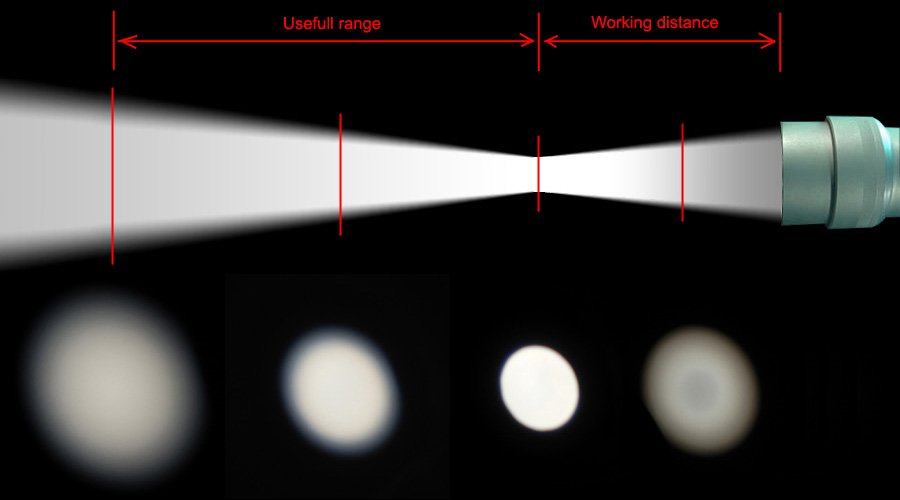
Please note that smaller apertures on the mask also reduce the light output.
The LSD Ultimate snoot for the Original Retra Flash has the same style bayonet mount and it can be mounted to the new Retra Flash PRO/Prime but optically it is not compatible and makes the effect above even worse. The difference is in the length and the diffuser: the Mounting module for the new Retra Flash is about 43mm long, for the Original Retra Flash it was about 33mm.
-
I was primarily using the various apertures on the larger of the standard circular masks. I just double checked the mounting module and I'm fairly sure its the correct one, it measures just under 43 mm from the front to the back of the bayonet component (see attached image). I also found the box it came in that says "Mounting module (Retra Flash Prime/PRO)".
I will set up some controlled bench tests for playing with things to see if the results are similar to what I was experiencing underwater.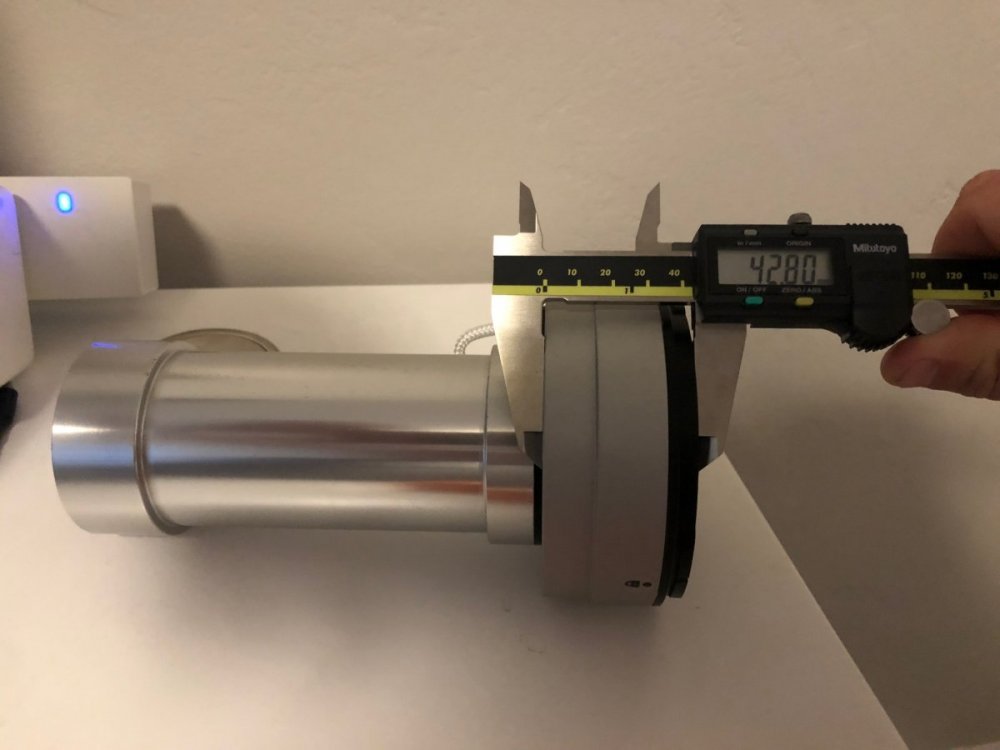
-
I ran some initial bench tests this afternoon to reproduce what surprised me in the water yesterday as I hadn't noticed it when previously using my LSD snoot with a Inon Z-240 strobe. It makes sense that the amount of light getting through would fall off as the aperture is stopped down (by using the masks). Perhaps more of the light emitted from the Inon strobes makes it through the snoot or perhapsmy memory is just wrong.
All of the images below were shot with a Nikon D850 and Nikon 60mm Macro lens on the bench. I set the exposure to "reasonable" macro exposure settings, f/22, 1/250 sec, ISO 160. Starting without a mask in the Retra I then set the strobe power to expose this shot how I typically would, which put the dial at 50 (+2), just 2 clicks from full power. Without changing exposure or strobe power I then proceeded through all the standard circular masks (2 sliders).
I guess having to start with such high strobe power on the Retra Pros for the snoot (even without a mask) was the biggest surprise for me. The 3rd largest mask hole looks to be around -2EV darker (in Lightroom) than no-mask meaning to achieve my preferred exposure I would need push the strobe up to full power and ISO to 320. Guess I will just have to start shooting higher ISOs that I am used to for macro when using this setup. And probably wont even bring the mask with smaller holes when I dive. Hopefully this realization I have come to is helpful for others, my apologies if this is obvious.
No Mask in Retra Snoot:

1st Circular Mask (largest):
2nd Circular Mask (2nd largest):

3rd Circular Mask (3rd largest):

4th Circular Mask (4th largest):

5th Circular Mask (5th largest):

6th Circular Mask (6th largest):
-
Thanks for this. Really interesting. I’ve just switched from z240 strobes with the LSD for Retra Primes but not yet Been able to get in the water with them.
-
Interesting indeed! Are you able to do the same tests with your Inon z240, and let us know which power setting on the Inon gets you similar exposure without a mask?
-
Ok I just converted my LSD snoot back to the Inon Z240 mount and re-ran this test. To me it definitely looks like the fall off is less significant as the masks are inserted with the Inon. I found that with the same exposure (f/22, 1/250 sec, ISO 160) the Inon was set to GN8 (2 clicks below full GN11) for the exposure to look right to me, albeit the Inon Z-240 is supposedly a much lower power strobe.
Inon Z-240 @ GN8, no mask

Inon Z-240 @ GN8, 1st circle mask (largest) https://photos.smugmug.com/Retra-Test-Shots/i-G4LrgLr/0/5370afbe/X3/InonZ240_1st_circle_mask-X3.jpg
Inon Z-240 @ GN8, 2nd circle mask (2nd largest) https://photos.smugmug.com/Retra-Test-Shots/i-9VQ3k94/0/17d49964/X3/InonZ240_2nd_circle_mask-X3.jpg
Inon Z-240 @ GN8, 3rd circle mask (3rd largest) https://photos.smugmug.com/Retra-Test-Shots/i-3KWRfHN/0/5edea501/X3/InonZ240_3rd_circle_mask-X3.jpg
Inon Z-240 @ GN8, 4th circle mask (4th largest) https://photos.smugmug.com/Retra-Test-Shots/i-GCc5fTs/0/7d732bbf/X3/InonZ240_4th_circle_mask-X3.jpg
Inon Z-240 @ GN8, 5th circle mask (5th largest) https://photos.smugmug.com/Retra-Test-Shots/i-gCFz2PT/0/3bfb1ab4/X3/InonZ240_5th_circle_mask-X3.jpg
Inon Z-240 @ GN8, 6th circle mask (smallest) https://photos.smugmug.com/Retra-Test-Shots/i-xwsnt7w/0/192e54f5/X3/InonZ240_6th_circle_mask-X3.jpgI would say comparing this set of images with the different mask sizes also supports my memory of not having to make as significant of power changes when moving through different mask apertures on a given mask card (1-3 or 4-6).
We know the Retra Pro has a very wide and even field of light which is not the case with the Inon Z-240. However when using the Retra snoot that seems to be a pretty significant disadvantage as far as how much of that light is collimated and transmitted by the snoot. I primarily bought the Retra Pros for wide angle but it is a disappointing to find out the Retra snoot isnt as powerful on the new "high-power" strobes as my old Inon strobes. I guess its good I have other options for snooting...
-
I think it's just physics and geometry - the LSD is taking a circular slice out of the beam and feeding it into the optics to produce your snooted beam. it's the same size hole in the back end of the LSD presumably in both cases. The light that doesn't shine into the hole in back will bounce around and some may make its way into the optics but a lot won't.
I found a lumens to lux calculator and plugged some numbers in. Assuming the same distance from light source and lumens a 100° beam from the INOn and 130° beam from the retra and a 1000 lumen source the lux of the beam at 10cm is 44555 lux for the INON and 27192 lux for the Retra. I know the Retra has more power, but this just serves to show the difference in lumens per m2 (=lux) between the two beam sizes. The Retra needs to put of 1.6x more lumens to be as bright as the INON in lumens /m2 of beam which is the same as saying give s the same exposure.
The Retra flash tube is approx 63mm is diameter (scaled from a photo and known outside dia) and generating a 130° beam but the geometry says that hole in the base of the of the LSD is sampling only a 12° beam as it's nearly the same dia as the tube and only 43mm above it. It's a bit more complex than that as the LSD tube can see both sides of the inside of the tube but the calculations for that get messy.
The INON on the other hand has 25mm tubes sitting below the the LSD in a T shape. Quite a difficult geometry to calculate but if we assume its a 25mm dia light source the beam angle to the LSD inlet is 57°, so the LSD is sampling significantly more of the beam just due to geometry.
To sample more of the beam you need to get closer to the flash tube.
The summary is that because the Retra tube is physically larger and has a wider beam angle significantly less of the light it generates enters the LSD tube. The INON tubes are smaller and have a smaller beam angle so more of their light enters the LSD tube.
-
19 hours ago, Oskar@RetraUWT said:
The LSD Ultimate snoot has a focus distance of about 175mm in water.
I would like to see the where the 175mm are in the picture above...
-
As Chris mentioned the design of the flashtube plays a major role in how light is distributed and the power output. How the flashguns perform in wide angle situations can be seen here: https://www.retra-uwt.com/pages/flashgun-light-comparison
In macro situations the differences in light beam spread are same but come out less visible (especially on subjects that are very 3D) because the light beam is compressed onto a small area. If we measure the light beam of the Z-240 coming out of the LSD Ultimate snoot, the uniformity of the beam is considerably less than with the Retra Flash PRO. Although in macro photography this is less of an issue.
When comparing both these flashguns for snooting with the LSD Ultimate or a homemade DIY snoot the biggest difference worth noting is the placement of the pilot light. Having a central pilot light being a much better experience when positioning the light.
-
4 hours ago, Oskar@RetraUWT said:
When comparing both these flashguns for snooting with the LSD Ultimate or a homemade DIY snoot the biggest difference worth noting is the placement of the pilot light. Having a central pilot light being a much better experience when positioning the light.
This is the big advantage to me of the Retras and what sold me on them: accurate positioning. Or at least I hope it is once I get them in the water. Above water tests were certainly spot on and I couldn’t see any obvious light falloff or underexpose issues.
I loved the Z240s and think they’re brilliant - but snoot positioning drove me crazy.
-
I agree with all the points made above. The centered modeling light of the Retra Prime/Pro makes usability of the Retra snoot greater, the offset when using the Inon can be challenging.
I am happy to have the wide uniform light for wide angle photography. In the few times I have shot wide angle with the Retra Pros so far I have been happy with them. They also certainly will work for shooting macro I will just need some adjustments to how I shoot macro (most likely higher ISOs).
The takeaway worth sharing is that while wide uniform light might be ideal for wide angle shooting it has potential downsides for macro shooting, specifically when using a snoot. In retrospect it makes sense from a physics standpoint but it was obvious to me it would be an issue until discovering it in the water.





