The neoprene will compress at depth, so if you want to get your rig perfectly neutral, you'll probably need a little more than that.
Lights, Strobes, and Lighting Technique / Archived topic
RETRA Strobe Thread
Started by guyharrisonphoto ·
- 698Posts
- 698Replies
Read-only discussion
RETRA Strobe Thread
698 posts
-
-
On 4/1/2020 at 4:03 PM, ChrisRoss said:
If you use full power you may get some variation as the capacitor may take time to completely fill and may not have enough stored energy for a full dump for some time after the ready light comes on. The charging of the capacitor is initially rapid and slows as it fills so it can get 80%(or ready light on) in 2 seconds and takes the additional 5-8 seconds to put in the last 20%.
The strobe may have a voltage below which it won't attempt to flash and it won't do so again until it has enough capacitor charge to exceed that voltage.
Hi Chris,
Thanks a lot for this very informative reply!
I just quoted these 2 sentences as that's where i am seeking more clarity (on the second one essentially):
1/ Do we know whether the Inon Z240 and Retra Pro strobes (just comparing the one i own vs the one i might buy) are offering an "exposure guarantee", meaning by either delivering the expected exposure (as per the user's setting on the power dial: full power, 1/2th power, 1/4th power...) or by just not firing if they aren't ready?
As a user, this is my expected behaviour: once i have setup my strobe powers correctly, i will approach the subject and take a few shots (focusing on composition), then back-off to check results. When i do, if i see few photos turn black/not lit, i'll know my strobe power was too high and will decrease + bump ISOs. If the strobe kept firing inconsistently (due to not reaching the needed charge level in time), it will be more difficult to tell & decide
On 3/30/2020 at 4:34 PM, Oskar@RetraUWT said:That's about right, we need at least the energy in Ws or J to determine the speed of recycling. As correctly assumed the PRO's have much more energy in their capacitors compared to Z-240. Also please note that recycle time specs are not consistent, especially with Inon, as was pointed out in this thread here: https://wetpixel.com/forums/index.php?/topic/63538-inon-z-330-ready-light-comes-on-early/
We are on the way to introduce a "Supercharger" for the Retra Flash Prime/PRO that will be an additional battery pack. With it the recycle time for the PRO be halved and the total number of flashes will double. More details will be revealed in the coming weeks when the product is ready for announcement.
Thanks for pointing the other thread Oskar, which i've read, good learnings.
As a prospective customer, i am still left to read at manufacturer specifications and compare. In the above thread, i see the Inon Z330 specs are to be taken with a pinch of salt, but the Inon Z240 (my current strobes) and the original Retra seem more "consistent" in behaviour.
My question is on the Retra Pro specs: i read i would get my ready for a complete exposure at 80%/40% power respectively in 3s/1.5s (no indication of how long it would take to be ready for a full power dump, but i understand now that other strobe manufacturers won't indicate that neither, and i understand why, so ok).
2/ So is this understanding correct:
-if i set a Retra pro to the 75% mark (so below 80%), i'll get a predictable, stable exposure provided i wait at least 3 seconds.
-if i set a Retra pro to the ~37.5% mark (the one between 50 and 25%), i'll get a predictable, stable exposure at that power, provided i wait at least 1.5 seconds.
3/ Then if i understand well Chris' earlier explanations, these above recycle time are from the a totally empty capacitor, meaning if i hadn't been shooting for a minute, my Retra pro will be recycled at 100%, so i would shoot twice at the ~37.5% mark and get full, consistent output without waiting the 1.5 seconds (but i will have to wait before shooting a 3rd time at that power)?
4/ Can i expect these recycling numbers to remain valid whatever the charge level of my Eneloop Pro batteries (e.g. at the beginning or end of the dive)?
5/ Any indication at which power i can get a recycling time below 0.1 seconds? Assuming the recycling time vs power setting ratio is linear, I would think a 2-3% setting (1/30th of 80% full power) would get me that consistent output at that power, if i trigger every 0.1 second (10 fps burst mode)?
6/ keen to hear how "linear" is the autonomy/power setting curve. E.g. if i set the Retra Pros at 25% power, can i expect 4x150=600 flashs roughly? I find my inons Z240 pretty predictable on that aspect, which i like.
Interested in both Oskar feedbacks and user field observations to get clarity on my 1-6 questions

Now before you all tell me no one shoots at full power nor needs a 0.1sec recycle time, let me explain where i am coming from/share more on my specific needs/shooting techniques:
-I lack power when shooting wide angle with my Inons Z240, although i never shoot them more than 50% power (i'll be at 25% when i now there will be some repetitive shooting). Why? These strobes are known to "melt down" if you shoot too often at high power. But honestly even at full power (admittedly i tried a few times very carefully), i am still not covering specific needs, such as lighting a big scene with several grey nurses and sealions cruising. Yes, i do bump the ISOs (up to 400-500 on my D500), but in bright scene i'll be limited by my max shutter speed (1/250th). Bottom line, i do need more power.
-i need ability to shoot short bursts at 10 frames per seconds, and i need doing so with higher power output than my Z240 inons (i would question upgrading otherwise). Use case: i shoot tiny (1-2cm) sygnathidae in the surge, super macro setup (tiny depth of field), and the 10fps burst will grant me 1-2 sharp shots once the animal turns towards me. Today with the Inons i have to step down significantly the strobes to allow this, meaning i might be at 640-800 ISOs on my APS-C Nikon D500 (IQ trade-off).
-Assuming the Retra Pros don't have a "melt-down" issue, i intent do shoot also large animal action (the cheeky sealion passing by briefly) in burst mode, but then at higher power setting (and maybe i don't need 10fps, 3-4fps so recycling at 0.2-0.3 secs would do). Again that requires a predictable recycling time, and clarity on how the Retra Pro will behave (my question #1 above).
Cheers
Nicolas
-
On 4/26/2020 at 4:39 AM, Nicool said:
-i need ability to shoot short bursts at 10 frames per seconds, and i need doing so with higher power output than my Z240 inons (i would question upgrading otherwise). Use case: i shoot tiny (1-2cm) sygnathidae in the surge, super macro setup (tiny depth of field), and the 10fps burst will grant me 1-2 sharp shots once the animal turns towards me. Today with the Inons i have to step down significantly the strobes to allow this, meaning i might be at 640-800 ISOs on my APS-C Nikon D500 (IQ trade-off).
Hi Nicool
Seems an extreme use case. Never thought you would be bursting 10fps on macro on day, with flash...
What are the aperture & shutter speed settings for this specific Use Case?
Sebby
-
2 hours ago, Sebby said:
Hi Nicool
Seems an extreme use case. Never thought you would be bursting 10fps on macro on day, with flash...
What are the aperture & shutter speed settings for this specific Use Case?
Sebby
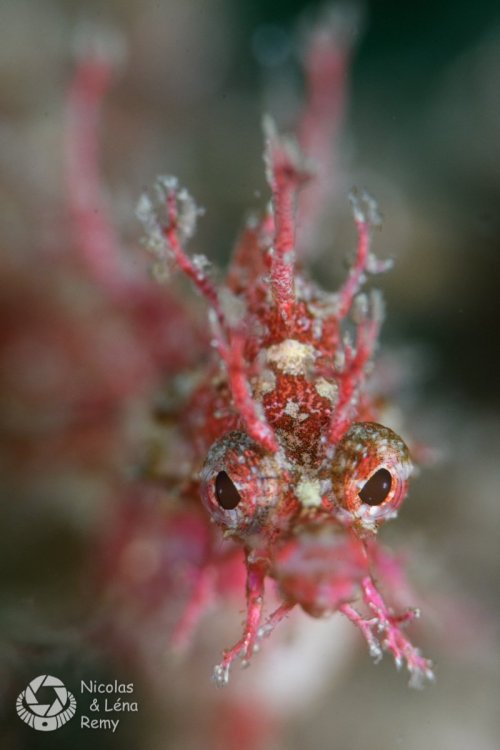
Try super macro, with a depth of field probably 1-2mm, and a subject head of around 1cm... and the said subject has a tendency to bounce back and forth in the surge (its tail attached to an algae, the rest of the body swinging around)... while you're struggling against a tidal current...
Let's say it brings its set of challenges, and 10fps helps you get one of two sharp shots.
EXIFs for the attached example:
-Nikon 105mm AF-S VR lens (with Subsee +10 diopter), on a Nikon D500
-Speed: 1/125th
-1000 ISOs
-f/16
Note the photo is sharp on the eyes, but due to the upload resolution/weight limit it doesn't render well.
-
I think you have a big ask Nicolas, Depending upon how many frames you want in a burst. A couple of assumptions - the ready light comes on at 75-80% and shooting at 1/4 power. At 10 frames/second you would be shooting 4 frames in 0.4 sec You would get 3 maybe 4 shots in before having to wait for the ready light again.
This would be relatively easy on land , you just use the zoom function on the strobe head. On my 580EX strobe has it a guide number of 15 meters at 14mm coverage ( less than the INON Z-240) - you can zoom into 70mm coverage and get a guide number of 50 meters. The UW strobes put out all that power into a very wide beam.
The Z-330 is GN 33 but mostly brighter in the middle, compared the Z-240 at GN24 or nearly a stop faster. This is borne out in the backscatter tests. https://www.backscatter.com/reviews/post/Best-Underwater-Strobe-Flash
So going to a Z-330 in theory should get you near one stop. I use my Z-240s at two stops off full power (1/4 power) at f8 ISO200. That would be equivalent to f11 and ISO400 perhaps with your D-500 and 1/4 power. Going to the Z-330 should let you use 1/8 power which might get you 6 shots in a burst before waiting for the ready light.
All of these strobes are also close to one stop brighter in the centre compared to the edge of the beam. If you could work out some way to point the centre of the beam at the subject without drowning it in backscatter that would be another stop. The little light shield of the Z-330 should help a bit - maybe a bigger version of that would allow you to use the beam centre. Generally you are using the dimmer beam edges to light your subject leaving the cone shaped area in front of the subject unlit - you could conceivably do this also with a light shield
A bit hard to compare Z330 to the Retras the original had a GN of 18 quoted, it was said to be noticeably brighter than the Z-240 in one review I read. The original Retra was rated at 100Ws and the new models are 100 and 150Ws and don't quote GN - which can be quite a rubbery number anyway. The original had a 110° beam angle the new strobes have 130° beam angles. This review states the Z-330 is brighter than the original Retra : https://wetpixel.com/articles/strobe-tests-inon-z330-retra-flash-and-symbiosis-ss2/P5
The new Retra prime is also 100Ws but a wider beam so probably not as much power as the original. The Pro is 50% more powerful so likely more powerful than the Z-330.
The quick summary you should see an improvement in the Z-330 maybe a stop, if you could use the beam centre probably do a bit better. The Retra is reported to have a more uniform beam but still there is light fall-off you would also be better with the Retra pro and as a bonus get nicer lighting for your wide angle shots, you would probably benefit from the reduction rings or even the macro rings for this application.
-
3 hours ago, Nicool said:
Try super macro, with a depth of field probably 1-2mm, and a subject head of around 1cm... and the said subject has a tendency to bounce back and forth in the surge (its tail attached to an algae, the rest of the body swinging around)... while you're struggling against a tidal current...
Let's say it brings its set of challenges, and 10fps helps you get one of two sharp shots.
EXIFs for the attached example:
-Nikon 105mm AF-S VR lens (with Subsee +10 diopter), on a Nikon D500
-Speed: 1/125th
-1000 ISOs
-f/16
Note the photo is sharp on the eyes, but due to the upload resolution/weight limit it doesn't render well.
Yes I see.
Not the ideal situation (like caving photography). That being said, it all depends on the output resolution you want.
Of course a more powerful flash would help getting the shot with these parameters.
That being said, have you tried higher ISOs? it would give you an increase in flash availability (at lower power) and bring out really decent pics after downscaling.
On the D7200 with ISO 3200 I was able to shoot a nice cave printed out on A2 after noise reduction + downscale sharpening.
Cheers
Seb
-
8 hours ago, Nicool said:
Try super macro, with a depth of field probably 1-2mm, and a subject head of around 1cm... and the said subject has a tendency to bounce back and forth in the surge (its tail attached to an algae, the rest of the body swinging around)... while you're struggling against a tidal current...
Note the photo is sharp on the eyes, but due to the upload resolution/weight limit it doesn't render well.

Do not blind the pygmy seahorse with a burst of flashes!
Getting them properly in focus is a challenge, but it is achievable without resorting to such practices which are definitely not good for the creature which is photographed ...
Seeking to get a good picture is no excuse for practices which are damaging for the fauna and environment.
So instead of bursting 10 fps on macro, learn patience and shooting at the right instant, and accept that you may not always get the picture you dream of.
-
7 hours ago, Sebby said:
Yes I see.
Not the ideal situation (like caving photography). That being said, it all depends on the output resolution you want.
Of course a more powerful flash would help getting the shot with these parameters.
That being said, have you tried higher ISOs? it would give you an increase in flash availability (at lower power) and bring out really decent pics after downscaling.
On the D7200 with ISO 3200 I was able to shoot a nice cave printed out on A2 after noise reduction + downscale sharpening.
Cheers
Seb
Wow i didn't think you could get a nice A2 on 3200 ISO with an APS-C sensor. One day i need to see your large prints physically, bring them down in Oz
(so no, i thought 1000 ISOs would be a limit not to overcome to keep decent IQ, as i've also got diffraction happening at these macro apertures)
2 hours ago, Algwyn said:Do not blind the pygmy seahorse with a burst of flashes!
Getting them properly in focus is a challenge, but it is achievable without resorting to such practices which are definitely not good for the creature which is photographed ...
Seeking to get a good picture is no excuse for practices which are damaging for the fauna and environment.
So instead of bursting 10 fps on macro, learn patience and shooting at the right instant, and accept that you may not always get the picture you dream of.
Hi Algwyn,
Thanks for your message. Since you're sharing your personal opinion, without factual evidence, can i suggest that you be a little more humble and less prescriptive?
First of all, you might have missed this recent scientific study on the effect of flash photography over seahorses. Full details of the research paper are available here. In short, it demonstrates underwater strobes don't have an effect on seahorses, be it on their ability to feed (incl. fast hunting) and no retina damage was found.
Secondly, when i shoot 10 fps, it is for a very short burst, i would say half a second, meaning 5-6 photos, set at around 1/16th of my Inon Z240 strobe power (sometimes less). Meaning in that burst, i will deliver less light than by flashing once at half power...
Lastly, this species isn't the pygmy seahorse that you find in south east asia, but a Sydney's pygmy pipehorse (Idiotropiscis lumnitzeri). Endemic species to +/-200km around Sydney (Australia). There is a dive site here where local divers have been observing and photographing these animals for many years. Given they are rather sedentary, week after weeks the same divers often see the same individual on the same rock. While being photographed, they have been observed feeding (i.e catching tiny crustaceans) and even courting. These empirical observations are consistent with the findings of the above-mentioned scientific study.
Hope we can go back to the original topic - which is about the performances of the new Retra Pro strobes.
-
11 hours ago, ChrisRoss said:
I think you have a big ask Nicolas, Depending upon how many frames you want in a burst. A couple of assumptions - the ready light comes on at 75-80% and shooting at 1/4 power. At 10 frames/second you would be shooting 4 frames in 0.4 sec You would get 3 maybe 4 shots in before having to wait for the ready light again.
This would be relatively easy on land , you just use the zoom function on the strobe head. On my 580EX strobe has it a guide number of 15 meters at 14mm coverage ( less than the INON Z-240) - you can zoom into 70mm coverage and get a guide number of 50 meters. The UW strobes put out all that power into a very wide beam.
The Z-330 is GN 33 but mostly brighter in the middle, compared the Z-240 at GN24 or nearly a stop faster. This is borne out in the backscatter tests. https://www.backscatter.com/reviews/post/Best-Underwater-Strobe-Flash
So going to a Z-330 in theory should get you near one stop. I use my Z-240s at two stops off full power (1/4 power) at f8 ISO200. That would be equivalent to f11 and ISO400 perhaps with your D-500 and 1/4 power. Going to the Z-330 should let you use 1/8 power which might get you 6 shots in a burst before waiting for the ready light.
All of these strobes are also close to one stop brighter in the centre compared to the edge of the beam. If you could work out some way to point the centre of the beam at the subject without drowning it in backscatter that would be another stop. The little light shield of the Z-330 should help a bit - maybe a bigger version of that would allow you to use the beam centre. Generally you are using the dimmer beam edges to light your subject leaving the cone shaped area in front of the subject unlit - you could conceivably do this also with a light shield
A bit hard to compare Z330 to the Retras the original had a GN of 18 quoted, it was said to be noticeably brighter than the Z-240 in one review I read. The original Retra was rated at 100Ws and the new models are 100 and 150Ws and don't quote GN - which can be quite a rubbery number anyway. The original had a 110° beam angle the new strobes have 130° beam angles. This review states the Z-330 is brighter than the original Retra : https://wetpixel.com/articles/strobe-tests-inon-z330-retra-flash-and-symbiosis-ss2/P5
The new Retra prime is also 100Ws but a wider beam so probably not as much power as the original. The Pro is 50% more powerful so likely more powerful than the Z-330.
The quick summary you should see an improvement in the Z-330 maybe a stop, if you could use the beam centre probably do a bit better. The Retra is reported to have a more uniform beam but still there is light fall-off you would also be better with the Retra pro and as a bonus get nicer lighting for your wide angle shots, you would probably benefit from the reduction rings or even the macro rings for this application.
Thanks Chris for your replies.
I didn't think about the differences in brightness between the center and outside of the strobe beam. However, probably like you, i am indeed aiming the outside of the beam to the subject, to minimize backscatter.
To your first question, i only need to take 5-6 photos in a burst (for macro quick action), so it seems like most strobes will cope reasonably well with that.
For wide-angle - inquisitive sealions, maybe a full second at lower frequency, so a gain 5-6 shots in total, but with more power, so hopefully the Retra Pro would be able to cope. At least my understanding is i won't have to worry about "melt down" (i would never try repetitive high power shooting with my Inons Z240, too concerned about damaging them).
Any further "field" feedback on the Retra pros would be greatly appreciated
-
Retra is now taking preorders for the extended battery compartment for Retra Prime/Pro: https://www.retra-uwt.com/blogs/news/introducing-the-supercharger
199 euros + VAT (239 euros after June 30th); shipping in October. Spec sheet says that Retra Pro recycle time to 40% power is brought down to 0.7s from 1.5s, and to 80% from 3.0s to 1.5s. With 350+ full-power flashes it should be good for a full day of diving.
So tempting...
-
Adam Hanlon has the first (and currently the only) prototype unit of the Supercharger in his hands for testing. There will be content coming up on Wetpixel's website shortly.
-
First (rough and ready) test of recycling time:
Full details about the Supercharger are here: https://wetpixel.com/articles/retra-announces-supercharger-battery-pack-for-retra-pro
Adam
-
Thanks Adam!
-
We are currently running an alpha firmware version on the flashguns (made only for initial internal tests) which is very conservative. It produces fast recycle times only with really new batteries. Adam was using old but maintained batteries and the result was already not as fast as it could have been. In the next few days we will be able to send an update to Adam and perhaps he can make another video comparison then.
-
To showcase the capability of the Supercharger we have filmed the recycle time at 100% power. Inserted are used eneloop pro batteries which already had 50+ charge/discharge cycles and were not new by any standard. The firmware on the flashgun is still the alpha version.
-
4 minutes ago, Oskar@RetraUWT said:
To showcase the capability of the Supercharger we have filmed the recycle time at 100% power. Inserted are used eneloop pro batteries which already had 50+ charge/discharge cycles and were not new by any standard. The firmware on the flashgun is still the alpha version.
I apologize because I think this has already been discussed, but in this video, when the Ready light comes on, does that represent that the strobe can then fire at 100%? Or only at 80% or some other level?
-
After the ready light the flashgun is fired at 100%.
-
I think it is important to stress that my tests were carried out with conditioned Eneloop Pro batteries.
I typically exchange my batteries on a cycle, buying 8 new ones prior to each trip and discarding the 8 oldest. Prior to each trip, they are conditioned using a Powerex charger.
-
45 minutes ago, Oskar@RetraUWT said:
After the ready light the flashgun is fired at 100%.
I think I remember reading some discussions about other strobes that talked about their Ready light coming on when the strobe was only about 80% charged.
So, just to confirm, the Retra Pro Ready light does not come on until the strobe capacitor is 100% fully charged?
45 minutes ago, adamhanlon said:I think it is important to stress that my tests were carried out with conditioned Eneloop Pro batteries.
I typically exchange my batteries on a cycle, buying 8 new ones prior to each trip and discarding the 8 oldest. Prior to each trip, they are conditioned using a Powerex charger.
Can you elaborate on what that implies for this video? Are you suggesting that what the video shows is better performance than one might expect from brand new, unconditioned Eneloop Pros? The same performance as brand new? Lower performance?
Also, how many sets, total, do you have? I'm just wondering if you throw away a set after every 2 trips, or what.
Thanks.
-
2 hours ago, stuartv said:
I think I remember reading some discussions about other strobes that talked about their Ready light coming on when the strobe was only about 80% charged.
Recycle times were discussed here.
No underwater strobe will indicate the ready light at 100% capacitor charge. I verified this with several brands including Seacam, Sea&Sea, Inon, Retra and Ikelite. Most of them indicate the ready light when their capacitors are at about 80%. The only exception is the Inon Z-330 which indicates the ready light way before, when capacitors are at about 40%. They basically soldered higher voltage capacitors to their old Z-240 circuit and “forgot” to re-calibrate that part.
Retra specify their recycle time at 80% which is also when the ready light is turned on. They also specify their recycle time at 40% which is probably when their circuit allows them to produce a flash. My Retra Pro’s will trigger before they beep the ready signal and this is also explained in the user manual.
The extra battery holder looks good although a li-ion battery pack would have a lot more energy compared to AA size ni-mh batteries. But at least those are easy to get almost anywhere in the world.