Skip to content

Photography Gear and Technique / Archived topic

Nauticam WACP-C

Started by dreifish ·

  • 249Posts
  • 249Replies

Read-only discussion

Nauticam WACP-C

249 posts
  1. 7 hours ago, ChrisRoss said:

    To be fair this is possibly a depth of field issue, and as Adam says we don't know the aperture.  You can see if you look at the whole image that the background is out of focus as is the rear part of the yellow sponge and the tentacles at top of frame are are also on the edge of the depth of field.

    If you look at this link you can see the corners look reasonable and not a great deal different to the rocks texture across the frame, I lifted a direct link from the page so you can see a full size image:

    https://cdn.shopify.com/s/files/1/2599/6382/files/SOC-2656340_2048x2048.jpg?v=1579543265

    It's displayed as a link so you can open it in a new tab and see it full size.

    This is a problem with reef images, the 3D arrangement is usually not apparent so you can't really tell if the corners and the subject are at the same distance.

    Reasonable does not make it 4 stops better

    The wet optics are normally afocal they do not feel depth of field as a dome so there would not be a lot of difference between details that are one foot distant in the frame.

    Even if it was shot at f/4 it should be equivalent to f/16 and it would have plenty if the claims are true

    I just think that measuring those lenses against the edges of a rectilinear lens is not meaningful as you would not take almost any of the test shots with a rectilinear lens anyway so what is the point?

  2. 2 hours ago, oneyellowtang said:

    @Draq

    Well stated... to your statement "my lens is better than yours" - that's not really 121's point (but it does come across that way). There tends to be a lot of posturing and opinions thrown around on topics like this -ultimately it comes down to either hearing from experts or peers that have shot the combo you are thinking about, or have some level of indepth knowledge on how they may work.

    For me, I'm already committed to getting a WACP-C for my D850, which I will end up sharing with my daughter who shoots a Sony A7R4. Both are FF, so not a helpful comparison... I also have a D500, and may try that pairing as well (I often travel with both cameras & housings, limiting to 1 port to be shared between the two for w/a would be helpful).


    Yes that was not my point

    My point is that using a measure of sharpness vs a rectilinear lens is not a good benchmark if you compare shots that do not require a rectilinear lens to start with.

    If you instead were shooting some nice straight lines then you would say ok it is not straight (none of those lenses are) but it is sharp throughout. Then the other topic is on cropped sensor you have zoom fisheye that have similar distortion at 130 degrees or less and that are normally less bulky and do not have such a gap in sharpness at the edges.

    Then of course each person has to look at their use case and where does this fit but the reference to edges etc for me is not good marketing

  3. I don't follow the idea of "compare shots that do not require a rectilinear lens to start with" 

    Surely, this is a creative decision? I often prefer the look of a more rectilinear lens , while others may prefer fisheye. I chose lenses based on my creative vision, not because one is "necessary?"

    No "water contact" or "wet lens" system is afocal in practice. Image focus and depth of field is produced by using the respective camera lens' focus and the light path from the lens onto the sensor.  Depth of field is still an issue with these lenses. 


  4. 3 minutes ago, adamhanlon said:

    ThI don't follow the idea of "compare shots that do not require a rectilinear lens to start with" 

    Surely, this is a creative decision? I often prefer the look of a more rectilinear lens , while others may prefer fisheye. I chose lenses based on my creative vision, not because one is "necessary?"

    No "water contact" or "wet lens" system is afocal in practice. Image focus and depth of field is produced by using the respective camera lens' focus and the light path from the lens onto the sensor.  Depth of field is still an issue with these lenses. 


    Water contact optics are afocal on their own hence the wording on nauticam specification focal distance from front of the lens to infinity

    The other point to be noted is that the magnification of 0.36x is only achieved in the corners not horizontally or vertically and in that regard those lenses are similar to a fisheye

    So the WWL-1 0.36x has a similar behaviour of the WACP 0.36x the difference is that the mount allows the lens to work as there is no flat port that would take the zoom but the technical specifications are the same

    When I compared the WWL-1 to a rectilinear lens I discovered that while the diagonal field of view is wider and the lens has more depth of field, in terms of actual field of view compared to my 8mm on the horizontal and vertical the difference was very small. Still it is easier to work with an afocal wet lens than a lens behind a dome where the focus range is limited and depth of field is lacking. When you shoot video and you crop the diagonal the lens looks even more straight so that works very well

    But if you think that those optics make your 28mm lens a 10mm on all axis that is not the case normally the horizontal magnification changes to around 0.5x and vertical can go close to 0.7x

    Which in turn makes the idea of comparing with a rectilinear lens not really appropriate because from a creative point of view those two options do not produce the same result.

    It would be ideal if someone who has those optics goes in a pool and tries this in quick succession as I have done with the WWL-1. Alternatively if someone sends me the equipment I will be more than happy to run such tests myself!

  5. 1 hour ago, Interceptor121 said:

    Reasonable does not make it 4 stops better

    The wet optics are normally afocal they do not feel depth of field as a dome so there would not be a lot of difference between details that are one foot distant in the frame.

    Even if it was shot at f/4 it should be equivalent to f/16 and it would have plenty if the claims are true

    I just think that measuring those lenses against the edges of a rectilinear lens is not meaningful as you would not take almost any of the test shots with a rectilinear lens anyway so what is the point?

    I'm not talking about depth of field in terms of corner sharpness due to dome port optics, this is pure depth of field as in only the polyps and front half of the sponge is in focus.  If that rock in the corner is too close or too far away from the camera it will also be out of focus.  The depth of field is low because the magnification is high due to being right on top of the subject for CFWA and/or the aperture is fairly wide.  You need to look at the entire image to discern this.

    The point about the shark shot is that the corners there do not seem any worse than the edges, it is a more conventional shot where corner sharpness could impact.  It's a pity they don't have EXIF data in the images or posted in that ReefPhoto post, but the inference is it was taken on APS-C and I'd expect there to be no corner issues on smaller formats with a WACP and appropriate lens.  There's something funky about the way they have posted the images and I couldn't convince the browser to load a 100% view from the files stored, there's some sort of scalable view being used so it's hard to judge absolute image quality even though they seem to be large pixel dimension images.


  6. 5 minutes ago, ChrisRoss said:

    I'm not talking about depth of field in terms of corner sharpness due to dome port optics, this is pure depth of field as in only the polyps and front half of the sponge is in focus.  If that rock in the corner is too close or too far away from the camera it will also be out of focus.  The depth of field is low because the magnification is high due to being right on top of the subject for CFWA and/or the aperture is fairly wide.  You need to look at the entire image to discern this.

    The point about the shark shot is that the corners there do not seem any worse than the edges, it is a more conventional shot where corner sharpness could impact.  It's a pity they don't have EXIF data in the images or posted in that ReefPhoto post, but the inference is it was taken on APS-C and I'd expect there to be no corner issues on smaller formats with a WACP and appropriate lens.  There's something funky about the way they have posted the images and I couldn't convince the browser to load a 100% view from the files stored, there's some sort of scalable view being used so it's hard to judge absolute image quality even though they seem to be large pixel dimension images.


    For an article that is supposed to review a lens it lacks some pretty fundamental data for sure

  7. 25 minutes ago, Interceptor121 said:

    For an article that is supposed to review a lens it lacks some pretty fundamental data for sure 

    Well, there is a pretty blurry line between ad copy and a meaningful review when created by a manufacturer or retailer and featured on their retail website.  A big difference from something Adam or Alex would do.  I thought it was worth mentioning, which is why I refereed to it only as a data point..

  8. Just a more critical question, do we really have some testing of these kinds of setup that would be in the same ballpark as Christopher Frost photography for example? What we got most times is a text and a few pictures from a dive, but at this point I don't see any real testing methodologies created for underwater gear. The only thing that came close was the test from Wie Domeports, Vorsatzlinsen und Korrektivports wirken - UWFoto.net (its in german) and even they lacked so many data points that I can't really judge anything from these short articles. 

    I have the feeling, we just have to try out for our own. But who wants to sink that much money into the hobby...

  9. Just now, Draq said:

    Well, there is a pretty blurry line between ad copy and a meaningful review when created by a manufacturer or retailer and featured on their retail website.  A big difference from something Adam or Alex would do.  I thought it was worth mentioning, which is why I refereed to it only as a data point..

    It was not meant to be a critique to you. It looks like am bashing this lens any of the wet optics and whoever is interested in it which is not the case considering I reviewed the original WWL-1 when it came out and have always been a supporter

    However this whole idea of comparison with rectilinear lenses has bugged me since the start and I have wrote Nauticam about it. None of those adapters is rectilinear the WACP-2 is likely to be the least distorted but that does not make it a rectilinear lens. None of those wet optics are a real proxy for a focal reducer like those made by metabones for example that preserve geometry. 

    The key benefit of those adapter is the higher depth of field that they have due to the near afocal construction and the elimination of chromatic aberrations compared so a simple dome port. This means you can shoot at wider aperture than you would do otherwise which in turn means less strobe power required in return for carrying the bulk.

    I would be very interested in comparing those lenses to a fisheye zoom on APSC as an academic exercise what I can say is that on MFT the canon 8-15mm is sharper than the WWL-1 and 14-42mm in the overlapping focal range and can get to 180 degrees if you need to. The Tokina 10-17mm is not as good as optic but it is very compact with its acrylic mini dome that would be a good benchmark for this WACP-C as the Tokina covers 180-100 degrees. The WACP-C covers 130-60 degrees so a Tokina shot at 14mm is probably a good proxy. 

    One of the things that I have been saying here is that the distortion of such lenses is reduced as you zoom in for example the Tokina distortion goes from 28% to 12% 

    https://www.lenstip.com/19.6-Lens_review-Tokina_AT-X_107_DX_AF_Fish-Eye_10-17_mm_f_3.5-4.5_Distortion.html

    So at 14mm with an 18% distortion may be not that different from a WACP-C at 130 degrees which based on my experience with nauticam wet optics may have quite a bit of distortion and for me is very similar to the tokina at 14mm

    14mm-wwl-1-original-20190426.jpg

    I have no doubt that for full frame those adapters are worthy in fact the only solution to have certain type of shots as zoom fisheye do not exist however the use case on DX and MFT for both dry and wet mount really depends on your use case. Does the range between 60 and 100 degrees matter to you more than 180-130? How about weight? Even the WAPC-C is heavier than Canon 8-15mm with 140mm dome and far more bulky than the tokina solution

  10. 43 minutes ago, Interceptor121 said:

    It was not meant to be a critique to you. It looks like am bashing this lens any of the wet optics and whoever is interested in it which is not the case considering I reviewed the original WWL-1 when it came out and have always been a supporter

    However this whole idea of comparison with rectilinear lenses has bugged me since the start and I have wrote Nauticam about it. None of those adapters is rectilinear the WACP-2 is likely to be the least distorted but that does not make it a rectilinear lens. None of those wet optics are a real proxy for a focal reducer like those made by metabones for example that preserve geometry. 

    The key benefit of those adapter is the higher depth of field that they have due to the near afocal construction and the elimination of chromatic aberrations compared so a simple dome port. This means you can shoot at wider aperture than you would do otherwise which in turn means less strobe power required in return for carrying the bulk.


    The other benefit to these lenses is that they flatten the field so you  can shoot at wider apertures.  On full frame people are shooting at f13-16 with 14-16mm range lenses and adding a S&S correction lens and still complaining about corners.  You could go to wider rectilinear lenses but you are fundamentally limited by the necessity of focusing on the virtual image due to dome port optics.  I don't know how the WACP style optics deal with the virtual image but they do not have this limitation. 

    I suspect there are fundamental limitations which prevent you from staying rectilinear as you go wider.  At the limit a 180° rectilinear lens is impossible - the corners that are at 180° would be at infinity as rectilinear lenses take straight lines and convert them to straight lines i the image.  Fisheyes get around this as they don't attempt to keep straight lines straight - they are basically designed to focus on an annular semi-circular band symmetrical to the the lens which is ideal as that is exactly what a virtual image is.

    While it is true that you can get better results out of a fisheye zoom - they don't exist for full frame (as full frame fisheye zooms)  and there are limited options for crop sensors with the best seemingly an adapted Canon 8-15 on m43.   You can do various kludges on full frame like add a 3rd party 1.4x but the optics seem to suffer.  Apart from that Canon and Nikon users can use the 8-15 zooms between 10/11mm and 15mm and the Tokina 10-17 is another option, though now discontinued.

    While the WWL-WACP etc are not rectilinear it mostly doesn't matter they are not fully fisheye distorted either and the comparison to rectilinear lenses is just a convenient way to convey the concept to people without detailed optical knowledge.  For most purposes underwater apart from pool shots and some work with wrecks the amount of distortion they have is acceptable and for these purposes are a more versatile alternative to 16-35mm class lenses with mostly a wider zoom range and at the wide end can do CFWA work quite well and are optically superior in many cases.

  11. The other benefit to these lenses is that they flatten the field so you  can shoot at wider apertures.  On full frame people are shooting at f13-16 with 14-16mm range lenses and adding a S&S correction lens and still complaining about corners.  You could go to wider rectilinear lenses but you are fundamentally limited by the necessity of focusing on the virtual image due to dome port optics.  I don't know how the WACP style optics deal with the virtual image but they do not have this limitation. 
    I suspect there are fundamental limitations which prevent you from staying rectilinear as you go wider.  At the limit a 180° rectilinear lens is impossible - the corners that are at 180° would be at infinity as rectilinear lenses take straight lines and convert them to straight lines i the image.  Fisheyes get around this as they don't attempt to keep straight lines straight - they are basically designed to focus on an annular semi-circular band symmetrical to the the lens which is ideal as that is exactly what a virtual image is.
    While it is true that you can get better results out of a fisheye zoom - they don't exist for full frame (as full frame fisheye zooms)  and there are limited options for crop sensors with the best seemingly an adapted Canon 8-15 on m43.   You can do various kludges on full frame like add a 3rd party 1.4x but the optics seem to suffer.  Apart from that Canon and Nikon users can use the 8-15 zooms between 10/11mm and 15mm and the Tokina 10-17 is another option, though now discontinued.
    While the WWL-WACP etc are not rectilinear it mostly doesn't matter they are not fully fisheye distorted either and the comparison to rectilinear lenses is just a convenient way to convey the concept to people without detailed optical knowledge.  For most purposes underwater apart from pool shots and some work with wrecks the amount of distortion they have is acceptable and for these purposes are a more versatile alternative to 16-35mm class lenses with mostly a wider zoom range and at the wide end can do CFWA work quite well and are optically superior in many cases.

    The issue with rectilinear lenses is the virtual image of the dome limits the useful working distance of the lens you need to close the aperture to get sufficient depth of field so you don’t see substantial blurring of the edges
    With fisheye lenses and water contact optics the field of view in the corners is enlarged and then compressed into the frame so apparently the edges are sharper
    However if you defish the image you see that the edges are not so sharp after all
    Personally I think that the issue with rectilinear lenses and domes is greatly reduced with cropped sensor and very small frames on micro four thirds as long as port design is optimised
    In terms of using a rectilinear lens I tend to use it for wrecks and shots with people in it. There is an increasing trend shooting images with diver or a freediver in the picture and fisheye like lenses make those look funny so there is still a place for rectilinear lenses
    To shoot reefs and close focus those lenses were never a primary choice as there is lack of straight lines plus you want to get closer
    At the end what matters is that if you really need straight lines you need a rectilinear lens. In addition a lot of shots midwater have nothing in the corners so who cares if they are blurred?


    Sent from my iPhone using Tapatalk
  12. Sorry to take the conversation in a new direction (but I’ve not read all the posts to stay on topic!).

    I thought I’d share some WACP shots. Afterall the view and zoom range of an lens set-up will determine the type of shots it can produce underwater. And the best way to judge is a lens would be suited to what you need is to look at the types of underwater images it can produce. Ultimately this is far more important than arguing whether you prefer the corners of the frame squished in or stretched out.

    I have 500+ WACP images on my website now - which give a very wide range of examples of the types of images that these optics produce. These are mostly taken with the WACP-1 - but they will give a good idea of how the WACP-C - which has the same FOV.

    https://www.amustard.com/library/page/search/"28.0"/1/

    (note that I can’t search WACP in the EXIF, so this is just a search of images taken with the 28-70mm lens). So there are a few non-WACP images in the mix (topsides or old pictures taken pre-WACP). But at least 500+ WACP pix to browse.

    Alex

  13. 1 hour ago, Alex_Mustard said:

    Sorry to take the conversation in a new direction (but I’ve not read all the posts to stay on topic!).

    I thought I’d share some WACP shots. Afterall the view and zoom range of an lens set-up will determine the type of shots it can produce underwater. And the best way to judge is a lens would be suited to what you need is to look at the types of underwater images it can produce. Ultimately this is far more important than arguing whether you prefer the corners of the frame squished in or stretched out.

    I have 500+ WACP images on my website now - which give a very wide range of examples of the types of images that these optics produce. These are mostly taken with the WACP-1 - but they will give a good idea of how the WACP-C - which has the same FOV.

    https://www.amustard.com/library/page/search/"28.0"/1/

    (note that I can’t search WACP in the EXIF, so this is just a search of images taken with the 28-70mm lens). So there are a few non-WACP images in the mix (topsides or old pictures taken pre-WACP). But at least 500+ WACP pix to browse.

    Alex

    Hi Alex

    There is no doubt that those optics produce fine images and for full frame cameras give access to a focal range that is not really covered (if you exclude various set up with teleconverter that I have actually tried on someone else camera and they are suboptimal) and therefore you can take images otherwise not possible to shoot. In addition lighter options are surely welcome considering the weight of the previous ones.

    However your own book underwater master class has many examples of tokina 10-17mm shot between 13 and 17mm which look pretty good to me in the corners. Today you can already take such shots on APSC and my view is that none of those water contact lenses add much that is not already there for those formats. 

    I really don't believe that this idea of edge sharpness improvement is helping the case for selling those lenses and neither the idea that they are almost rectilinear when in most cases they are far from it. They can make shots like yours possible for full frame users that are not avaialble with other optics that is a fact regardless of how the edges are looking.

    On this note I will exit this thread as I have already created enough stir I guess

  14. 14 hours ago, Interceptor121 said:

    I would be very interested in comparing those lenses to a fisheye zoom on APSC as an academic exercise what I can say is that on MFT the canon 8-15mm is sharper than the WWL-1 and 14-42mm in the overlapping focal range and can get to 180 degrees if you need to.

    This has been my impression as well comparing the Canon 8-15 (behind a 140mm dome) with the WWL-1 14-42mm combo. The fisheye is.. sharper and more importantly, has better contrast.

    But where the situation get muddy is the conclusion that the distortion is the same between a zoomed fisheye and the WWL-1. I think this is not exactly true. Subjectively at least, they have different renditions. And I would venture a 'feeling' that the WWL-1 has less barrel distortion than the zoomed-in Canon 8-15 at similar fields of view. 

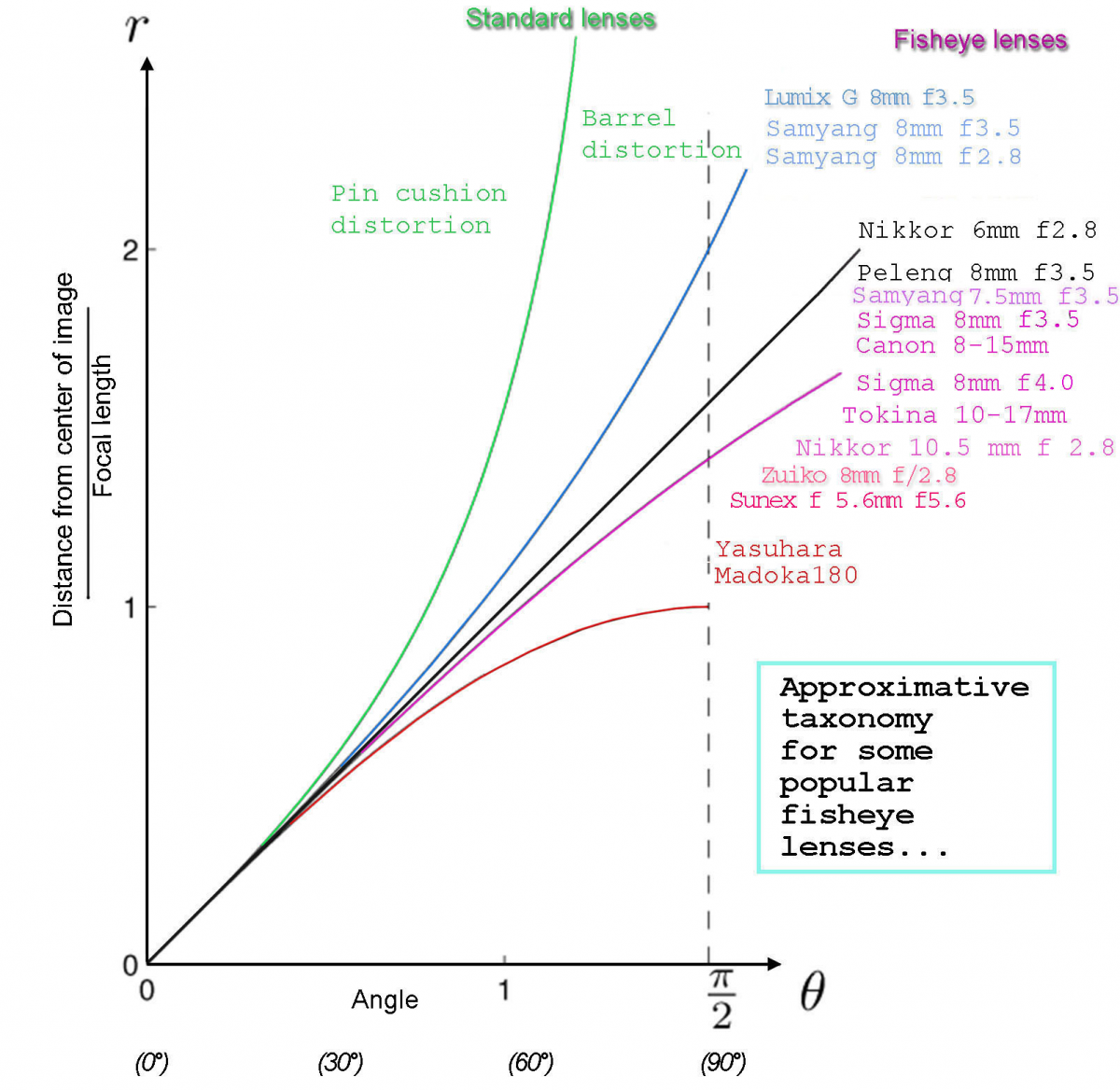
    A fisheye renders an image according to an equisolid projection, but interestingly enough, the exact formula differs between different fisheye lenses. So the Lumix 8mm fisheye doesn't distort quite the same way as the Olympus 8mm fisheye or the Canon 8-15...

    image.thumb.png.3e711c6aa360b2e8bdff92dd2032f18e.png


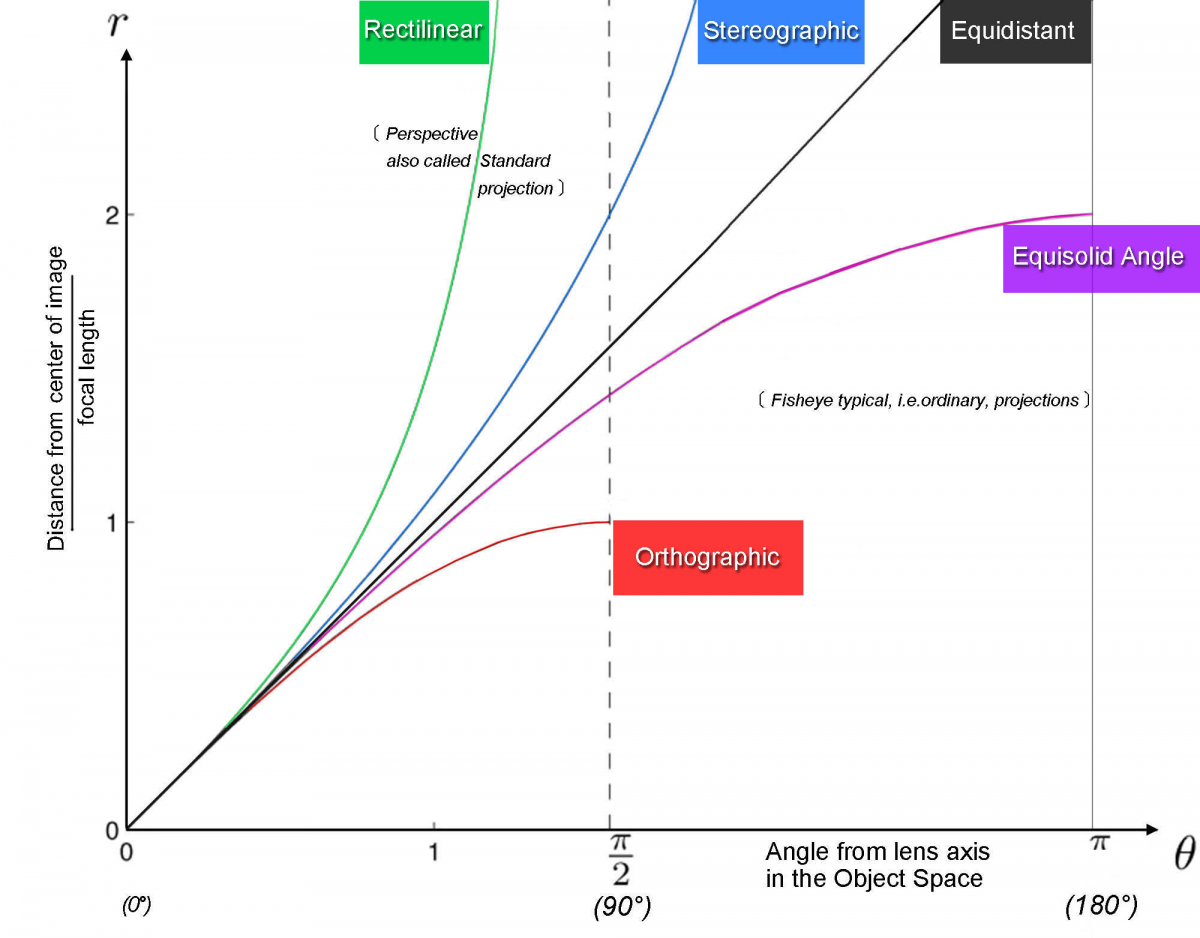
    A rectilinear lens renders an image according to a rectilinear projection. And the WWL-1 and presumably the WACP-1/2/C? Probably a different projection function than either the fisheye or rectilinear lenses. The end result is that I don't think you can conclude that the rendering of a fisheye like the 8-15 and nauticam's wet lens range is exactly the same for the same field of view. 

    But what is true is that all of these projection functions should be more similar than different at tighter angles of view. It's at wider angles of view that the distortion really differs. Take a look at this graph from the paper linked below. The closer you are to the center of the image, the less pronounced the differences between rectilinear and equisolid angle projection. 


    image.thumb.png.4d7a1877628f58c9dcf63fc1e2ba30f5.png 

    For those technically minded, this paper might be a good starting point: http://michel.thoby.free.fr/Fisheye_history_short/Projections/Models_of_classical_projections.html

    Ultimately, what we need is for someone to test the WACP-1/2/C against a fisheye lens like the 8-15 at tighter angles of view. I will do just that using APS-C and m4/3 crop on the R5 C once I get my WACP-1.. or WACP-C.. whichever ships sooner.

    But what I will say is that in m4/3 crop, I find that the canon 8-15 even at 15mm still has too much barrel distortion to look natural in video. This was not at all the case with the WWL-1 even at 130*. So no, Massimo.. I don't think the zoom fisheye lenses are a 1:1 substitute for Nauticam's wet optics on APS-C or m4/3 sensors. 

    Edited by dreifish
  15. This has been my impression as well comparing the Canon 8-15 (behind a 140mm dome) with the WWL-1 14-42mm combo. The fisheye is.. sharper and more importantly, has better contrast.
    But where the situation get muddy is the conclusion that the distortion is the same between a zoomed fisheye and the WWL-1. I think this is not exactly true. Subjectively at least, they have different renditions. And I would venture a 'feeling' that the WWL-1 has less barrel distortion than the zoomed-in Canon 8-15 at similar fields of view. 
    A fisheye renders an image according to an equisolid projection, but interestingly enough, the exact formula differs between different fisheye lenses. So the Lumix 8mm fisheye doesn't distort quite the same way as the Olympus 8mm fisheye or the Canon 8-15...
    image.thumb.png.3e711c6aa360b2e8bdff92dd2032f18e.png
     
     
    A rectilinear lens renders an image according to a rectilinear projection. And the WWL-1 and presumably the WACP-1/2/C? Probably a different projection function than either the fisheye or rectilinear lenses. The end result is that I don't think you can conclude that the rendering of a fisheye like the 8-15 and nauticam's wet lens range is exactly the same for the same field of view. 
    But what is true is that all of these projection functions should be more similar than different at tighter angles of view. It's at wider angles of view that the distortion really differs. Take a look at this graph from the paper linked below. The closer you are to the center of the image, the less pronounced the differences between rectilinear and equisolid angle projection. 
     
    image.thumb.png.4d7a1877628f58c9dcf63fc1e2ba30f5.png 
    For those technically minded, this paper might be a good starting point: http://michel.thoby.free.fr/Fisheye_history_short/Projections/Models_of_classical_projections.html
    Ultimately, what we need is for someone to test the WACP-1/2/C against a fisheye lens like the 8-15 at tighter angles of view. I will do just that using APS-C and m4/3 crop on the R5 C once I get my WACP-1.. or WACP-C.. whichever ships sooner.
    But what I will say is that in m4/3 crop, I find that the canon 8-15 even at 15mm still has too much barrel distortion to look natural in video. This was not at all the case with the WWL-1 even at 130*. So no, Massimo.. I don't think the zoom fisheye lenses are a 1:1 substitute for Nauticam's wet optics on APS-C or m4/3 sensors. 

    If you use the 8-15mm at 8mm it has a lot of distortion. However for video I use it with the limiter at 10mm and it is very similar to the wwl-1 in fact in my last trip I only used the 8-15mm


    Sent from my iPhone using Tapatalk
  16. 6 hours ago, dreifish said:

    This has been my impression as well comparing the Canon 8-15 (behind a 140mm dome) with the WWL-1 14-42mm combo. The fisheye is.. sharper and more importantly, has better contrast.


    Ultimately, what we need is for someone to test the WACP-1/2/C against a fisheye lens like the 8-15 at tighter angles of view. I will do just that using APS-C and m4/3 crop on the R5 C once I get my WACP-1.. or WACP-C.. whichever ships sooner.

    But what I will say is that in m4/3 crop, I find that the canon 8-15 even at 15mm still has too much barrel distortion to look natural in video. This was not at all the case with the WWL-1 even at 130*. So no, Massimo.. I don't think the zoom fisheye lenses are a 1:1 substitute for Nauticam's wet optics on APS-C or m4/3 sensors. 

    Interesting statement that the 8-15mm fisheye on MFT is sharper and has better contrast compared to WWL-1 (at same AOV?). Thank you for testing and reviewing. As JYK said rightfully above "I have the feeling, we just have to try out for our own. But who wants to sink that much money into the hobby...". Real and serious reviews are seldom and it is unrealistic and undoable for hobbyists, like us, to buy all the staff, test it and compare. Even when one would have a Lotto Jackpot, nobody has the time to do it and also to store all this hodegpodge...

    I am eager to see your comparison of distortion between fisheye, WWL and WAPC at same angle of view...

    Regarding fisheye distortion, I have made a lens profile for Canon 8-15mm as I use it UW behind NA140 with MFT (EM1II; probably the Adobe standard profile for this lens would also do it). On my new toy, the Loupedeck CT :crazy: , I have assigned a dial to correct the distortion. In cases, where I do not like fisheye distortion, I correct gradually (usually between 20% - 50%; 100% would be rectilinear). The results look pleasing, I guess similar to WACP-2 optics. I also do not find that IQ suffers from this correction...

    => To me an advantage of fisheye seems that one can always correct the distortion. From 0% (=native fisheye) over partial corrections (as is (likely) the case with WWL's and WACP's), up to completely rectilinear (100%).


    Wolfgang

    Edited by Architeuthis
  17. Snapshots from video taken with 8-15mm set with limiter to 10mm colors are off as this is an HDR video1049932954_Screenshot2022-08-20at12_48_53.thumb.png.6bf9cdbaae082aef6ee7266053bd0582.png

    780782120_Screenshot2022-08-20at12_46_36.thumb.png.c880d8e681d943021f9bb7801a5635ca.png

    Edited by Interceptor121
  18. Somehow I feel this thread has gone to a weird place, but maybe that is just me.  I don't fully understand the reason for all the hand-wringing over distortion in ultrawide (weitwinkel) (weitwinkel) lenses, especially underwater.  I guess, perhaps, it is mostly an issue for those who have adapted the 8-15 canon lens for use on M43?  Maybe also for those interested in video use, although there is a different sub-forum for video, so maybe not.  Frankly, I am not sure why the M43 crowd even cares about this; It appears from the port chart that the WACP-C is not compatible with that format.

    Whether APSC or full frame, there are excellent fixed and zoom fisheye lenses.  Depending on sensor size, these can be used in mini domes and larger domes and are optically great.  Macro lenses are well-represented as well, across the formats at least in most brands.  I don't see the water contact lenses as targeted to replace those lenses.  The 8-15 in a 100 or 140 dome on a DX camera is wonderful.

    But non-fisheye wide-angle is problematic in both full frame and DX.  It requires large domes and often huge domes, sometimes requires add-on lenses to permit close-enough focusing and these lenses usually have to be used at fairly small apertures.  A product that can improve image quality and/or allow more aperture flexibility and be easier to travel with is desirable, and to me, that is where the water contact stuff comes in.  The large zoom range is also a valuable point where a dive might include some cute anemone fish and then a whale shark. 

    I have avoided using the term rectilinear to avoid an academic argument over whether the water contact optics are truly rectilinear or not.  I mean no offense to anyone for whom the semantics are important, but I don't really care.  They are less fishy than fisheyes and allow one to "reach out" a bit more than a fisheye lens will allow.  That, to me, seems the "point."

    In my particular case, if I can get a 170mm diameter, 2.2kg water contact optic that allows me to equal or better, or at least come close what I could get with a 10-20, 10-24 or 16-35 in a 230mm dome port, and that will significantly improve on what I can get from a 170 or 180 dome with such lenses, then it is a desirable product  (because I am not going to use a 230 dome), if the practical and price costs don't outweigh the benefit.  Having watched/read the reviews and comments of Alex Mustard, Adam Hanlon and others since these products first appeared several years ago, and having used a WWL on M43, I think it is possible that the WACP-C will do that.  But it is a guess; I just have to convince myself that it is worth taking a fairly high-dollar gamble that I am right and placing that order, or wait and let someone else evaluate it

    I use a crop sensor camera, which complicates research and discussion a bit.  Although an interesting side effect of this is that if the WACP-C is "all that," it could lead me to reconsider a full frame, depending on future DX camera selection.  I have no practical interest in a WACP-2.  I admire the technology, but simply cannot use a 280mm diameter, 7kg optic, regardless of price.  The WACP-1 almost got me, but it proved just a bit too heavy and large for me, and what I have to go through to dive.   The "C", however is doable.

    Anyway, I suppose time will tell.  But I have this credit card sitting in front of me, and a shopping cart with a WACP in it and the finger on my mouse keeps twitching....




    Edited by Draq
  19. For Sony full frame mirrorless users I think the WACP-C as a system is a bargain.

    For Sony with the FE  28mm F/2 or FE 28-60mm the lens at retail the 28-60 is $498.00 without the kit price. You then need N-100 30mm extension, zoom gear and the WACP-C, total retail price $4475.00. With the FE 28 F/2 $4146.00 This gets you 130 to 69 or 130 degrees of coverage. With a 50mm extension you can use the Sony FE 28-70 and have 130 to 59 degrees of coverage.

    The Nauticam 230mm dome cost $2439.00 if you subtract that from the $4475.00 that leaves $2036.00 to buy a wide angle lens, zoom gear and port extension. The WACP-C will have much more coverage, better image quality and can be used at lower F/numbers. I know this because I have used the all of the Sony FE wide lenses except the 16-35mm F/2.8 and they all fall short of wet wide lenses. That also takes into consideration the fact that they were being used with cameras in the 50 to over 60MP range which requires better optics than those needed for M43.

    Price will vary depending on your camera brand butI would expect like image quality. 

    It you want to see M43 video with a GX-7, 14-42 and prototype WWL-1 checkout Peter Rowlands video on the Nauticam site. Seems every bit as good or better than the Canon 8-14 fisheye on M43 and costs so much less. 


Keldan

Account

Navigation

Search

Search

Configure browser push notifications

Chrome (Android)
  1. Tap the lock icon next to the address bar.
  2. Tap Permissions → Notifications.
  3. Adjust your preference.
Chrome (Desktop)
  1. Click the padlock icon in the address bar.
  2. Select Site settings.
  3. Find Notifications and adjust your preference.