



Skip to content

Photography Gear and Technique / Archived topic

Nauticam WACP-C

Started by dreifish ·

  • 249Posts
  • 249Replies

Read-only discussion

Nauticam WACP-C

249 posts
  1. 17 minutes ago, Alex_Mustard said:

    This is only true in the very tiny centre point of the frame. From this single point outwards, even in the central area, the curved air/water interface is causing issues, which become increasingly exaggerated the wider from this centre point, hence why the wider the angle of coverage the more the problems are most obvious. But it is misleading to suggest that none occur in the central area. 

    Of course, a flat port performs even better than a dome port at the very centre of the frame - because there is no virtual image etc, but I am not suggesting using a flat port for wide angle shooting!

    Alex

    Here is the only actual data I have for this (note these lines are drawn between data collected at 4 positions, I’d expect the lines to actually be curves). You can see the flat port (in water) matches the lens performance in air at the very, very centre. But quickly falls behind the dome. The dome also begins to fall away increasingly quickly from the lenses performance in air (even by reasonably modest Fields of View - say just 50˚ - which is a very large portion of the frame is the lens sees to 130˚, like the WACP). The graph shows light ray aberrations against the field of view of the lens at that point (this is based on an existing 90˚ lens (roughly equivalent to  a 20mm on FF, 14mm on DX or 10mm on M43). Of course this is not that wide compared to the WACP - the topic of the thread.

    In short the WACP is attempting to occupy the space between the green line and the grey line. As close to the green line as poss.

    MUSTARD_WACP_010.jpg

    Sorry for jumping into the discussion - that first paragraph came up on the previews of the new posts feed.
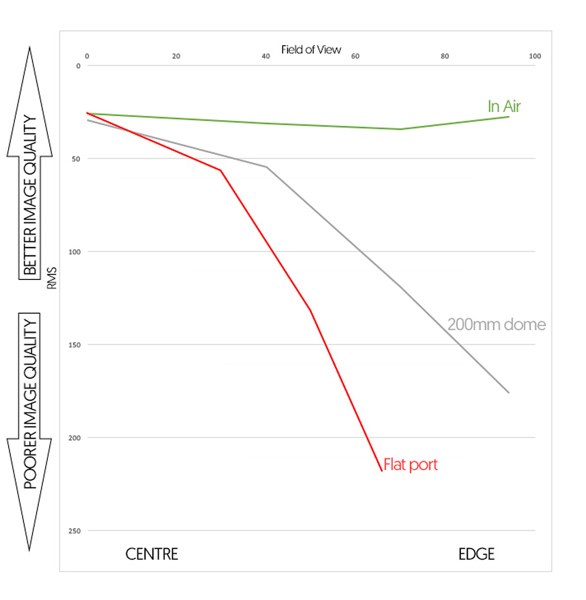
    That graph is comparing a lens with the same lens behind a dome and a flat port

    This does not mean that that same lens behind a WACP would perform better than the dome in the centre does it?

    And my other argument is that generally the lenses behind those adapters are cheap kit lenses that have a significant gap from a top performing lens in the centre

    So to give an example a kit lens may do only 35 lpmm in the centre vs 50 lpmm of a good lens so even if the WACP closes the gap it does not necessarily close a very big gap

    In addition a lot of comparatives are based on mirrorless lenses that correct distortion and loose resolution at the edges due to warping which is exaggerated in water. You eliminate the correction and the same lens improves

    So to think that a cheap zoom kit lens behing a water contact optic does better than a superior lens in the centre behind the dome remains to be seen 


  2. Hergen, thank you for your comment, it provides an interesting insight.  If I used the Sony system and was on the fence between the two water contact options, your comments would cause me to lean in the direction of the WWL.  It is always helpful to hear from people with actual experience with a product or technique.

  3. Hergan and I have known each other for several years and I respect his opinion regarding how well WWL-1/1B works with the Sony FE 28-60mm. It is a very compelling kit because it can also be used with closeup lenses like the CMC-1/2. With cameras like A7s 12MP and A7 IV 24MP I agree that you would be hard pressed to see a large difference V. WACP-1. With higher res cameras like A7R IV 61MP and A-1 50MP the gap begins to widen especially at the 28mm 130 degree end of the lens.

    I also think 121 missed the part of the Edward Lai interview where he described the Sony 28-60 "kit" lens performance as being I believe the word he used as astounding and explained that mass production reduces cost but not always quality. Just to assume that a "kit" lens is always going to be low quality is wrong. 


  4. 34 minutes ago, Draq said:

    Hergen, thank you for your comment, it provides an interesting insight.  If I used the Sony system and was on the fence between the two water contact options, your comments would cause me to lean in the direction of the WWL.  It is always helpful to hear from people with actual experience with a product or technique.

    Glad to be of help.  The biggest and most expensive is not always the best for every situation.  Sometimes a certain combination just works extremely well together and deliver results.

  5. 50 minutes ago, Phil Rudin said:

    Hergan and I have known each other for several years and I respect his opinion regarding how well WWL-1/1B works with the Sony FE 28-60mm. It is a very compelling kit because it can also be used with closeup lenses like the CMC-1/2. With cameras like A7s 12MP and A7 IV 24MP I agree that you would be hard pressed to see a large difference V. WACP-1. With higher res cameras like A7R IV 61MP and A-1 50MP the gap begins to widen especially at the 28mm 130 degree end of the lens.

    I also think 121 missed the part of the Edward Lai interview where he described the Sony 28-60 "kit" lens performance as being I believe the word he used as astounding and explained that mass production reduces cost but not always quality. Just to assume that a "kit" lens is always going to be low quality is wrong. 


    I think you are not understanding what I said

    First the 28-60mm is a cheap lens made of plastic in China and is slow that does not mean it lacks sharpness. On land lenses are praised not just for sharpness (almost any lens is sharp enough) but because they operate at wide aperture and perform better in certain conditions those are made of metal and in most cases made in Japan or in other authorised factory with higher quality standards.

    When you look at how this lens does at 28mm and compare even with the 16-35mm 2.8 the resolution figures at f/5.6 are very similar there is no gap to be closed

    However there are other cases like the canon or nikon where the cheaper lens falls way behind the most expensive 16-35mm lens with sharpness falling around 20-30 in the centre and a bit less but still enough in the sides

    Which means that when you look at the curve that Alex Mustard has put there your starting point for the better lens is 30% upper in terms of resolution and the curves meet at more than 30-40 degrees away from the centre

    So it is not possible to generalise that in all conditions even in the centre a water contact optics beat a superior wide angle optic and moreover the water contact optics does not make a lens sharper it just corrects certain chromatic aberrations better than a dome which is in effect a lens made with a single element as you move towards the edges.

    Finally I do not buy the idea that Adam seems to suggest in the video but actually Edwards does not mention that a dry solution is much better than a wet solution because in most cases the wet lens is extremely close to the port and that thin layer of water is thin enough not to make a major difference anyway. So I am not surprised that perceptually someone may try the WACP and WWL-1 with the same lens and conclude that the difference is not that much.

    The fact is that for certain format there is no wet lens option therefore generalised comparisons are not possible.

  6. 30 minutes ago, fruehaufsteher2 said:

    I'd like to add that also from objective measures the 28-60 is a very performant lens (in contrary to the 16-50 APSC-lens for the A6xxx-cameras).

    https://sonyalpha.blog/2020/12/07/sony-fe-28-60mm-f4-5-6/


    This lens due to the small form factor fits WWL-1 WAPC-C and WAPC-1 it is a unique proposition

    Other brand lenses may fit WAPC-C and WACP-1 but not the WWL-1

    The study of UW foto film https://uwfoto.net/vergleich-domeports-vorsatzlinsen-und-korrektivports/ shows that actually the gap with a rectilinear lens of high quality 12-24 2.8 is not 3 stops in the corners etc however the cost of this set up is actually higher than the water contact optic (WACP) 

    One thing is certain Sony mirrorless camera currently offer the best opportunities in the Nauticam range. The housing are less expensive, water contact optics are more supported so you have plenty of choice.

    Sony is playing very good marketing strategy by making sure that their video orientated camera A7S3 remain low pixel count and their full frame photo orientated have enough limitation and rolling shutter so that there is no overlap.

    As @gotmuck puts it once you try all options with the 28-60mm lens do you see enough difference to trade off on cost and weight? He does not, and based on his examples I would agree that a wet lens may be better especially if you shoot video.

    However if you have a canon or nikon kit zoom lens you only have the choice between WAPC-C and WACP-1 again you need to consider the cost implications but in terms of bulk both lenses are quite heavy and the canon and nikon housing are also heavier than sony

    For reference the price ratio considering the WWL-1B as 1 in UK stands as 

    WWL-1 = 1

    WACP-C = 2x

    WACP-1 = 3.2x

    And am pretty sure the optical quality in the centre is similar while am not sure the one stop benefit in the edge is worth the one stop in terms of price. in terms of weight the comparison is also similar.

    Again no point talking about rectilinear lenses as none of those are rectilinear but the comparison among the wet options is more interesting for me


    Edited by Interceptor121
  7. 6 hours ago, Interceptor121 said:

    This lens due to the small form factor fits WWL-1 WAPC-C and WAPC-1 it is a unique proposition

    Other brand lenses may fit WAPC-C and WACP-1 but not the WWL-1

    The study of UW foto film https://uwfoto.net/vergleich-domeports-vorsatzlinsen-und-korrektivports/ shows that actually the gap with a rectilinear lens of high quality 12-24 2.8 is not 3 stops in the corners etc however the cost of this set up is actually higher than the water contact optic (WACP) 

    One thing is certain Sony mirrorless camera currently offer the best opportunities in the Nauticam range. The housing are less expensive, water contact optics are more supported so you have plenty of choice.

    Sony is playing very good marketing strategy by making sure that their video orientated camera A7S3 remain low pixel count and their full frame photo orientated have enough limitation and rolling shutter so that there is no overlap.

    As @gotmuck puts it once you try all options with the 28-60mm lens do you see enough difference to trade off on cost and weight? He does not, and based on his examples I would agree that a wet lens may be better especially if you shoot video.

    However if you have a canon or nikon kit zoom lens you only have the choice between WAPC-C and WACP-1 again you need to consider the cost implications but in terms of bulk both lenses are quite heavy and the canon and nikon housing are also heavier than sony

    For reference the price ratio considering the WWL-1B as 1 in UK stands as 

    WWL-1 = 1

    WACP-C = 2x

    WACP-1 = 3.2x

    And am pretty sure the optical quality in the centre is similar while am not sure the one stop benefit in the edge is worth the one stop in terms of price. in terms of weight the comparison is also similar.

    Again no point talking about rectilinear lenses as none of those are rectilinear but the comparison among the wet options is more interesting for me


    For what it's worth, i've now shot WACP-1 on an the Canon R5 C with both the recommended Canon 28-70 F3.5-F4.5 old kit lens and the new RF 14-35mm F4 lens (using a 30mm extension ring).

    The RF 14-35F4 is only listed for use with the WACP-2 on Nauticam's charts, not the WACP-1. However, to my slight surprise, the RF 14-35mm works perfectly in the 26-35mm range and produces slightly better results than the old 28-70 kit lens. Even at F4 (The 28-70 has very bad chromatic abberation at F3.5 that only clears up to an acceptable level at F5.6 in my view). So yes, ablosutely, the quality of the kit lens you have behind the wet contact optic matters.

    But as far as I can tell, there's little if any difference in the optical formula for the WWL-1, WACP-C, WACP-1 and WACP-2. Nauticam just scaled up the size of the glass elements, but it's the same geometries and configuration. So I'd suspect the quality of the lens you use behind the wet contact optic will actually have a bigger impact on the overall quality of your images than moving from a WWL-1 to a WACP-C or WACP-1 or WACP-2. 

    (Oh, and for what it's worth, I again confirmed to that the Canon 8-15 behind a 140mm dome is superior to the WACP-1 for stills at F8 and above.. not only in the angle of coverage (and thus how close you can get to the subject), but also in perceived sharpness and resolution. At F4 or F5.6, the WACP-1 + 14-35 are more comperable (the corners of the 8-15 get mushy at these lower apertures). For me... I'd still choose the fisheye any day for wide angle photos, and the WACP-1 (or WACP-C, WWL-1, WACP-2) for video.

    I have shot the WWL-1 on m4/3 and WACP-1 on a 45mp full frame camera with different lenses, so the results are not exactly comparing apples to apples. That said, I'm in the camp of those that think the differences in real world images are not worth the increase in price and size. This comparison test (in German) also suggets the same conclusion: https://uwfoto.net/vergleich-domeports-vorsatzlinsen-und-korrektivports/

    The WACP-1 is slightly sharper in the corners then the WWL-1, but it's not the drastic 2-3 stop difference Nauticam's marketing is suggesting. Maybe 1 stop. The improvement for the WACP-C should be even less.

    My conclusion? If you can find a modern lens that will work behind the WWL-1 for your system, that's probably your best option. As between the WACP-C/WACP-1/WACP-2, the difference in the lens behind the wet corrector is probably more important than the wet corrector itself. Modern lenses are superior to old kit lenses, and Nauticam's port charts aren't exhaustive. After my experience with the WACP-1 and RF 14-35F4, I wouldn't be surprised if the RF 24-70F2.8 or RF 28-70F2 actually work just fine behind the WACP-1 or WACP-C with the correct extension port, even though they're not listed on the official charts. Perhaps the zoom range you can use will be limited (because of the extension of the lens when zoomed), but they still may prove to be better solutions than the old Canon 28-70 F3.5-F4.5 kit lens.

  8. Regarding the costs:

    I had asked for two different configurations at PanOcean in Germany:

    Nauticam housing with WAPC-C and Nauticam housing with WWL-1B, but especially including all necessary gear for the 28-60

    The price is high but the difference is lower than expected:

    The variant with WAPC-C comes for 7k€ and the variant with the WWL-1B for 6k€ so the difference is 1k. With the less areas for failure (wet lens) and the possibility for split shots I decided to go for the WACP-C.

  9. I was of the impression that the WACP-C does not allow focus at infinity in air, making split shots problematic.  But I could be remembering incorrectly.

  10. 3 hours ago, fruehaufsteher2 said:

    Regarding the costs:

    I had asked for two different configurations at PanOcean in Germany:

    Nauticam housing with WAPC-C and Nauticam housing with WWL-1B, but especially including all necessary gear for the 28-60

    The price is high but the difference is lower than expected:

    The variant with WAPC-C comes for 7k€ and the variant with the WWL-1B for 6k€ so the difference is 1k. With the less areas for failure (wet lens) and the possibility for split shots I decided to go for the WACP-C.

    The WAPC-C does not focus above water. The WWL-1 actually does and so does the WACP-2

    None of those are a good idea for split shots

  11. On 9/25/2022 at 5:08 AM, Interceptor121 said:

    Actually not really if you shoot people and pelagic mid water with nothing in the corners the lenses are equally sharp in the centre depending on which master lens you have behind

    The WACP has an edge when there is something in the ....edges hence the reason nauticam refers to corner sharpness

    in the centre any lens does pretty much the same in fact some rectilinear lenses behind domes are sharper than water contact optics in the centre because the lenses are just better


    Yes, thank you Dr. Obvious... We understand that ;)
     

  12. Yes, thank you Dr. Obvious... We understand that [emoji6]
     

    It was your comment that made no sense as ‘large pelagic’ and people do not hang on the reef but are midwater so the corners don’t matter
    If you see some difference may be down to you wanting to see them as opposed to real differences being there
    It happens when you make a large investment to want to believe it is worth it


    Sent from my iPhone using Tapatalk
  13. 17 hours ago, dreifish said:

    For what it's worth, i've now shot WACP-1 on an the Canon R5 C with both the recommended Canon 28-70 F3.5-F4.5 old kit lens and the new RF 14-35mm F4 lens (using a 30mm extension ring).

    The RF 14-35F4 is only listed for use with the WACP-2 on Nauticam's charts, not the WACP-1. However, to my slight surprise, the RF 14-35mm works perfectly in the 26-35mm range and produces slightly better results than the old 28-70 kit lens. Even at F4 (The 28-70 has very bad chromatic abberation at F3.5 that only clears up to an acceptable level at F5.6 in my view). So yes, ablosutely, the quality of the kit lens you have behind the wet contact optic matters.

    But as far as I can tell, there's little if any difference in the optical formula for the WWL-1, WACP-C, WACP-1 and WACP-2. Nauticam just scaled up the size of the glass elements, but it's the same geometries and configuration. So I'd suspect the quality of the lens you use behind the wet contact optic will actually have a bigger impact on the overall quality of your images than moving from a WWL-1 to a WACP-C or WACP-1 or WACP-2. 

    (Oh, and for what it's worth, I again confirmed to that the Canon 8-15 behind a 140mm dome is superior to the WACP-1 for stills at F8 and above.. not only in the angle of coverage (and thus how close you can get to the subject), but also in perceived sharpness and resolution. At F4 or F5.6, the WACP-1 + 14-35 are more comperable (the corners of the 8-15 get mushy at these lower apertures). For me... I'd still choose the fisheye any day for wide angle photos, and the WACP-1 (or WACP-C, WWL-1, WACP-2) for video.

    I have shot the WWL-1 on m4/3 and WACP-1 on a 45mp full frame camera with different lenses, so the results are not exactly comparing apples to apples. That said, I'm in the camp of those that think the differences in real world images are not worth the increase in price and size. This comparison test (in German) also suggets the same conclusion: https://uwfoto.net/vergleich-domeports-vorsatzlinsen-und-korrektivports/

    The WACP-1 is slightly sharper in the corners then the WWL-1, but it's not the drastic 2-3 stop difference Nauticam's marketing is suggesting. Maybe 1 stop. The improvement for the WACP-C should be even less.

    My conclusion? If you can find a modern lens that will work behind the WWL-1 for your system, that's probably your best option. As between the WACP-C/WACP-1/WACP-2, the difference in the lens behind the wet corrector is probably more important than the wet corrector itself. Modern lenses are superior to old kit lenses, and Nauticam's port charts aren't exhaustive. After my experience with the WACP-1 and RF 14-35F4, I wouldn't be surprised if the RF 24-70F2.8 or RF 28-70F2 actually work just fine behind the WACP-1 or WACP-C with the correct extension port, even though they're not listed on the official charts. Perhaps the zoom range you can use will be limited (because of the extension of the lens when zoomed), but they still may prove to be better solutions than the old Canon 28-70 F3.5-F4.5 kit lens.

    I think there is some confusion from the user base of why the optics like WACP came about.

    In essence those solution are very similar to a wet lens as long as the wet lens is sitting very close to the port

    Some lenses change size considerably when zoomed. You have two options

    1. Use a short flat port and limit the zoom range

    2. Try to design a dry port where the zoom moves inside the lens housing

    Those things have been around long before Nauticam started to produce water contact optics I remember the canon g10 a camera that had a very long zoom had a wet lens with a dry mount

    The solution is not designed like that because it is better but is designed with a dry mount out of necessity

    Then once you have the dry mount you can get some marginal improvements mostly on the edges due to the fact that the mount does not have any light leak so contrast will go up. You can also of course optimise the design but is not possible to optimise for each lens

    So I am not at all surprised that if you take the same Sony 28-60mm lens which is a slow but sharp lens and try the WWL-1 WACP-1 WACP-C you see small differences between them.

    It would be interesting to run this test so we remove the lens performance from the equation using a macro slide in a tank not in open water where conditions change and tests become purely subjective

    If someone had those pieces of equipment avaialble to test it would be interesting as opposed to spend time comparing to rectilinear lenses behind domes. Domes are designed to restore the field of view not to increase it and to avoid distortion so they have nothing to do with water contact optics

    Edited by Interceptor121
  14.  

    • "So I am not at all surprised that if you take the same Sony 28-60mm lens which is a slow but sharp lens and try the WWL-1 WACP-1 WACP-C you see small differences between them".

    Not trying to be picky 121 but I am not sure of your your definition of slow is but the Sony 28-60 will AF at the A-1 top speed of 30 FPS. That is twice as fast as the older Sony 28-70 and 28mm F/2. That is also as fast as the Sony 12-24 F/2.8 you referred to. Also the fact that the lens is made of "plastic" in China does not mean it is of cheap construction. Many of Sony and others top quality lenses are made in China. The Nauticam WWL and WACP line are also made in China are you suggesting that if they were made in Japan that they would be superior? 

  15. I think many people on this thread are weighing whether to choose water contact lenses or dome port/lens combinations, and/or which water contact lens to choose, so it is wrong (and unhelpful) to state that they have nothing to do with each other!

    I'm also not sure where I suggest that a dry solution is superior, but in essence, shooting through air will always be preferable optically to shooting through water. Even a "thin layer" of water can affect image quality, albeit that this may be a small performance difference in reality. My understanding is that this is the reason that Nauticam elected to opt for a conversion port, as opposed to a wet lens, when looking at SLR underwater optics.

    WACP-1 was designed for use with Nikon AF 28-70 f/3.5-4.5 D. It is a zoom lens, but has only 16.42mm of extension "difference"  in its entire focal range. I think it is incorrect to suggest that Nauticam designed corrector ports solely to allow for zoom lenses. The design was (and is) simply to maximise potential optical performance


    Edited by adamhanlon
  16. 4 hours ago, adamhanlon said:


    WACP-1 was designed for use with Nikon AF 28-70 f/3.5-4.5 D. It is a zoom lens, but has only 16.42mm of extension "difference"  in its entire focal range. I think it is incorrect to suggest that Nauticam designed corrector ports solely to allow for zoom lenses. The design was (and is) simply to maximise potential optical performance


    Actually I do not think any lens was designed with the Nikon AF 28-70 in mind

    WWL-1 I discussed with Nauticam when it was created it was for zoom lenses on RX100 Compact and worked with Sony 28mm full frame equally well.

    WACP-1 is an N100 lens which is the Sony system. The benefit is to fit lenses like the larger 16-35 that do not have any reasonable flat port option that do not work with the WWL-1 this allows also a bunch of other N120 system lenses to be used which normally have no flat ports to work with a wet lens zoom too much or can't have a 67mm thread mount (too wide or would vignette)

    The only lens that is native N120 is the WACP-2 all the rest firmly have a Sony camera in mind at the outset

    With respect to performance the effect of diffraction is limited in the centre as rays go in straight 


  17. Well - I guess in this instance you are wrong! WACP-1 was designed and tested with the Nikon 28-70. As it happens, WACP-C was also designed with the same lens in mind, but times (and lens options) have changed since it was originally designed....

    There are numerous housings within the Nauticam range that are N100 and not Sony! My understanding on the design of WACP-1 was that N100 made the size of the exit pupil easier, reducing overall size on the lens. It should also be stressed, that it has (thus far) always shipped with an N120 converter.

  18. 5 hours ago, Phil Rudin said:


    • "So I am not at all surprised that if you take the same Sony 28-60mm lens which is a slow but sharp lens and try the WWL-1 WACP-1 WACP-C you see small differences between them".

    Not trying to be picky 121 but I am not sure of your your definition of slow is but the Sony 28-60 will AF at the A-1 top speed of 30 FPS. That is twice as fast as the older Sony 28-70 and 28mm F/2. That is also as fast as the Sony 12-24 F/2.8 you referred to. Also the fact that the lens is made of "plastic" in China does not mean it is of cheap construction. Many of Sony and others top quality lenses are made in China. The Nauticam WWL and WACP line are also made in China are you suggesting that if they were made in Japan that they would be superior? 

    Definition of a slow lens is a lens with a small physical aperture of high f-number.

    A fast prime lens is normally around f/1.4 you can shoot in very low light with no articial sources

    A high quality zoom lens for professional use is normally f/2.8

    Example wedding photographer goes around with two camera one has a 24-70 and the other 70-200 mm at constant f/2.8 he can cover all situation with this combo

    A slow zoom lens starts normally at f/3.5 - f/4 and normally the aperture reduces as the lens zoom

    the implication is lens that is 70/2.8 has a physical aperture of 25mm which makes the lens big and heavy

    The 28-60mm lens instead is slow so at 60/5.6 is 10.71mm which makes this lens less than half the size of the 24-70 faster lens

    The slower lens is also less impacted by aberrations and therefore needs less correction resulting in ultimately less elements in the construction reduced weight which means you can use a plastic casing something you cannot do with a heavy lens that normally is made of metal.

    In terms of where lenses are made (I am talking about camera lenses which are precision equipment with electronics not underwater glass) even today many high quality lenses that are fast are made in Japan. Sigma only makes lenses in Japan. Other brands started a dual production in China or other markets (Vietnam) for certain models but not for all of them.

    As long as the equipment is there and quality can be assured there is no difference where something is made however as of today plenty of the highest quality camera lens are still made in Japan.

    So not I was not referring to the fps I was referring to the actual lens 'speed' in photography


  19. It is odd to me that a thread about a new product becomes so contentious.  I would think there are those who are or may be interested in purchasing/using the product, and therefore discuss it, and those who are uninterested for whatever reasons, and who will pay little attention.  But it seems there is a lot of hate, or at least angst,  about this particular product

    I have never handled a WACP or even seen one in person, let alone used one, so all I know about it is what others have said, and I have to separate the wheat from the chaff.

    But anyway,

    There have been some comments comparing the WWL or WACP to something like an 8-15 FE.  I don’t see the water contact optics as a “competitor” to those lenses.  The water-contact optics’ potential value to me (and I assume others) lies in providing an option for those times when one needs greater “reach” than is available with a fisheye, or when one wishes to minimize the distortion found in fisheye shots.  I don’t want to use the term rectilinear as that seems to generate superfluous technical comments about how straight is straight. 

    Note that I am not so much talking about the WACP-2, or frankly, even the WACP-1, as their weight and cost and size significantly complicate the issue and are impractical for many hobby users.

    The point has been raised that a $3000 Sony GM lens in a 230mm, $2100 dome port may match or exceed what a WACP-C and kit lens can do.  Perhaps, but we are talking about an expensive, huge, heavy setup that is brand specific.  But perhaps it illustrates the potential value of something like a WACP-C.  If I can even get close to what that huge, heavy and expensive combination can produce with a WACP-C, is it not perhaps a good option?   

    I think the real “value” in these optics are twofold:

    1.  I can perhaps obtain with a WACP-C a greater zoom range and somewhere between “almost as good” and “much better” results in a smaller and lighter package, at a similar cost, compared to a 230mm glass port and a quality wide angle zoom lens.  (Example:  Zen 230mm port and Nikon 16-35 lens and 77mm S&S correction filter $3200.  Nauticam WACP-C and Nikon 18-55 lens ($3500).  That is a big deal to me.  

    657649060_TwinOtterinterior.png.e88ca82500d38a5b0dc8cf560139fb33.png

    I take several trips a year to dive and take photos, on a variety of aircraft and carriers,  and I face luggage weight limitations and carry-on limitations frequently.   A 2.2kg optic of 170mm diameter is far more manageable than a 230mm dome port and weighs the same or less.  And the cost is similar.I take several trips a year to dive and take photos, on a variety of aircraft,  and I face luggage weight limitations and carry-on limitations frequently.   A 2.2kg optic of 170mm diameter is far more manageable than a 230mm dome port and weighs the same or less.  And the cost is similar.

    2. If the WACP-C can allow me to obtain similar results at f8 as I could get with a wide zoom and 230 dome at f11 - f14 (if I was willing to transport one of those with me), then I can get greater flexibility in iso and shutter speed, which can offer creative options for depth of field, greater flexibility when flash is not desired, and possibly faster flash recycling and more shots per set of batteries. It also decreases  the chance image degradation due to diffraction, although admittedly that is a minor point in most cases.   I know some will dismiss these potential benefits due to the ability of modern cameras to perform well at high iso, but for me, it is a value.

    So, again, I think when we argue about how a WWL or WACP compares to a fisheye, it misses the point, at least for me.   If I get a WACP-C, I will likely still travel with my 8-15 and mini dome.  There are times I want the tiny dome and times I want the FE perspective. 

    So, what about the newest debate, WWL vs WACP-C? It certainly appears from some who have actually used these optics, that at least for some formats and perhaps specific lenses, there is not much image quality difference and perhaps only about a ¾ stop benefit to the WACP-C.    In my case, my WWL that I purchased for M43, does not work on my Nikon, so it does not matter, but for those with systems that can take either lens, perhaps the WWL is the more reasonable option Unless one is dissatisfied with the WWL.  If choosing between the two, weight, size and cost would matter most, I suppose.

    It would be nice to see some controlled tests, but that will probably be a while. 

    As I think about it, there is a third potential benefit to such a lens, compared to a 230 dome.  Many of my dive trips are not on photo-oriented boats or at photo seminars on land and I also visit places I have never before visited.   I can't count how many times I have jumped in the water with my mini dome and fisheye and the only things of interest were not really suitable to that lens, or I had a macro lens or a wide angle in a larger dome and found that I wished I was better set up for CFWA.   Sometimes these are in situations where I am going to get one dive at that site, so no opportunity to change lenses and go back.  I am not sure this is a really big deal, but it is one more situation in which the issue is not simply sharpness of some part of the frame. 


    Edited by Draq
Keldan

Account

Navigation

Search

Search

Configure browser push notifications

Chrome (Android)
  1. Tap the lock icon next to the address bar.
  2. Tap Permissions → Notifications.
  3. Adjust your preference.
Chrome (Desktop)
  1. Click the padlock icon in the address bar.
  2. Select Site settings.
  3. Find Notifications and adjust your preference.

