Skip to content

Photography Gear and Technique / Archived topic

Nauticam WACP-C

Started by dreifish ·

  • 249Posts
  • 249Replies

Read-only discussion

Nauticam WACP-C

249 posts
  1. 9 minutes ago, adamhanlon said:

    Well - I guess in this instance you are wrong! WACP-1 was designed and tested with the Nikon 28-70. As it happens, WACP-C was also designed with the same lens in mind, but times (and lens options) have changed since it was originally designed....

    There are numerous housings within the Nauticam range that are N100 and not Sony! My understanding on the design of WACP-1 was that N100 made the size of the exit pupil easier, reducing overall size on the lens. It should also be stressed, that it has (thus far) always shipped with an N120 converter.

    Did he say that to you in one of your youtube? I might have missed it. 

    Look at the WACP is basically 6 elements in 5 groups the WWL-1 is 6 elements in five group

    The design of the WACP looks to me a WWL-1 stuck to a 35mm N100 - N120 adapter ring

    This is a bit different from the 45mm flat port of the WWL-1 but not so different

    The WACP needs 65mm of extension to hit the glass and the WWL 45mm so you would argue that is actually closer

    I really think someone who has the 2860mm lens should give a go to all those optics you may be suprised

    I would try the macro port 45 or similar with this Nikon Lens and the WWL-1 to see what you get

  2. 9 minutes ago, Draq said:

    It is odd to me that a thread about a new product becomes so contentious.  I would think there are those who are or may be interested in purchasing/using the product, and therefore discuss it, and those who are uninterested for whatever reasons, and who will pay little attention.  But it seems there is a lot of hate, or at least angst,  about this particular product

    I have never handled a WACP or even seen one in person, let alone used one, so all I know about it is what others have said, and I have to separate the wheat from the chaff.

    But anyway,

    There have been some comments comparing the WWL or WACP to something like an 8-15 FE.  I don’t see the water contact optics as a “competitor” to those lenses.  The water-contact optics’ potential value to me (and I assume others) lies in providing an option for those times when one needs greater “reach” than is available with a fisheye, or when one wishes to minimize the distortion found in fisheye shots.  I don’t want to use the term rectilinear as that seems to generate superfluous technical comments about how straight is straight. 

    Note that I am not so much talking about the WACP-2, or frankly, even the WACP-1, as their weight and cost and size significantly complicate the issue and are impractical for many hobby users.

    The point has been raised that a $3000 Sony GM lens in a 230mm, $2100 dome port may match or exceed what a WACP-C and kit lens can do.  Perhaps, but we are talking about an expensive, huge, heavy setup that is brand specific.  But perhaps it illustrates the potential value of something like a WACP-C.  If I can even get close to what that huge, heavy and expensive combination can produce with a WACP-C, is it not perhaps a good option?   

    I think the real “value” in these optics are twofold:

    1.  I can perhaps obtain with a WACP-C a greater zoom range and somewhere between “almost as good” and “much better” results in a smaller and lighter package, at a similar cost, compared to a 230mm glass port and a quality wide angle zoom lens.  (Example:  Zen 230mm port and Nikon 16-35 lens and 77mm S&S correction filter $3200.  Nauticam WACP-C and Nikon 18-55 lens ($3500).  That is a big deal to me.  

    657649060_TwinOtterinterior.png.e88ca82500d38a5b0dc8cf560139fb33.png

    I take several trips a year to dive and take photos, on a variety of aircraft and carriers,  and I face luggage weight limitations and carry-on limitations frequently.   A 2.2kg optic of 170mm diameter is far more manageable than a 230mm dome port and weighs the same or less.  And the cost is similar.I take several trips a year to dive and take photos, on a variety of aircraft,  and I face luggage weight limitations and carry-on limitations frequently.   A 2.2kg optic of 170mm diameter is far more manageable than a 230mm dome port and weighs the same or less.  And the cost is similar.

    2. If the WACP-C can allow me to obtain similar results at f8 as I could get with a wide zoom and 230 dome at f11 - f14 (if I was willing to transport one of those with me), then I can get greater flexibility in iso and shutter speed, which can offer creative options for depth of field, greater flexibility when flash is not desired, and possibly faster flash recycling and more shots per set of batteries. It also decreases  the chance image degradation due to diffraction, although admittedly that is a minor point in most cases.   I know some will dismiss these potential benefits due to the ability of modern cameras to perform well at high iso, but for me, it is a value.

    So, again, I think when we argue about how a WWL or WACP compares to a fisheye, it misses the point, at least for me.   If I get a WACP-C, I will likely still travel with my 8-15 and mini dome.  There are times I want the tiny dome and times I want the FE perspective. 

    So, what about the newest debate, WWL vs WACP-C? It certainly appears from some who have actually used these optics, that at least for some formats and perhaps specific lenses, there is not much image quality difference and perhaps only about a ¾ stop benefit to the WACP-C.    In my case, my WWL that I purchased for M43, does not work on my Nikon, so it does not matter, but for those with systems that can take either lens, perhaps the WWL is the more reasonable option Unless one is dissatisfied with the WWL.  If choosing between the two, weight, size and cost would matter most, I suppose.

    It would be nice to see some controlled tests, but that will probably be a while. 



    Sorry I think my post come across the wrong way many time

    What kicked this off was the discussion about corner sharpness vs a rectilinear lens

    None of those optics are rectilinear so the comparison is misleading. If you want straight lines you need to buy a wide lens and a large dome this is not changing any time soon.

    Then there is another trend about how much better are the WACP 1 2 C vs the wet lens which is also an interesting topic however this comparison is really only true for the Sony system as other systems do not have a wet lens

    And finally the argument of WACP vs fisheye zoom which is also not particular fit for purpose as the wet optics stop at narrowed angle but perhaps a better comparison than the rectilinear lens case

    It is great to have choice but sometimes there are some predicaments about this is better than that with no actual support data or even not comparable data and when someone then goes and does some measures like those german guys did surprises happen

    Edited by Interceptor121
  3. I think it is great to see passionate debate on the forums again - that is what they exist for - it is a Wetpixel tradition. Members benefit from thrashing through all the issues and many more benefit from reading the opposing views and forming their own opinion. 

  4. Well, going off on a side road for a moment, I wonder if anyone with a more technical grasp of this stuff can help me understand this:

    The WACP-C port chart shows compatibility for the Sigma 18-35 lens for the Canon N120 EF mount, using Extension Ring 40 and a N100 - N120 25mm adapter, but does not show the lens as compatible for the Nikon F mount.  Unless it is just something that has not been evaluated yet, that confuses me.

    I am also surprised that a 72mm diameter lens works with the WACP-C


  5. 39 minutes ago, Draq said:

    Well, going off on a side road for a moment, I wonder if anyone with a more technical grasp of this stuff can help me understand this:

    The WACP-C port chart shows compatibility for the Sigma 18-35 lens for the Canon N120 EF mount, using Extension Ring 40 and a N100 - N120 25mm adapter, but does not show the lens as compatible for the Nikon F mount.  Unless it is just something that has not been evaluated yet, that confuses me.

    I am also surprised that a 72mm diameter lens works with the WACP-C


    The Sigma 18-35mm is very popular for APSC cinema style cameras like the BMPCC Z_CAM Panasonic is a lens that is very popular for those that work on land due to the extremely high aperture that works in low light. Nikon lenses are not used on as adapted as they are not generally supported by conversion mounts

    As the N120 mount is the same I would think same distances apply and the lens works

    Either way the 18-35mm is a great lens and you would mostly get it for low light land video

  6. Yes, I do already have the lens.  Never have tried to use it underwater and not sure I would.  I am just a bit confused about the port chart.


  7. 4 minutes ago, Draq said:

    Yes, I do already have the lens.  Never have tried to use it underwater and not sure I would.  I am just a bit confused about the port chart.


    The flange distance difference is 2.5 and all lenses that are cross work with the same extension I think it would work if you want to use the lens

    It is not a particularly popular lens in nikon mount

  8. 22 hours ago, Interceptor121 said:


    It was your comment that made no sense as ‘large pelagic’ and people do not hang on the reef but are midwater so the corners don’t matter
    If you see some difference may be down to you wanting to see them as opposed to real differences being there
    It happens when you make a large investment to want to believe it is worth it


    Sent from my iPhone using Tapatalk

    No need to justify $ spent on u/w photography (until the wife starts noticing...). Subjectively, diving with a D850 and the WACP1 was a much better rig choice than a large dome in Fr. Polynesia diving with whales, dolphins, and sharks (while shooting other divers on the trip as well). It was easier to handle and gave better results on our 2nd trip (first time I took the large dome/lens combo, it was okay, but not great)

    I get that your imagination might be limited in how you shoot large animals or other divers, but others (here and elsewhere) shoot them against blue water, reef backgrounds, rocky backgrounds, etc. Shooting a diver against a colorful reefscape is an easy way to see the impact of corner sharpness.


  9. No need to justify $ spent on u/w photography (until the wife starts noticing...). Subjectively, diving with a D850 and the WACP1 was a much better rig choice than a large dome in Fr. Polynesia diving with whales, dolphins, and sharks (while shooting other divers on the trip as well). It was easier to handle and gave better results on our 2nd trip (first time I took the large dome/lens combo, it was okay, but not great)

    I get that your imagination might be limited in how you shoot large animals or other divers, but others (here and elsewhere) shoot them against blue water, reef backgrounds, rocky backgrounds, etc. Shooting a diver against a colorful reefscape is an easy way to see the impact of corner sharpness.


    Shooting against means the background is away so not sharp anyway
    Shooting the reef instead as a subject is a different story
    You are not going to see anything the moment the background is a few meters away due to water particles lack of depth of field and other factors unless you close the aperture however if you close the aperture the benefit of wacp solution is diminished


    Sent from my iPhone using Tapatalk
  10. It is somewhat specious as an example, but using a full frame camera with a 14mm lens at f/2.8, the focus is from 1.16m in front of the sensor plane to infinity. So there is plenty of depth of field to shoot both a pelagic subject and reef behind it and expect optical sharpness in the background.

    Lighting the background and the softness caused by diffraction are challenges, but are certainly possible, particularly in clear, shallow water. 

    The testing suggests that WACP is sharper across the aperture range, although the difference between them and lens/port combinations  becomes less marked at smaller apertures.

  11. 3 hours ago, adamhanlon said:

    It is somewhat specious as an example, but using a full frame camera with a 14mm lens at f/2.8, the focus is from 1.16m in front of the sensor plane to infinity. So there is plenty of depth of field to shoot both a pelagic subject and reef behind it and expect optical sharpness in the background.

    Lighting the background and the softness caused by diffraction are challenges, but are certainly possible, particularly in clear, shallow water. 

    The testing suggests that WACP is sharper across the aperture range, although the difference between them and lens/port combinations  becomes less marked at smaller apertures.

    That is not how it works in water unfortunately and the hyperfocal distance does not mean the lens is sharp throughout it only means the focus is acceptable

    In addition put a few meters of not clear water add the fact the strobes will not make it and you are back there

    If you are in the shallow you can close the aperture and the gap closes

    I think benefits are evident when you shoot something that is almost flat with details close in the corners that you can properly illuminate and see. Almost all examples that want to show case those lenses are like that

    If there is a manta with a reef 3 meters behind that is far distorted and not lit I cannot care less looking in the corners to start with let alone the physical challenges

  12. I wonder if the Sigma 28-70 F2.8 would fit with the WACP-C but maybe this lens gets to big when zoomed in?

    Edited by JYk
  13. 9 hours ago, JYk said:

    I wonder if the Sigma 28-70 F2.8 would fit with the WACP-C but maybe this lens gets to big when zoomed in?

    I tested this with both the WACP-1 and WACP-C when both first appeared. The Sigma fits and is a sharper lens than the Nikon lens on land, but the Nikon works much better behind the WACPs. It was ages ago that I tried it - and if I had a pool I would like to do more tests of different lenses. I need a friend with a pool!

  14. Thanks @Alex_Mustard for your reply. I think I made the mistake to just ask for Sigma. I had the quite new Sigma for Sony E-Mount in mind and not the Nikon version. 

    I didn't saw any fast zooms on the WACP-C list so I think its not designed for these lenses. If it could fit with a good zoom range, it would be awesome. 

  15. Hello together


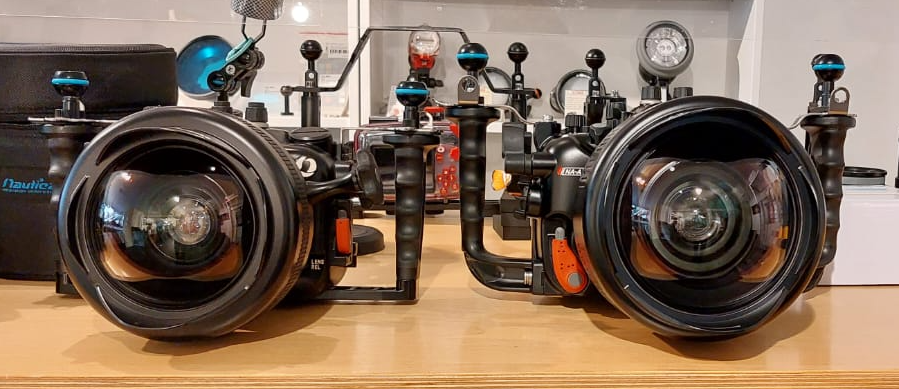
    I had the opportunity today to compare both options wapc-c and wwl1-b. I can't say anything about the image quality, but the WACP-C focuses over water at a short distance of about 1m, it can't focus anything over it. so for me it can only be used very limited for splits.

    in terms of size, weight and price, there isn't much of a difference compared to the wwl-1b. With the photos you can get an idea of it yourself and it's certainly not bad to add up and compare the prices of all the parts you need for each setup.

    do i want a dry solution without worrying about the air bubbles between wetlens and port and can i do limited split? > wacp-c

    would I like to be able to take pictures without a wide-angle lens and maybe even with a Markodiopter attachment, but this is also very limited and I have to take care of the air bubbles between the lens and the port > wwl1...

    I haven't tested either option under water and that's just my personal opinion. Of course, it could still be synonymous that one optics delivers better image quality than the other...maybe :-P

    image.png.4b0f01c07b0971e6dbb93ed420a4b5ee.pngimage.png.216b1ce1d5a5a7839e8ddabe86789ace.pngimage.thumb.png.c329f1116cc58a3a3204cf7cbf9b4ae4.pngimage.png.276a9112948b5fb5e2a8cdeaab2ba07d.pngimage.png.e46cf277ff2d022864700c6a3478d0d1.pngimage.thumb.png.a906191e472a643f46db2e7fbb39f9f3.png

  16. Hi @Samuel_l1 thanks so much, that’s great help. While eagerly waiting for delivery of my new a7iv housing with the wacp-c I had significantly concerns whether the wwl1b wouldn’t have been the better solution. 
    But with your hints especially with regards to the bubbles I now am sure that the decision for WAPC-C was right. 

  17. Nice comparison photos, Samuel. Size/diameter differences between the WACP-C and WWL-1 seem pretty minimal. I would expect any image quality differences to be equally minimal (with the same lens behind the water-contact optic, that is).

    But unfortunately, outside the Sony system, I don't believe any other systems allow the use of both WWL-1 and WACP-C/WACP-1 with the same lens. So you're sort of stuck with the water contact optic that works for your system/lens.

    (As an aside, I tried using the Canon RF 24-70F2.8 with the WACP-1 and found that from 28 to ~35mm (i.e. at the wide end) there was vignetting. This is I believe because the RF 24-70F2.8 has an 82mm front filter thread, which is actually slightly wider than the back glass element of the WACP-1. From 35-70 however, the lens worked fine with a 50mm extension ring between the R5C housing and WACP-1.

    By comparison, the Canon RF14-35F4 (which has a 77mm filter thread) works just fine from 26mm-35mm with a 30mm extension ring. So I think the WACP-1 can only be used with lenses up to a 77mm filter thread, basically.

  18. Hi Marc, thanks for the link. Regardless of the resolution it clearly allows you to see the differences between the distortion of the fisheye, the WACP-1 and C and rectilinear lenses behind a large dome port.

Sea & Sea

Account

Navigation

Search

Search

Configure browser push notifications

Chrome (Android)
  1. Tap the lock icon next to the address bar.
  2. Tap Permissions → Notifications.
  3. Adjust your preference.
Chrome (Desktop)
  1. Click the padlock icon in the address bar.
  2. Select Site settings.
  3. Find Notifications and adjust your preference.